Time Dependent Schrodinger Equation时间依赖的薛定谔方程
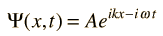
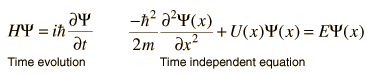
The time dependent Schrodinger equation for one spatial dimension is of the form ![]() For a free particle where U(x) =0 the wavefunction solution can be put in the form of a plane wave ![]() For other problems, the potential U(x) serves to set boundary conditions on the spatial part of the wavefunction and it is helpful to separate the equation into the time-independent Schrodinger equation and the relationship for time evolution of the wavefunction 在一维空间中,时间相关的薛定谔方程具有以下形式。对于自由粒子(其中U(x)=0),波函数解可以表示为平面波的形式。对于其他问题,势能U(x)用于设定波函数空间部分的边界条件,并且将方程分离为时间无关的薛定谔方程和波函数随时间演化的关系。
![]() |
Index Schrodinger equation concepts 索引:薛定谔方程概念 | ||
|
Go Back
返回 |
Free-Particle Wave Function自由粒子波函数
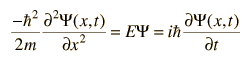
For a free particle the time-dependent Schrodinger equation takes the form 对于自由粒子来说,时间依赖的薛定谔方程的形式为
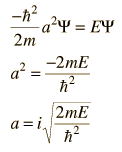
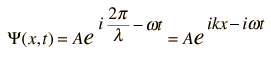
![]() and given the dependence upon both position and time, we try a wavefunction of the form 并且考虑到波函数对位置和时间的依赖性,我们尝试采用如下形式的波函数 ![]() Presuming that the wavefunction represents a state of definite energy E, the equation can be separated by the requirement 假定波函数表示一个具有确定能量E的状态,则可通过要求将该方程分离
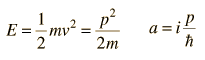
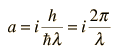
![]() Proceeding separately for the position and time equations and taking the indicated derivatives: 分别处理位置和时间的方程,并取指示的导数:
This gives a plane wave solution: 这给出了平面波解:
|
Index Schrodinger equation concepts 索引:薛定谔方程概念 | ||||||
|
Go Back
返回 |
Free Particle Waves自由粒子波
The general free-particle wavefunction is of the form 一般的自由粒子波函数形式为
![]() which as a complex function can be expanded in the form 该复函数可以展开为下列形式
Either the real or imaginary part of this function could be appropriate for a given application. In general, one is interested in particles which are free within some kind of boundary, but have boundary conditions set by some kind of potential. The particle in a box problem is the simplest example. either 实际部分或虚部可能适合某种应用。一般来说,人们关注的是在某种边界条件下自由的粒子,但这些边界条件由某种势能设定。粒子在盒中的问题是最简单的例子。
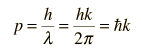
The free particle wavefunction is associated with a precisely known momentum: 自由粒子的波函数与一个精确已知的动量相关:
![]() but the requirement for normalization makes the wave amplitude approach zero as the wave extends to infinity (uncertainty principle). 但归一化的要求使得波幅在波延伸到无穷远处时趋于零(不确定性原理)
|
Index Schrodinger equation concepts 索引:薛定谔方程概念 | |||||
|
Go Back
返回 |
Time Independent Schrodinger Equation时间独立的薛定谔方程
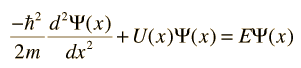
The time independent Schrodinger equation for one dimension is of the form 一维的无时间依赖的薛定谔方程具有以下形式
![]() where U(x) is the potential energy and E represents the system energy. It has a number of important physical applications in quantum mechanics. A key part of the application to physical problems is the fitting of the equation to the physical boundary conditions. The time independent equation is readily generalized to three dimensions, and is often used in spherical polar coordinates. 时间独立的方程很容易推广到三维空间,并且常用于球坐标系中。
其中U(x)是势能,E表示系统的能量。它在量子力学中有许多重要的物理应用。将方程拟合到物理边界条件是应用到物理问题中的关键部分。 |
Index Schrodinger equation concepts 索引:薛定谔方程概念 | ||
|
Go Back
返回 |
Energy Eigenvalues能本征值
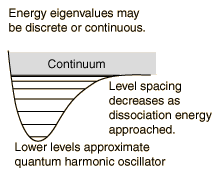
To obtain specific values for energy, you operate on the wavefunction with the quantum mechanical operator associated with energy, which is called the Hamiltonian. The operation of the Hamiltonian on the wavefunction is the Schrodinger equation. Solutions exist for the time-independent Schrodinger equation only for certain values of energy, and these values are called "eigenvalues" of energy. 要获得具体的能量值,你需要将波函数与能量的量子力学算符作用在一起,这个算符称为哈密顿量。对波函数作用哈密顿量的过程就是薛定谔方程。只有在某些特定能量值下,时间无关的薛定谔方程才有解,这些值被称为能量的‘本征值’。
|
Index Schrodinger equation concepts 索引:薛定谔方程概念 | ||||
|
Go Back
返回 |
1-D Schrodinger Equation一维薛定谔方程
The time-independent Schrodinger equation is useful for finding energy values for a one dimensional system 时间无关的薛定谔方程对于求解一维系统的能量值很有用
This equation is useful for the particle in a box problem which yields: 这个方程对于粒子在盒中的问题很有用,其结果为:
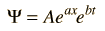
![]() To evaluate barrier penetration, the wavefunction inside a barrier is calculated to be of form: 为评估穿透势垒,计算势垒内部的波函数形式为:
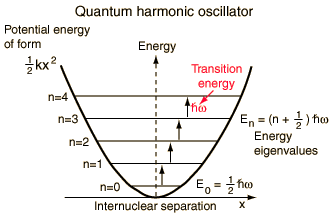
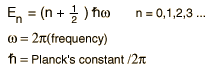
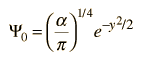
![]() The quantum harmonic oscillator in one dimension yields: 一维量子谐振子给出:
![]() This is the ground state wavefunction, where y is the displacement from equilibrium. 这是基态波函数,其中 y 是从平衡位置的位移。
3-dimensional Shrodinger equation三维薛定谔方程 |
Index Schrodinger equation concepts 索引:薛定谔方程概念 | ||
|
Go Back
返回 |
Physical Boundary Conditions and the Uniqueness Theorem物理边界条件和唯一性定理
For physical applications of quantum mechanics that involve the solution of the Schrodinger equation, such as those of the time independent Schrodinger equation, one must find specific mathematical solutions that fit the physical boundary conditions of the problem. 对于涉及求解薛定谔方程的量子力学物理应用,例如时间无关的薛定谔方程,必须找到符合问题物理边界条件的具体数学解。 One very important idea in differential equations is the "uniqueness theorem", which basically says that if you can find a solution to the differential equation that fits the physical boundary conditions of the problem you are considering, then that is in fact the correct solution. That leads to typical comments from students of differential equations like "if you can guess the solution and force it to fit the boundary conditions, then you have the right answer." 微分方程中一个非常重要的概念是“唯一性定理”,它基本上意味着如果你能找到一个符合你所考虑问题物理边界条件的微分方程的解,那么这就是正确的解。这往往导致微分方程的学生做出这样的评论:‘如果你能猜出解并强制它符合边界条件,那么你就有正确的答案。’ The time-independent Schrodinger equation is used for a number of practical problems. Systems with bound states are related to the quantum mechanical "particle in a box", barrier penetration is important in radioactive decay, and the quantum mechanical oscillator is applicable to molecular vibrational modes. 时间无关的薛定谔方程被用于解决许多实际问题。具有束缚态的系统与量子力学中的‘粒子在盒中’问题有关,贯穿势在放射性衰变中起重要作用,而量子力学振子模型适用于分子振动模式。 If, for example, you go to the "particle in a box", you find that for an infinite-walled box the wavefunction must equal zero at the edges of the box, and you can propose a sine wave solution and force it to fit the boundary conditions. How would you know to propose a sine wave solution? Well, in many areas of mathematics and science we "stand on the shoulders of giants" and can make use of the fact that many in the past have explored these kinds of problems and can suggest to us the types of solutions to try. This is part of the nature of applying differential equations to physical problems. 例如,如果你去查看‘粒子在盒中’,你会发现对于无限墙的盒子,波函数必须在盒子边缘等于零,并且你可以提出一个正弦波解并强制其满足边界条件。你如何知道要提出正弦波解?因为在数学和科学的许多领域中,我们‘站在巨人的肩膀上’,可以利用过去许多人在这些问题上进行探索的事实,从而建议我们尝试的解的类型。这是将微分方程应用于物理问题的性质之一。 |
Index Schrodinger equation concepts 索引:薛定谔方程概念 | ||
|
Go Back
返回 |