Wave Nature of Electron电子的波性质
As a young student at the University of Paris, Louis DeBroglie had been impacted by relativity and the photoelectric effect, both of which had been introduced in his lifetime. The photoelectric effect pointed to the particle properties of light, which had been considered to be a wave phenomenon. He wondered if electrons and other "particles" might exhibit wave properties. The application of these two new ideas to light pointed to an interesting possibility: ![]() Confirmation of the DeBroglie hypothesis came in the Davisson- Germer experiment.德布罗意假说的确认来自戴维森-格雷默实验。
作为巴黎大学的一名年轻学生,路易·德布罗意受到相对论和光电效应的影响,这两种概念在他的一生中被引入。光电效应表明了光的粒子性质,而光曾被认为是一种波现象。他开始思考,电子和其他‘粒子’是否也具有波动性质。将这些新思想应用于光,指出了一个有趣的可能性: |
Index
索引 | |||
|
Go Back
返回 |
Examples of Electron Waves电子波的示例
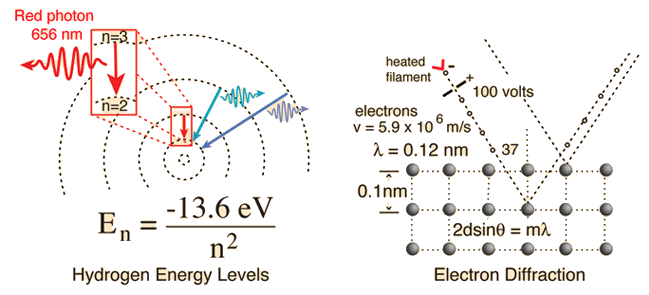
Two specific examples supporting the wave nature of electrons as suggested in the DeBroglie hypothesis are the discrete atomic energy levels and the diffraction of electrons from crystal planes in solid materials. In the Bohr model of atomic energy levels, the electron waves can be visualized as "wrapping around" the circumference of an electron orbit in such a way as to experience constructive interference. 支持德布罗意假设的电子波性质的两个具体例子是原子的离散能级和固体材料中电子对晶体平面的衍射。在玻尔模型中,电子波可以被可视化为以一种方式‘环绕’电子轨道的周长,从而经历建设性干涉。
![]() The wave nature of the electron must be invoked to explain the behavior of electrons when they are confined to dimensions on the order of the size of an atom. This wave nature is used for the quantum mechanical "particle in a box" and the result of this calculation is used to describe the density of energy states for electrons in solids. 必须引入电子的波动性,以解释当电子被限制在与原子尺寸相当的维度时的行为。这种波动性被用于量子力学中的'粒子在盒中'模型,该计算结果用于描述固体中电子的密度的能态。
点击任一示例以获取更多详情。 |
Index
索引 | ||
|
Go Back
返回 |
DeBroglie Hypothesis德布罗意假说
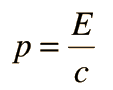
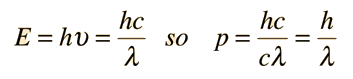
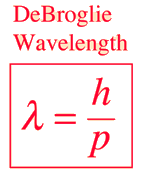
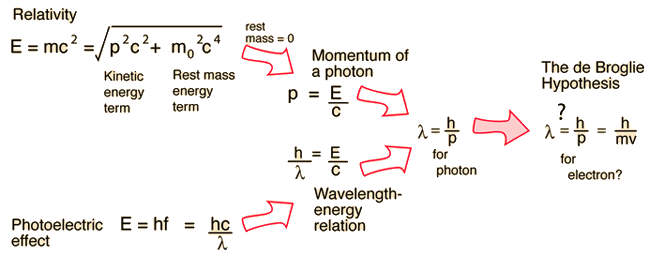
Suggested by De Broglie in about 1923, the path to the wavelength expression for a particle is by analogy to the momentum of a photon.
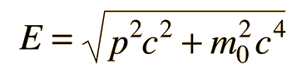
Starting with the Einstein formula:![]()
德布罗意在约1923年提出,粒子的波长表达式是通过类比光子的动量来获得的。从爱因斯坦公式开始: |
Index
索引 | ||||||||||||
|
Go Back
返回 |
DeBroglie Wavelengths德布罗意波长
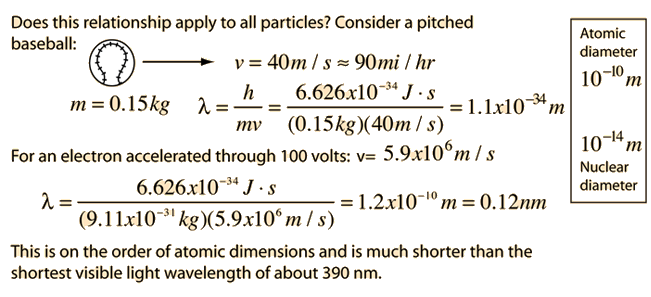
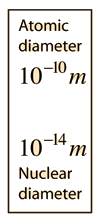
![]() If you explore the wavelength values for ordinary macroscopic objects like baseballs, you will find that their DeBroglie wavelengths are ridiculously small. Comparison of the power of ten for the wavelength will show that the wavelengths of ordinary objects are much smaller than a nucleus. The implication is that for ordinary objects, you will never see any evidence of their wave nature, and they can be considered to be particles for all practical purposes. 如果你探索普通宏观物体(如棒球)的波长值,会发现它们的德布罗意波长极其微小。比较波长的十次方幂可以发现,普通物体的波长远小于原子核。这意味着对于普通物体来说,你将永远无法观察到其波动性,因此可以认为它们在所有实际用途中都是粒子。
Calculation计算 |
Index
索引 | ||
|
Go Back
返回 |
DeBroglie Wavelengths德布罗意波长
You may enter values in any of the boxes. When you have finished entering data, click on the quantity you wish to calculate in the formula above. Wavelength values will be reconciled, but no further calculation will be done until you select which item you wish to calculate. Caution! This calculation is non-relativistic and accurate only for speeds much less than the speed of light. For speeds over a tenth of the speed of light a relativistic calculation should be used. 您可以任意输入框中的值。在输入数据完成后,点击公式上方您希望计算的量。波长值将被校准,但在您选择要计算的项目之前,不会进行进一步的计算。注意!此计算是非相对论的,仅在速度远小于光速时才准确。当速度超过光速的十分之一时,应使用相对论计算。
一个粒子的波长可以通过以下公式计算:以速度x10^ m/s运动时,对应的德布罗意波长为x10^ m = m = nm。 中文译文中的待填/计算数值依次对应:1:mme 2:mmp 3:vb 4:vp 5:wb 6:wp 7:w 8:wnm。实际数值以上方原输入框为准。 |
Index
索引 | ||||||||
|
Go Back
返回 |