Wave-Particle Duality: Light
波粒二象性:光
Does light consist of particles or waves? When one focuses upon the different types of phenomena observed with light, a strong case can be
built for a wave picture:
光是由粒子还是波组成的?当关注光所表现出的不同现象时,可以强有力地支持波的观念:
By the turn of the 20th century, most physicists were convinced by phenomena like the above that light could be fully described by a wave, with no necessity for invoking a particle nature. But the story was not over.
20世纪初,大多数物理学家被上述现象所说服,认为光可以完全用波来描述,无需引入粒子性质。但故事并未结束。
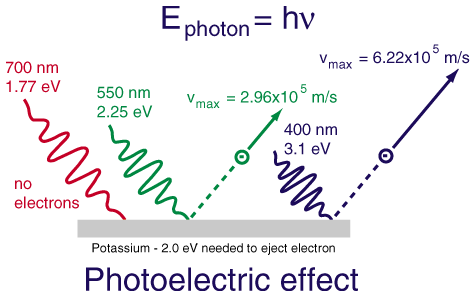
Most commonly observed phenomena with light can be explained by waves. But the photoelectric effect suggested a particle nature for light. Then electrons too were found to exhibit dual natures.
大多数与光相关的现象可以通过波动来解释。但光电效应表明了光具有粒子性。随后,电子也被发现具有波粒二象性。
 | There is a considerable amount of discussion in the literature about whether reflection and refraction of light at an interface where the medium changes can be described in particle terms. For practical applications of geometrical optics, treating light as a wave phenomenon is adequate.
文献中关于在介质变化的界面处,光的反射和折射是否能用粒子观点来描述存在大量讨论。对于几何光学的实用应用,将光视为波现象是足够的。 |
Newton's corpuscular theory: Newton proposed that light was composed of corpuscles that traveled in straight lines. That worked fine for reflection, because the bouncing of either particles or waves off a planar surface follows the same law of reflection. But to explain refraction, he had to presume that the particles traveled faster in a more optically dense material. But Foucault's 1850 experiment showed that light traveled more slowly in such media, so that version of a particle theory of light had to be set aside.
牛顿的粒子理论:牛顿提出光是由粒子组成的,这些粒子沿直线传播。这在解释反射时表现良好,因为无论是粒子还是波在平面表面反射时都遵循相同的反射定律。但要解释折射,他必须假设粒子在更光学密集的介质中传播更快。但福科1850年的实验表明,光在这样的介质中传播更慢,因此这种粒子理论版本必须被摒弃。 Huygens wave theory: Presuming that light was composed of waves, in 1678 Huygens proposed that each point of a light wavefront could be considered to be the source of a spherical wave. The Huygens' principle helped develop the wave theory of light and it was further developed by Fresnel and Kirchhoff.
惠更斯波动理论:假设光是由波组成的,在1678年,惠更斯提出每个光波前的点都可以视为波源,产生球面波。惠更斯原理有助于发展光的波动理论,并由菲涅耳和基尔霍夫进一步完善。 Quantum view of light: The photoelectric effect introduced evidence that light exhibited particle properties on the quantum scale of atoms. At least light can achieve a sufficient localization of energy to eject an electron from a metal surface. So it might be implied that there must be a particle treatment of refraction of light, but for ordinary optics the wave view of light is the practical approach.
光的量子观点:光电效应提供了证据,表明在原子量级上,光表现出粒子性质。至少光能够将能量充分局部化,以从金属表面击 ejected 一个电子。因此,可以暗示光的折射也应当有粒子处理,但对普通光学而言,光的波观点是实际的处理方法。 |