Conflict Between the Uncertainty Principle and General Relativity
One of the early tests of general relativity was the observation of the bending of light around the sun - the total solar eclipse of 1919 provided the opportunity to observe the light from a star emerging a tiny 1.75 seconds of arc early because of the bending of the light by the sun's gravity. Alternatively and equivalently, you could say that the mass of the sun produces a curvature of space near it, and that the light follows that curvature of space. Part of the picture of space provided by general relativity is that light travels in straight lines except in the vicinity of gravitational mass. This is often described by saying that space is "flat" in the absence of gravitational mass.
Even in presumably empty space, this "flatness" gets called into question by the uncertainty principle if you examine space at extremely tiny scales. The two forms of the uncertainty principle
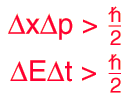
have complementary implications about small regions of space-time. Confined to a tiny space, a particle will have a large uncertainty in momentum and hence a large uncertainty in energy. On a short time scale, the uncertainty in energy plus the Einstein relationship permits the creation of massive particles. The smaller the scale in space and time, the more massive the particle which can be created, and the presence of that mass means that space is no longer "flat" on these tiny scales.
Greene invokes some interesting language in "The Elegant Universe" to describe these implications of the uncertainty principle. "Energy ... is the ultimate convertible currency. E=mc2 tells us that energy can be turned into matter and vice versa." So if the region of space and time is small enough, particle-antiparticle pairs can be continuously created and destroyed. These processes are often described as "fluctuations" of the vacuum. Saying that "the microscopic realm is intrinsically turbulent", Greene argues that "quantum mechanics shows that nothing likes to be cornered; narrowing the spatial focus leads to ever larger undulations." John Wheeler describes this ultramicroscopic world as being filled with "quantum foam" as particle-antiparticle pairs are being continually created and annihilated.
You might argue that such effects are not unmanageable so long as you don't go to scales smaller than the fundamental particles, the quarks and leptons. But the highest energy scattering experiments to date reach a resolution about a thousand times smaller than a proton, and at that extreme resolution you still don't see any evidence of structure for the electron (a lepton) or the quarks, so everything looks like it is made up of point particles. But particles of zero spatial extent would imply infinite energy fluctuations. To avoid this blowup of increasingly violent "fluctuations of the vacuum", Greene and others argue for a limit on how small a scale you can reach with matter. They propose that matter in its most fundamental form is composed of "strings" or "superstrings". Having met a lot of initial resistance, "superstring theory" is now being looked at more carefully as a way to avoid the headlong collision between general relativity and quantum mechanics at the submicroscopic scale.
Uncertainty principle concepts
| HyperPhysics***** Quantum Physics
HyperPhysics ***** 量子物理 | R Nave |