Bilingual edition: English is preserved and Chinese follows each unit. Terminology uses the confirmed v20260916 glossary; automated semantic review remains traceable.
中英双语版:英文原文完整保留,中文紧随对应单元;术语采用 v20260916 确认表,自动语义审校结果可追溯。

The Uncertainty Principle

不确定性原理

The position and momentum of a particle cannot be simultaneously measured with arbitrarily high precision. There is a minimum for the product of the uncertainties of these two measurements. There is likewise a minimum for the product of the uncertainties of the energy and time.

一个粒子的位置和动量不能同时以任意高的精度进行测量。这两个测量的不确定性的乘积有一个下限。同样,能量和时间的不确定性的乘积也有一个下限。
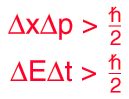
This is not a statement about the inaccuracy of measurement instruments, nor a reflection on the quality of experimental methods; it arises from the wave properties inherent in the quantum mechanical description of nature. Even with perfect instruments and technique, the uncertainty is inherent in the nature of things.

这并非关于测量仪器不准确的陈述,也并非对实验方法质量的评论;它源于量子力学对自然的描述中固有的波动性质。即使拥有完美的仪器和技巧,这种不确定性也根植于事物的本质。

Graphical interpretation of uncertainty principle

不确定性原理的图形解释
Index

Uncertainty principle concepts
索引不确定性原理概念
 
HyperPhysics***** Quantum Physics
HyperPhysics ***** 量子物理
R Nave
Go Back
返回


Uncertainty Principle

不确定性原理

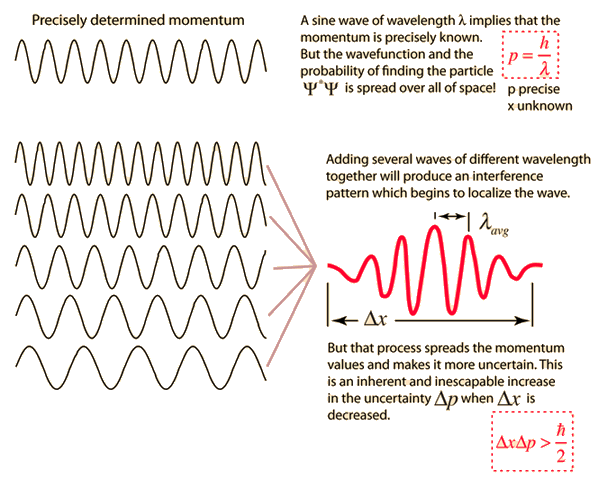
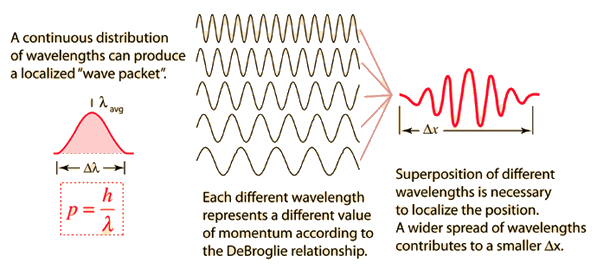
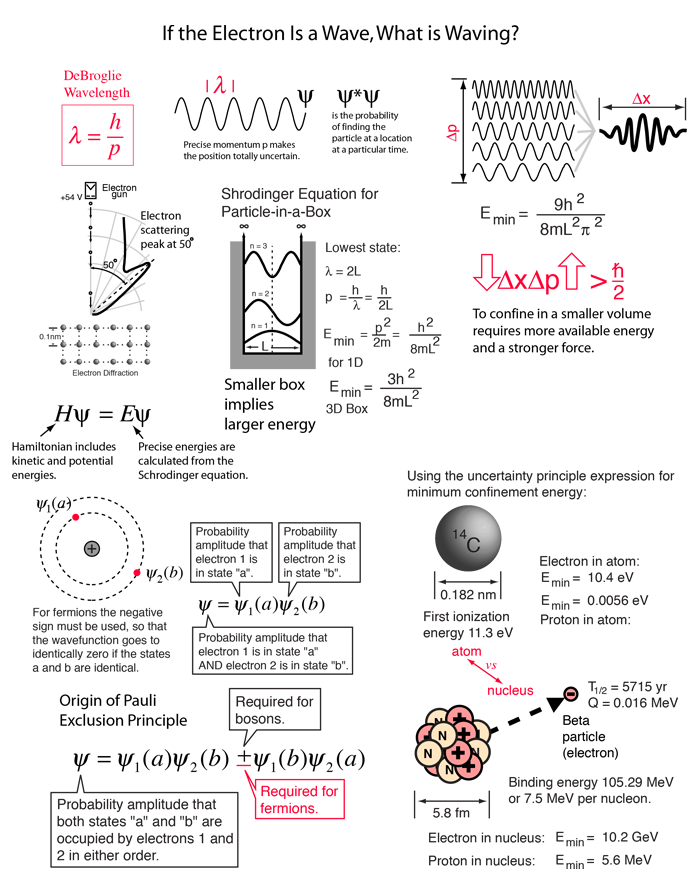
Important steps on the way to understanding the uncertainty principle are wave-particle duality and the DeBroglie hypothesis. As you proceed downward in size to atomic dimensions, it is no longer valid to consider a particle like a hard sphere, because the smaller the dimension, the more wave-like it becomes. It no longer makes sense to say that you have precisely determined both the position and momentum of such a particle. When you say that the electron acts as a wave, then the wave is the quantum mechanical wavefunction and it is therefore related to the probability of finding the electron at any point in space. A perfect sinewave for the electron wave spreads that probability throughout all of space, and the "position" of the electron is completely uncertain.

理解不确定性原理的重要步骤是波粒二象性和德布罗意假设。当你向下缩至原子尺度时,再将粒子视为硬球已不再合理,因为尺寸越小,其波动性越强。再也不能说已精确确定此类粒子的位置和动量。当你说电子表现为波时,这种波就是量子力学中的波函数,因此它与在空间中任何一点找到电子的概率有关。一个完美的正弦波描述电子的波,会使这种概率分布在整个空间中,电子的“位置”则完全不确定。

DeBroglie wavelength

德布罗意波长

Forms of uncertainty principle

不确定性原理的形式
Application example: required energy to confine particles
应用示例:将粒子约束所需的能量
Index
索引
 
HyperPhysics***** Quantum Physics
HyperPhysics ***** 量子物理
R Nave
Go Back
返回


Particle Confinement

质点束缚

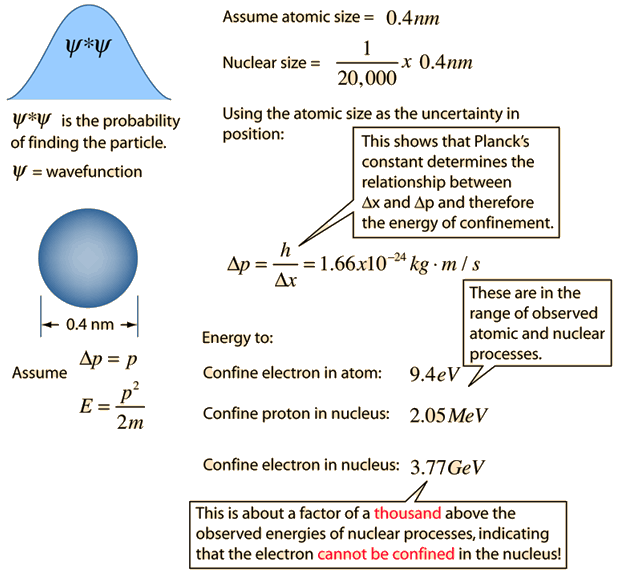
The uncertainty principle contains implications about the energy that would be required to contain a particle within a given volume. The energy required to contain particles comes from the fundamental forces, and in particular the electromagnetic force provides the attraction necessary to contain electrons within the atom, and the strong nuclear force provides the attraction necessary to contain particles within the nucleus. But Planck's constant, appearing in the uncertainty principle, determines the size of the confinement that can be produced by these forces. Another way of saying it is that the strengths of the nuclear and electromagnetic forces along with the constraint embodied in the value of Planck's constant determine the scales of the atom and the nucleus.

不确定性原理包含关于将粒子限制在给定体积内所需能量的含义。将粒子限制所需的能量来自基本力,特别是电磁力提供了将电子限制在原子内的吸引力,而强核力则提供了将粒子限制在原子核内的吸引力。但普朗克常数,出现在不确定性原理中,决定了这些力所能产生的限制大小。另一种说法是,核力和电磁力的强度以及普朗克常数的值所包含的约束,决定了原子和原子核的尺度。

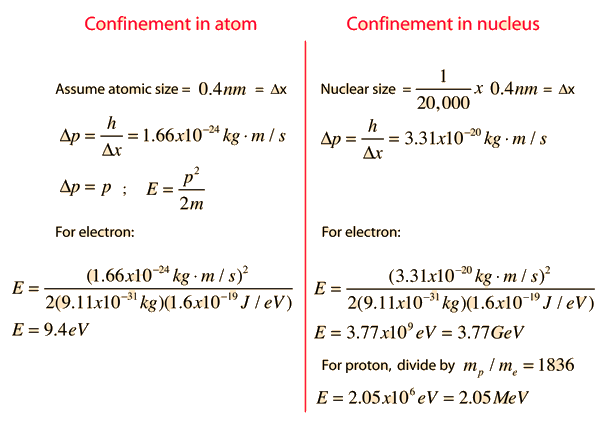
The following very approximate calculation serves to give an order of magnitude for the energies required to contain particles.

以下非常粗略的计算旨在给出容纳粒子所需能量的量级。

Show calculation

展示计算

Uncertainty principle

不确定性原理

Compare to particle in box.

与盒中粒子比较

More detailed treatment of 3-D box

三维箱体的更详细分析
Energies in electron volts (eV)
电子伏特(eV)中的能量
Application example: required energy to confine particles
应用示例:将粒子约束所需的能量
Index
索引
 
HyperPhysics***** Quantum Physics
HyperPhysics ***** 量子物理
R Nave
Go Back
返回


Confinement Calculation

约束计算

If you examine this calculation in detail, you will note that a gross approximation was made in the relationship Δp = h/Δx. This was done to get a qualitative relationship that shows the role of Planck's constant in the relationship between Δx and Δp and thus the role of h in determining the energy of confinement. The other reason for doing it was to get an electron confinement energy close to what is observed in nature for comparison with the energy for confining an electron in the nucleus. If you actually use the limiting case allowed by the uncertainty principle, Δp = hbar/2Δx, the confinement energy you get for the electron in the atom is only 0.06 eV. This is because this approach only confines the electron in one dimension, leaving it unconfined in the other directions. For a more realistic atom you would need to confine it in the other directions as well. A better approximation can be obtained from the three-dimensional particle-in-a-box approach, but to precisely calculate the confinement energy requires the Shrodinger equation (see hydrogen atom calculation).

如果你仔细检查这个计算,会注意到在关系式Δp = h/Δx中做了粗略的近似。这样做是为了得到一个定性关系,显示普朗克常数在Δx和Δp之间的关系中的作用,从而显示h在确定束缚能量中的作用。另一个原因是得到一个与自然观测中电子在原子中的束缚能量相接近的值,以便与将电子束缚在原子核中的能量进行比较。如果实际上使用不确定性原理允许的极限情况,Δp = ħ/(2Δx),则得到的电子在原子中的束缚能量仅为0.06 eV。这是因为这种近似方法仅将电子束缚在一个维度上,而在其他方向上未进行束缚。对于更现实的原子,你需要在其他方向上也进行束缚。可以通过三维粒子在盒中的方法获得更精确的近似,但要精确计算束缚能量则需要薛定谔方程(见氢原子计算)。

Confinement discussion

confinement 讨论

Uncertainty principle

不确定性原理

Calculation for 3-D box

三维箱的计算
Index
索引
 
HyperPhysics***** Quantum Physics
HyperPhysics ***** 量子物理
R Nave
Go Back
返回


Wavefunction Contexts

波函数上下文

Confinement discussion

confinement 讨论

Uncertainty principle

不确定性原理

Calculation for 3-D box

三维箱的计算
Index
索引
 
HyperPhysics***** Quantum Physics
HyperPhysics ***** 量子物理
R Nave
Go Back
返回