Relativistic Range
The ability to detect a short-lived particle depends upon it having enough range in the accelerator to reach the detector. This is a serious problem with particles which may have an average lifetime as short at 10-16 seconds! Even traveling at the speed of light, it will traveled only 0.03 micrometers before decaying, on average. The practical detection of short-lived particles depends upon relativistic time dilation.
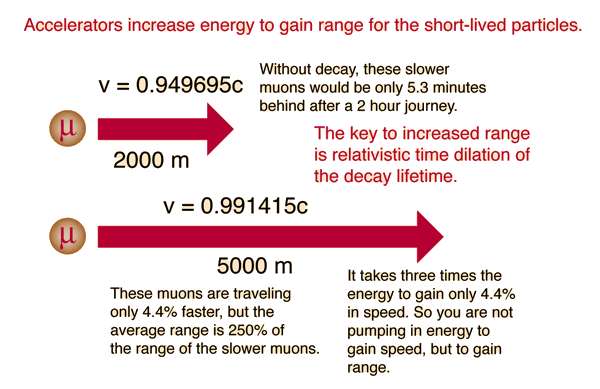
Because the clocks of the high speed particles run more slowly than the laboratory frame, the particles have a longer range in the accelerator than a non-relativistic treatment would anticipate. The numbers in the above illustration can be verified in the calculation below.
Note: Muon parameters will be entered by default. All values may be changed.
An example requiring the relativistic range to explain the observed data is the muon flux at the Earth's surface.
| Relativistic Mechanical Quantities
相对论力学量 |
| An Overview of Time
时间概述 |
| HyperPhysics***** Relativity
HyperPhysics ***** 相对论 | R Nave |