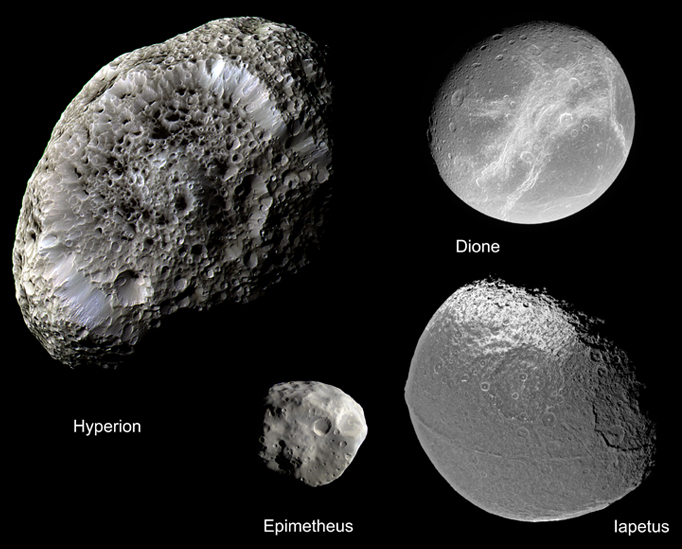
Dione
迪昂
Dione is among Saturn's 62+ moons. The voyage of the Cassini spacecraft has yielded an abundance of information about Saturn and its moons.
迪奥恩是土星的62颗以上卫星之一。卡西尼探测器的旅程为土星及其卫星提供了大量信息。
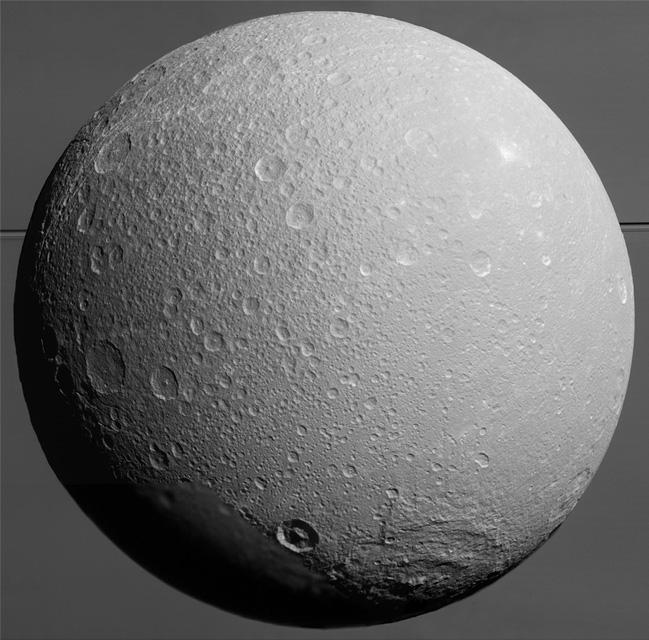
This grayscale image Image Credit:
NASA/JPL-Caltech/Space Science Institute
这幅灰度图像 图片版权:NASA/JPL-Caltech/Space Science Institute
From the original image caption: "This view from NASA's Cassini spacecraft looks toward Saturn's icy moon Dione, with giant Saturn and its rings in the background, just prior to the mission's final close approach to the moon on August 17, 2015.
At lower right is the large, multi-ringed impact basin named Evander, which is about 220 miles (350 kilometers) wide. The canyons of Padua Chasma, features that form part of Dione's bright, wispy terrain, reach into the darkness at left.
Imaging scientists combined nine visible light (clear spectral filter) images to create this mosaic view: eight from the narrow-angle camera and one from the wide-angle camera, which fills in an area at lower left. The scene is an orthographic projection centered on terrain at 0.2 degrees north latitude, 179 degrees west longitude on Dione. An orthographic view is most like the view seen by a distant observer looking through a telescope. North on Dione is up.
The view was acquired at distances ranging from approximately 106,000 miles (170,000 kilometers) to 39,000 miles (63,000 kilometers) from Dione and at a sun-Dione-spacecraft, or phase, angle of 35 degrees."
从NASA卡西尼探测器传回的图像来看,这幅图是探测器朝向土星的冰月狄俄涅方向拍摄的,背景中是巨大的土星及其环,这发生在2015年8月17日任务最后一次接近该月球之前。画面右下角是名为Evander的巨大多环撞击盆地,直径约220英里(350公里)。Padua Chasma的峡谷,这些特征是狄俄涅明亮、纤细地形的一部分,延伸至画面左侧的黑暗中。成像科学家结合了九张可见光(清晰光谱滤波器)图像,制作出这幅拼接图像:八张来自窄角相机,一张来自宽角相机,后者填补了画面左下部分。此场景是正射投影,以狄俄涅上纬度0.2度、经度179度西的地形为中心。正射视图最类似于远处观察者通过望远镜观察到的视图。狄俄涅的北方在上方。该图像是在从狄俄涅约106,000英里(170,000公里)到39,000英里(63,000公里)的距离范围内,以及太阳-狄俄涅-探测器,或相,角度为35度时拍摄的。 References:
Cassini-Huygens mission.
参考文献:卡西尼-惠更斯任务。 ESA/Cassini-Huygens, image source.
ESA/Cassini-Huygens,图片来源。 |