Saturn Aurora
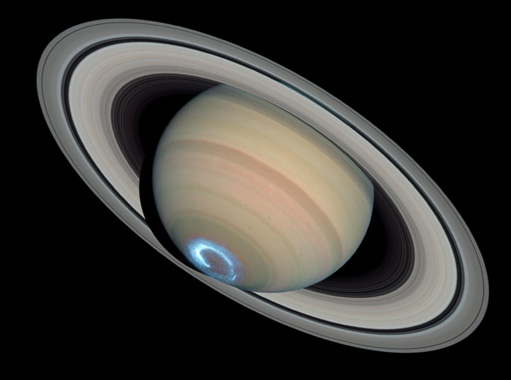
The ultraviolet image of the southern polar region of Saturn with its aurora was taken on January 28, 2004 by the Hubble Space Telescope's Imaging Spectrograph. The visible part of the image was taken by Erich Karkoschka of the University of Arizona using the telescope's Advanced Camera for Surveys on March 22, 2004. The ultraviolet image was transferred to the visible blue to show the geometry of the auroral display and superimposed upon the subsequently obtained visible image, as I understand it. Photo credit: NASA, ESA, J. Clarke (Boston University), and Z. Levay (STScI).
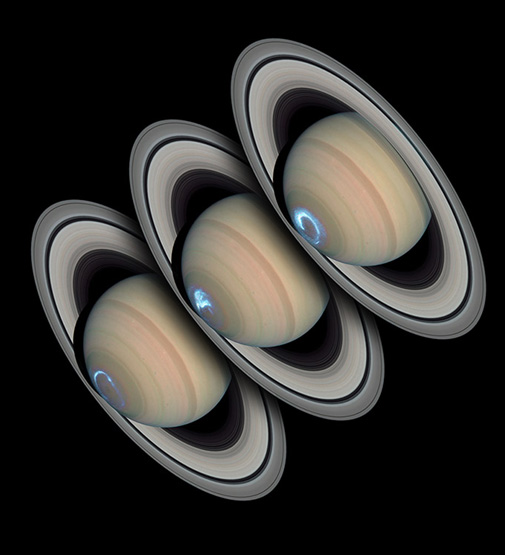
The ultraviolet parts of these three superimposed images were taken on January 24,26, and 28, 2004. This shows the dynamic nature of the auroral display. On Earth, auroral storms may develop in about 10 minutes last for a few hours, whereas Saturn's auroral displays always appear bright and may last for several days (NASA).
"The observations, made by Hubble and the Cassini spacecraft, while enroute to the planet, suggest that Saturn's auroral storms are driven mainly by the pressure of the solar wind -- a stream of charged particles from the Sun -- rather than by the Sun's magnetic field. The aurora's strong brightening on Jan. 28, 2004 corresponds with the recent arrival of a large disturbance in the solar wind. The image shows that when Saturn's auroras become brighter (and thus more powerful), the ring of light encircling the pole shrinks in diameter."(NASA)
|
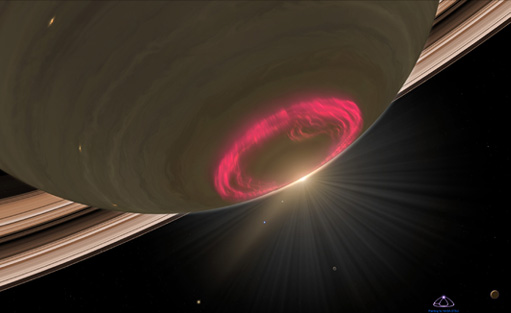
While the blue representation of the auroral display is dramatic and appropriate, transferring the ultraviolet data to the nearest visible color, it is a little misleading in that it does not represent what the human eye would see from a nearby spacecraft. If the ultraviolet is excited, then one can be fairly confident that the visible spectra would also be excited. It would then be expected that the hydrogen of the atmosphere would give off the bright n=3->2 red emission known astronomically as the H-alpha line. The above is a NASA artist's conception of the visual phenomenon as observed by the human eye. The credit for this graphic is NASA, ESA and A. Schaller, STScI-PRC05-06b. The familiar visible hydrogen spectrum is shown at right. 尽管蓝色的极光显示效果壮观且恰当,但将其紫外数据转换为最近的可见颜色时,这种表示方式略显误导,因为它并不反映从附近航天器上的人类眼睛所看到的景象。如果紫外光被激发,那么可以相当有信心地认为可见光谱也会被激发。因此,可以预期大气中的氢会发出明亮的n=3→2红光发射,这在天文学中被称为H-α线。上述内容是NASA艺术家的构想,展示了人类眼睛所观察到的视觉现象。此图形的版权属于NASA、ESA和A. Schaller,STScI-PRC05-06b。右侧显示了熟悉的可见氢谱线。
|

|
| Saturn Concepts
土星概念 |
Solar System Illustration
Solar System Concepts
| HyperPhysics********** Astrophysics
HyperPhysics ********** 天体物理学 | R Nave |