Cassini Mission
The Cassini Mission is a large scale project designed to study Jupiter and Saturn. It is somewhat in the grand tradition of the Voyager missions of the late 70's, and has some elements in common with the more recent Galileo mission.
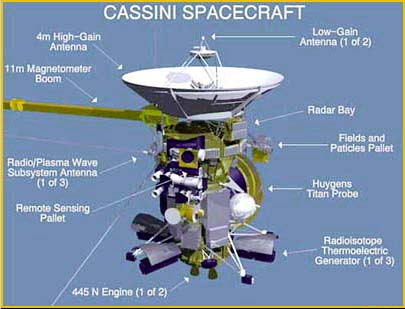 NASA插图 |
The Cassini spacecraft itself is large, standing over two stories tall.
The craft accomplished two gravity assist maneuvers past Venus and one on Earth before heading out to Jupiter and Saturn.
卡西尼探测器本身体积较大,高达两层楼高。该探测器在飞掠金星后进行了两次引力助推,随后在地球附近进行了一次引力助推,之后前往木星和土星。 |
| This characterization of the trajectory of the Cassini craft is from Wikipedia and may be freely used under their conditions.
卡西尼探测器轨迹的这一描述来自维基百科,其使用条件请参见维基百科的规定。 | 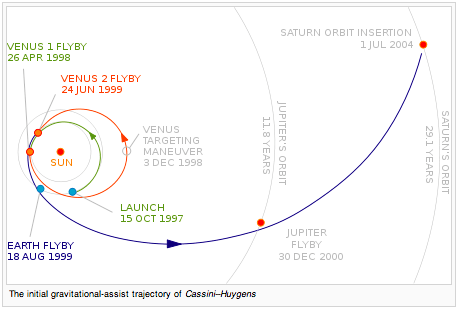 |
Cassini is an international space exploration mission. The Huygens probe, built by the European Space Agency, was launched to Titan, one of the moons of Saturn. Some of the experimental equipment was provided by ASI, the Italian space agency.
The plan is for Cassini to travel more than 2.2 billion miles over a decade, carrying 18 experimental instruments.
From NASA/JPL's Cassini site intro: "Cassini completed its initial four-year mission to explore the Saturn System in June 2008 and the first extended mission, called the Cassini Equinox Mission, in September 2010. Now, the healthy spacecraft is seeking to make exciting new discoveries in a second extended mission called the Cassini Solstice Mission. The mission's extension, which goes through September 2017, is named for the Saturnian summer solstice occurring in May 2017. The northern summer solstice marks the beginning of summer in the northern hemisphere and winter in the southern hemisphere. Since Cassini arrived at Saturn just after the planet's northern winter solstice, the extension will allow for the first study of a complete seasonal period. Cassini launched in October 1997 with the European Space Agency's Huygens probe. The probe was equipped with six instruments to study Titan, Saturn's largest moon. It landed on Titan's surface on Jan. 14, 2005, and returned spectacular results. Cassini's 12 instruments returned a daily stream of data from Saturn's system from the time of arriving at Saturn in 2004 until its directed plunge into Saturn on September 15, 2017.
References:
Cassini Soltice Mission
| Jupiter and moon Ganymede upon approach by Cassini
卡西尼号接近木星时木星和伽利略卫星木卫三 |
| Cassini's view of Saturn
卡西尼视角下的土星 |
| Earth as Seen Through Saturn's Rings
通过土星环观测的地球 |
Solar System Illustration
Solar System Concepts
Solar System Exploration
| HyperPhysics********** Astrophysics
HyperPhysics ********** 天体物理学 | R Nave |