Iapetus
Iapetus is one of Saturn's 62+ moons. The voyage of the Cassini spacecraft has yielded an abundance of information about Saturn and its moons.
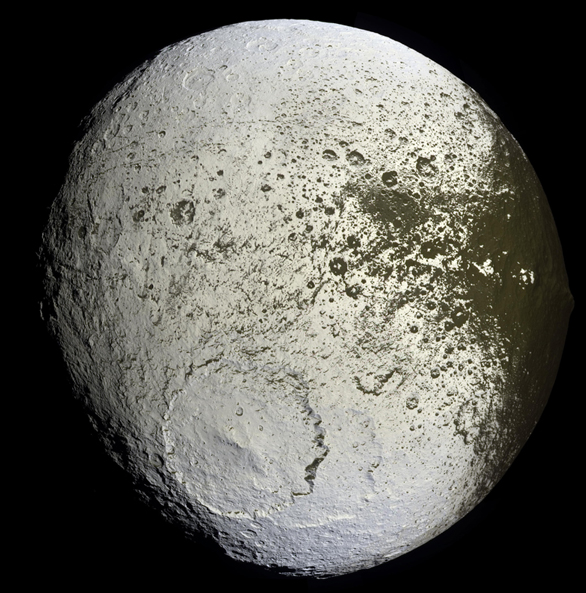
This grayscale image of Iapetus is from NASA/JPL/Space Science Institute.
Iapetus shows a brightness variation of a factor of 10, a change in intensity believed to be caused by the existence of ice on one side and black carbonaceous material on the other. ( Weisburd, Science News 133, June 11, 1988 p374)
Iapetus has a diameter of 1,468 kilometers. This two-toned moon was imaged on 10 September 2007 by Cassini. This image shows the complicated transition region between the dark leading and bright trailing hemispheres. The region appears heavily cratered, particularly in the north and south polar regions.
The most prominent topographic feature in this view, in the bottom half of the mosaic, is a 450-kilometer wide impact basin, one of at least nine such large basins on Iapetus. In many places, the dark material - thought to be composed of nitrogen-bearing organic compounds called cyanides, hydrated minerals and other carbonaceous minerals - appears to coat equator-facing slopes and crater floors. The distribution of this material and variations in the color of the bright material across the trailing hemisphere will be crucial clues to understanding the origin of Iapetus' peculiar bright-dark dual personality.
References:
Cassini-Huygens mission.
土星 | 卫星 |
行星数据 |
极光 | ||
Solar System Illustration
Solar System Concepts
| HyperPhysics********** Astrophysics
HyperPhysics ********** 天体物理学 | R Nave |