Saturn Images from Cassini
The voyage of the Cassini spacecraft has yielded an abundance of information about Saturn and its moons. These are some of the detailed images of Saturn and its ring system taken on the Cassini mission. For more information about the Cassini-Huygens mission visit http://saturn.jpl.nasa.gov/home/index.cfm. The Cassini imaging team homepage is at http://ciclops.org. The images and descriptions here are taken from the NASA websites.
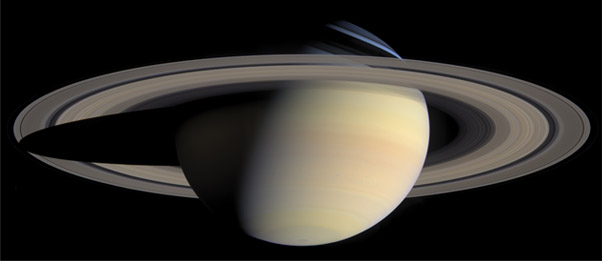
While cruising around Saturn in early October 2004, Cassini captured a series of images that have been composed into the largest, most detailed, global natural color view of Saturn and its rings ever made.
This grand mosaic consists of 126 images acquired in a tile-like fashion, covering one end of Saturn's rings to the other and the entire planet in between. The images were taken over the course of two hours on Oct. 6, 2004, while Cassini was approximately 6.3 million kilometers (3.9 million miles) from Saturn. Since the view seen by Cassini during this time changed very little, no re-projection or alteration of any of the images was necessary.
Three images (red, green and blue) were taken of each of 42 locations, or "footprints," across the planet. The full color footprints were put together to produce a mosaic that is 8,888 pixels across and 4,544 pixels tall.
The smallest features seen here are 38 kilometers (24 miles) across. Many of Saturn's splendid features noted previously in single frames taken by Cassini are visible in this one detailed, all-encompassing view: subtle color variations across the rings, the thread-like F ring, ring shadows cast against the blue northern hemisphere, the planet's shadow making its way across the rings to the left, and blue-grey storms in Saturn's southern hemisphere to the right. Tiny Mimas and even smaller Janus are both faintly visible at the lower left.
The Sun-Saturn-Cassini, or phase, angle at the time was 72 degrees; hence, the partial illumination of Saturn in this portrait. Later in the mission, when the spacecraft's trajectory takes it far from Saturn and also into the direction of the Sun, Cassini will be able to look back and view Saturn and its rings in a more fully-illuminated geometry.
Image Credit: NASA/JPL/Space Science Institute
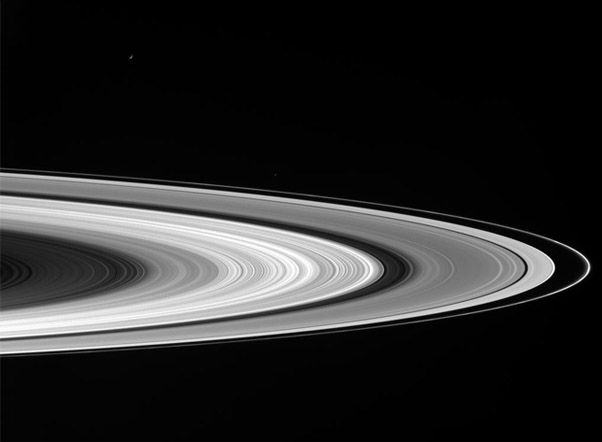
Saturn's sunlit rings gleam in the blackness as two icy moons cruise past in the foreground.
Enceladus (505 kilometers, or 314 miles across) is a small crescent near upper left; Janus (181 kilometers, or 113 miles across) is a speck above the F ring, near center. Janus was brightened slightly for visibility.
This view looks toward the lit side of the rings from about 5 degrees below the ringplane.
This image was taken in visible red light with the Cassini spacecraft wide-angle camera on Nov. 7, 2006, at a distance of approximately 1.1 million kilometers (700,000 miles) from Saturn and at a sun-Saturn-spacecraft, or phase, angle of 139 degrees. Image scale on the sky at the distance of Saturn is 63 kilometers (39 miles) per pixel.

This view is from Cassini's vantage point beneath the ring plane. The rings are tilted away from Cassini at an angle of about 4 degrees.
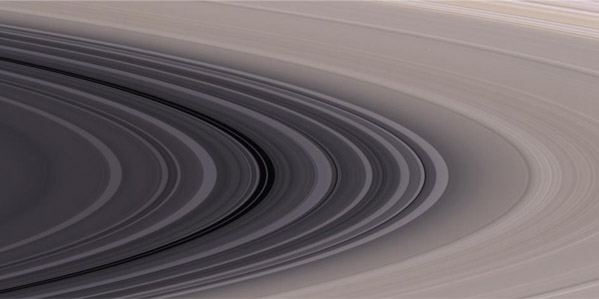
Images taken using red, green and blue spectral filters were used to create this natural color mosaic. The images were acquired using the Cassini spacecraft narrow angle camera on Dec. 12, 2004, at a distance of approximately 1.8 million kilometers (1.1 million miles).
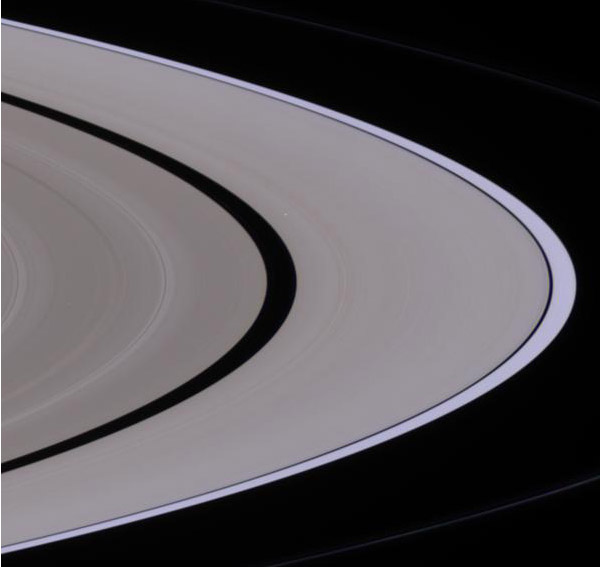
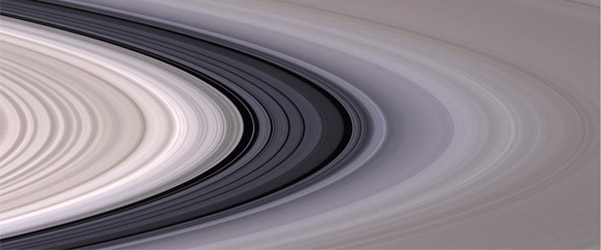
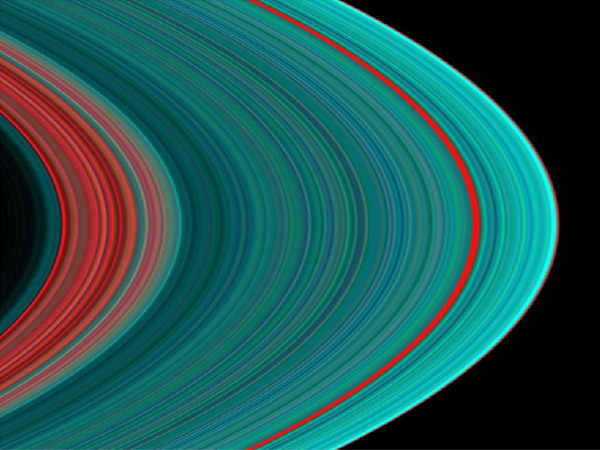
The best view of Saturn's rings in the ultraviolet indicates there is more ice toward the outer part of the rings, than in the inner part, hinting at the origins of the rings and their evolution.
Images taken during the Cassini spacecraft's orbital insertion on June 30 show compositional variation in the A, B and C rings. From the inside out, the "Cassini Division" in faint red at left is followed by the A ring in its entirety. The Cassini Division at left contains thinner, dirtier rings than the turquoise A ring, indicating a more icy composition. The red band roughly three-fourths of the way outward in the A ring is known as the Encke gap.
The ring system begins from the inside out with the D, C, B and A rings followed by the F, G and E rings. The red in the image indicates sparser ringlets likely made of "dirty," and possibly smaller, particles than in the icier turquoise ringlets.
This image was taken with the Ultraviolet Imaging Spectrograph instrument, which is capable of resolving the rings to show features up to 97 kilometers (60 miles) across, roughly 100 times the resolution of ultraviolet data obtained by the Voyager 2 spacecraft.
The Cassini-Huygens mission is a cooperative project of NASA, the European Space Agency and the Italian Space Agency. The Jet Propulsion Laboratory, a division of the California Institute of Technology in Pasadena, manages the mission for NASA's Science Mission Directorate, Washington, D.C. The Cassini orbiter and its two onboard cameras were designed, developed and assembled at JPL. The imaging operations center is based at the Space Science Institute in Boulder, Colo.
土星 | 卫星 |
行星数据 |
极光 | ||
Solar System Illustration
Solar System Concepts
| HyperPhysics********** Astrophysics
HyperPhysics ********** 天体物理学 | R Nave |