Bilingual edition: English is preserved and Chinese follows each unit. Terminology uses the confirmed v20260916 glossary; automated semantic review remains traceable.
中英双语版:英文原文完整保留,中文紧随对应单元;术语采用 v20260916 确认表,自动语义审校结果可追溯。

Sound Speed in Gases

气体中的声速

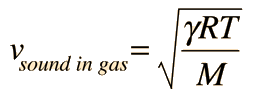
The speed of sound in an ideal gas is given by the relationship
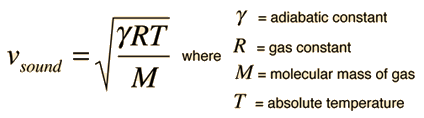
理想气体中声速由下述关系式给出
Show
显示

  • R = the universal gas constant = 8.314 J/mol K,
    R = 常见气体常数 = 8.314 J/(mol·K),
  • T = the absolute temperature
    T = 绝对温度
  • M = the molecular weight of the gas in kg/mol
    M = 气体的分子量(kg/mol)
  • γ = the adiabatic constant, characteristic of the specific gas
    γ 是绝热常数,特征于特定气体

For air, the adiabatic constant γ = 1.4 and the average molecular mass for dry air is 28.95 gm/mol. This leads to

对于空气,绝热常数γ = 1.4,干燥空气的平均分子质量为28.95 gm/mol。这导致

Therefore for air at T = K = °C = °F ,

因此对于空气在 T = K = °C = °F ,
中文译文中的待填/计算数值依次对应:1:tk 2:tc 3:tf。实际数值以上方原输入框为准。

the speed of sound is vsound = m/s = ft/s = mi/hr.

声音的速率是 v sound = m/s = ft/s = mi/hr.
中文译文中的待填/计算数值依次对应:1:v 2:vc 3:vm。实际数值以上方原输入框为准。

It is interesting to compare this speed with the speed of molecules as a result of their thermal energy. For the specific example of dry air at 20°C, the speed of sound in air is 343 m/s, while the rms speed of air molecules is 502 m/s using a mean mass of air molecules of 29 amu.

将这种速度与由于热能引起的分子速度进行比较是有趣的。以干燥空气在20°C时为例,空气中的声速为343 m/s,而空气分子的均方根速度为502 m/s,使用平均分子质量为29 amu。

For helium, γ = 5/3 and the molecular mass is .004 kg/mol, so its speed of sound at the same temperature is

对于氦气,γ = 5/3,其分子质量是0.004 kg/mol,因此在相同温度下其声速为

vsound in helium = m/s = ft/s = mi/hr.

氦气中的声速 = m/s = ft/s = mi/hr。
中文译文中的待填/计算数值依次对应:1:vh 2:vch 3:vmh。实际数值以上方原输入框为准。

Doing this calculation for air at 0°C gives vsound = 331.39 m/s and at 1°C gives vsound = 332.00 m/s. This leads to a commonly used approximate formula for the sound speed in air:

对空气在0°C时进行此计算得到声速v_sound = 331.39 m/s,而在1°C时得到v_sound = 332.00 m/s。这导致了用于空气中的声速的常用近似公式:

For temperatures near room temperature, the speed of sound in air can be calculated from this convenient approximate relationship, but the more general relationship is needed for calculations in helium or other gases.

在室温附近,空气中的声速可以用这个方便的近似关系来计算,但进行氦气或其他气体的计算时,需要使用更一般的关系式。

The calculation above was done for dry air, and moisture content in the air would be expected to increase the speed of sound slightly because the molecular weight of water vapor is 18 compared to 28.95 for dry air. A revised average molecular weight could be calculated based on the vapor pressure of water in the air. However, the assumption of an adiabatic constant of γ = 1.4 used in the calculation is based upon the diatomic molecules N2 and O2 and does not apply to water molecules. So the detailed modeling of the effect of water vapor on the speed of sound would have to settle on an appropriate value of γ to use.

上述计算是针对干燥空气进行的,由于水蒸气的分子量为18,而干燥空气的分子量为28.95,空气中的含水量增加预计会使声速略微增加。可以根据空气中水蒸气的蒸气压计算出一个修正的平均分子量。然而,计算中所采用的定熵指数γ = 1.4是基于双原子分子N₂和O₂的假设,而不适用于水分子。因此,要详细建模水蒸气对声速的影响,就必须选择一个合适的γ值来使用。
Table of sound speeds
声音速度表
Index

Traveling wave concepts

Sound propagation concepts
索引 旅行波概念 声波传播概念
 
HyperPhysics***** Sound
HyperPhysics ***** 声音
R Nave
Go Back
返回


Sound Speed in an Ideal Gas

理想气体中的声速

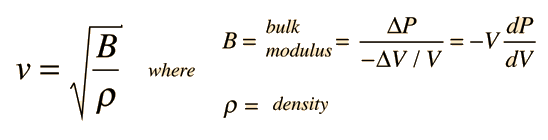
The speed of sound for a uniform medium is determined by its elastic property (bulk modulus) and its density

均匀介质中声速的大小由其弹性性质(体积模量)和密度决定

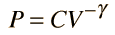
When a sound travels through an ideal gas, the rapid compressions and expansions associated with the longitudinal wave can reasonably be expected to be adiabatic and therefore the pressure and volume obey the relationship

当声波通过理想气体时,与纵波相关的快速压缩和膨胀可以合理地预期为绝热过程,因此压力和体积遵循关系

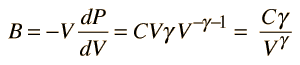
The adiabatic assumption for sound waves just means that the compressions associated with the sound wave happen so quickly that there is no opportunity for heat transfer in or out of the volume of air. The bulk modulus can therefore be reformulated by making use of the adiabatic condition in the form

声波的绝热假设仅仅意味着声波引起的压缩发生得如此迅速,以至于没有机会使空气体积内的热量传入或传出。因此,可以通过利用绝热条件将体积模量重新表述为

so that the derivative of pressure P with respect to volume V can be taken.

以便可以对压力P关于体积V的导数进行求导。

Since the gas density is

由于气体密度是

the speed of sound can be expressed as

声音的速率可以表示为

Using the ideal gas law PV = nRT leads to

使用理想气体定律 PV = nRT 可得到

The conditions for this relationship are that the sound propagation process is adiabatic and that the gas obeys the ideal gas law.

这种关系的条件是声波传播过程是绝热的,并且气体服从理想气体定律。
Calculation
计算
Index

Traveling wave concepts

Sound propagation concepts
索引 旅行波概念 声波传播概念
 
HyperPhysics***** Sound
HyperPhysics ***** 声音
R Nave
Go Back
返回