Einstein Model of a Solid
|
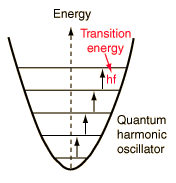
A useful step on the way to understanding the specific heats of solids was Einstein's proposal in 1907 that a solid could be considered to be a large number of identical oscillators. The quantum approach to the harmonic oscillator gives a series of equally spaced quantized states for each oscillator, the separation being hf where h is Planck's constant and f is the frequency of the oscillator. The sketch below visualizes a group of uniformly spaced oscillators in a solid, with any interaction between them neglected for the present. 理解固体比热的一个有用步骤是爱因斯坦于1907年提出的观点,即可以将固体视为由大量相同的振子组成。量子对谐振子的处理给出了每个振子的一系列等间距的量子化状态,状态之间的间隔为hf,其中h是普朗克常数,f是振子的频率。下图展示了一组在固体中均匀分布的振子,目前忽略它们之间的相互作用。
|
 |

The conceptual Einstein solid is useful for examining the idea of multiplicity in the distribution of energy among the available energy states of the system. All of the energy levels are considered to be equally probable within the constraint of having q units of energy and N oscillators.
As an example, consider q=3 units of energy distributed in an Einstein solid with N=4 oscillators.
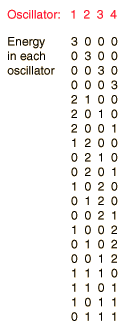 |
At left is the detailed listing of the possible distributions of the energy, a total of 20 different distributions for 3 units of energy among 4 oscillators (a multiplicity of 20). If we are trying to develop a description of a real solid with Avogadro's number of oscillators, this kind of approach is clearly impractical. Fortunately, mathematical expressions for the multiplicity make the task manageable. 左边是3个单位能量分配给4个振子的可能分布的详细列表,共有20种不同的分布(即乘积为20)。如果我们试图描述一个含有阿伏伽德罗数振子的真实固体,这种做法显然是不现实的。幸运的是,对于乘积的数学表达式使这项任务变得可行。
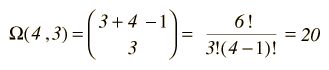
The multiplicity for q units of energy among N oscillators is given by the expression: q个能量单位在N个振子中的简并度由下式给出:
 which for this example becomes 对于这个例子来说变为
|
The entropy of the Einstein solid can be expressed in terms of the multiplicity.
To make the multiplicity expression manageable, consider the following steps:
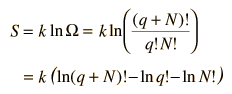
The numbers q and N are presumed large and the 1 is dropped. Now making use of Stirling's approximation to evaluate the factorials

Now making the physical assumption that the number of energy units is much larger than the number of oscillators, q>>N, the expression can be further simplified. With rearrangement
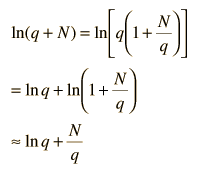
Besides making use of log combination rules, the above steps make use of the series expansion of ln(1+N/q) which can be approximated by the first term when q>>N: (approximately, ln(1+x)=x if x<<1). Substitution gives an expression for the entropy of the Einstein solid:
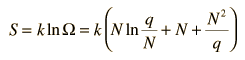
Finally we can make a connection to something akin to a real-world solid. The internal energy U can be represented by q times the oscillator energy unit hf = ε. The last term above will be negligible under the assumption q>>N, so the entropy expression becomes

Using the definition of temperature as a function of entropy gives

This is what is expected from equipartition of energy. Each oscillator has two degrees of freedom, and each should represent kT/2 of energy, giving U=NkT.
温度与熵 |
Entropy concepts
Reference
Schroeder
Ch 2
| HyperPhysics***** Thermodynamics
HyperPhysics ***** 热力学 | R Nave |