Law of Dulong and Petit杜隆-珀蒂定律
The specific heat of copper is 0.093 cal/gm K (.389 J/gm K) and that of lead is only 0.031 cal/gm K(.13 J/gm K). Why are they so different? The difference is mainly because it is expressed as energy per unit mass; if you express it as energy per mole, they are very similar. It is in fact that similarity of the molar specific heats of metals which is the subject of the Law of Dulong and Petit. The similarity can be accounted for by applying equipartition of energy to the atoms of the solids. 铜的比热是0.093 cal/gm K(0.389 J/gm K),而铅的比热只有0.031 cal/gm K(0.13 J/gm K)。为什么它们差异这么大?主要原因是它以单位质量的能来表达;如果以摩尔为单位来表达,它们就非常相似。事实上,金属的摩尔比热的相似性正是杜隆-珀蒂定律所讨论的内容。这种相似性可以通过将能量均分定理应用于固体中的原子来解释。
From just the translational degrees of freedom you get 3kT/2 of energy per atom. Energy added to solids takes the form of atomic vibrations and that contributes three additional degrees of freedom and a total energy per atom of 3kT. The specific heat at constant volume should be just the rate of change with temperature (temperature derivative) of that energy. 从平动自由度来看,每个原子的能是3kT/2。将能量加到固体中,会以原子振动的形式体现,并贡献三个额外的自由度,使得每个原子的总能量为3kT。在恒定体积下,定压比热应只是该能量对温度的导数(温度导数)。
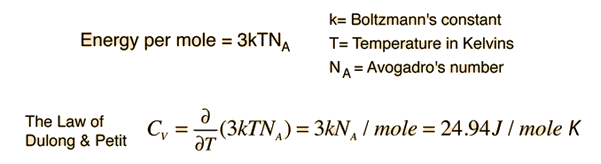
![]() When looked at on a molar basis, the specific heats of copper and lead are quite similar: 从摩尔的角度来看,铜和铅的比热容相当相似:

![]()
|
Index
索引 | ||||
|
Go Back
返回 |
Departure from the Law of Dulong and Petit偏离杜隆-佩蒂定律
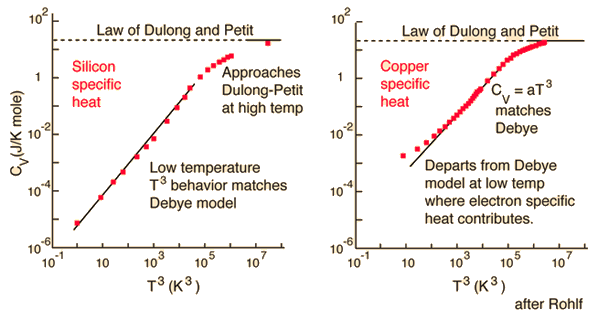
The Law of Dulong and Petit is based on Maxwell-Boltzmann statistics, and for low temperatures, quantum statistics must be used. 杜隆-珀蒂定律基于麦克斯韦-玻尔兹曼统计,低温下必须使用量子统计。
![]() Explaining the drastic departure from the Law of Dulong and Petit was a major contribution of Einstein and Debye. 解释为何偏离杜隆-珀蒂定律是爱因斯坦和德拜的重要贡献。
![]() |
Index Reference Rohlf Ch 14. 索引参考Rohlf第14章。 | ||
|
Go Back
返回 |
Einstein's Contribution to Specific Heat Theory爱因斯坦对特定热容理论的贡献
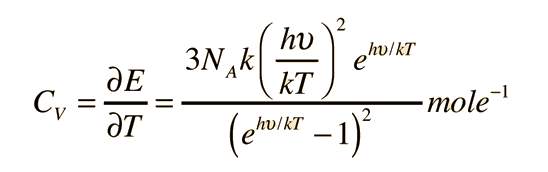
The Law of Dulong and Petit assumed that Maxwell-Boltzmann statistics and equipartition of energy could be applied even at low temperatures. Einstein recognized that for a quantum harmonic oscillator at energies less than kT, the Einstein-Bose statistics must be applied. This was the same conclusion that was drawn about blackbody radiation. The statistical distribution of energy in the vibrational states gives average energy: 杜隆-珀蒂定律假设即使在低温下,麦克斯韦-玻尔兹曼统计和能量等分定律也可以应用。爱因斯坦认识到,对于能量小于kT的量子谐振子,必须应用爱因斯坦-玻色统计。这一结论与关于黑体辐射的结论相同。振动态的能量统计分布给出平均能量:
![]() where this frequency is the frequency of a quantum vibrator. There are three degrees of freedom per vibrator, so the total energy is 其中这个频率是量子振子的频率。每个振子有三个自由度,因此总能量是
![]() The derivative of this gives: 这的导数为:
![]()
In the Einstein treatment, the appropriate frequency in the expression had to be determined empirically by comparison with experiment for each element. The quantity hu/k is sometimes called the Einstein temperature. Although the general match with experiment was reasonable, it was not exact. Debye advanced the treatment by treating the quantum oscillators as collective modes in the solid which are now called "phonons". 在爱因斯坦的处理中,表达式中适当的频率必须通过与实验的比较来经验性地确定,每个元素都需如此。量 h u /k 有时被称为爱因斯坦温度。尽管与实验的总体符合情况尚可,但并不精确。德拜通过将量子振荡器视为固体中的集体模式,即现在称为‘声子’的模式,进一步完善了这一处理。
|
Index Reference Blatt Sec 4.3. Rohlf Ch 14 索引参考Blatt第4.3节,Rohlf第14章 | ||||
|
Go Back
返回 |
The High Temperature Limit of the Einstein Specific Heat爱因斯坦特定热容的高温极限
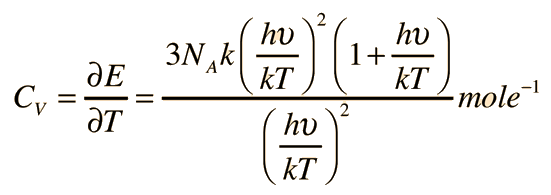
Einstein's introduction of quantum behavior showed why the specific heat became temperature dependent at low temperatures, and it had a high temperature limit which agreed with the Law of Dulong and Petit. To show this, note that for high temperatures, a series expansion of the exponential gives 爱因斯坦引入量子行为,说明了在低温下比热为何随温度变化,而且它在高温时有一个极限,与杜隆-珀蒂定律相符。为了说明这一点,注意对于高温情况,指数函数的级数展开给出
![]() The Einstein specific heat expression then becomes 爱因斯坦特定比热表达式则变为
![]() This reduces to the Law of Dulong and Petit. 这归结为杜隆-珀蒂定律。
![]() |
Index References Rohlf Ch 14 Blatt Sec 4.3. 索引参考Rohlf第14章Blatt第4.3节。 | ||
|
Go Back
返回 |