Bilingual edition: English is preserved and Chinese follows each unit. Terminology uses the confirmed v20260916 glossary; automated semantic review remains traceable.
中英双语版:英文原文完整保留,中文紧随对应单元;术语采用 v20260916 确认表,自动语义审校结果可追溯。

Debye's Contribution to Specific Heat Theory

德拜对特定热容理论的贡献

Einstein's oscillator treatment of specific heat gave qualitative agreement with experiment and gave the correct high temperature limit (the Law of Dulong and Petit). The quantitative fit to experiment was improved by Debye's recognition that there was a maximum number of modes of vibration in a solid. He pictured the vibrations as standing wave modes in the crystal, similar to the electromagnetic modes in a cavity which successfully explained blackbody radiation. The density of states for these modes, which are called "phonons", is of the same form as the photon density of states in a cavity.

爱因斯坦对特定热容的振子处理在定性上与实验结果一致,并给出了高温极限(杜隆-珀蒂定律)的正确形式。德拜认识到固体中振动模式的数量有一个最大值,从而改进了实验的定量拟合。他将振动描绘为晶体中的驻波模式,类似于腔体中电磁波模式,后者成功解释了黑体辐射。这些模式被称为“声子”,其密度与腔体中光子的密度形式相同。

To impose a finite limit on the number of modes in the solid, Debye used a maximum allowed phonon frequency now called the Debye frequency υD. In the treatment of specific heat, we define a Debye temperature by

为对固体中的模式数施加有限限制,德拜引入了一个最大允许的声子频率,现在称为德拜频率 υ_D。在比热处理中,我们定义德拜温度为

For low temperatures, Debye's treatment led to a specific heat

对于低温,德拜的处理方法导致了比热
Show
显示

The dependence upon the cube of the temperature agreed with experimental results for nonmetals, and for metals when the electron specific heat was taken into account. The measurement of the low temperature specific heat variation with temperature has led to tabulation of the Debye temperatures for a number of solid materials. The full expression for the Debye specific heat must be evaluated by numerical procedures. It has the correct limiting values at both high and low temperatures.

温度的立方关系与非金属的实验结果一致,并且在考虑了电子特定热容后,也与金属的情况相符。对低温下热容随温度变化的测量结果,导致了多种固体材料的德拜温度的列表。德拜热容的完整表达式必须通过数值方法进行评估。它在高温和低温极限下都有正确的极限值。
Define constants
定义常量
Table of specific heats
特定热容表
Einstein-Debye specific heat expression
爱因斯坦-德拜比热表达式
Table of Debye temperatures
德拜温度表
Index

Reference
Rohlf
Ch 14.

Blatt
Sec. 4.3
索引参考Rohlf第14章,Blatt第4.3节
 
HyperPhysics***** Thermodynamics
HyperPhysics ***** 热力学
R Nave
Go Back
返回


Einstein-Debye Specific Heats

爱因斯坦-德拜比热容

The Einstein-Debye phonon model produced agreement with the low-temperature cubic dependence of specific heat upon temperature. Explaining the drastic departure from the Law of Dulong and Petit was a major contribution of the Einstein and Debye models. The final step in explaining the low temperature specific heats of metals was the inclusion of the electron contribution to specific heat. When these were combined, they produced the expression

爱因斯坦-德拜声子模型与温度的低温度立方依赖性相符。解释与杜隆-珀蒂定律的显著偏离是爱因斯坦和德拜模型的重要贡献。解释金属低温比热的最后一步是包括电子对比热的贡献。当这些被结合时,它们产生了以下表达式

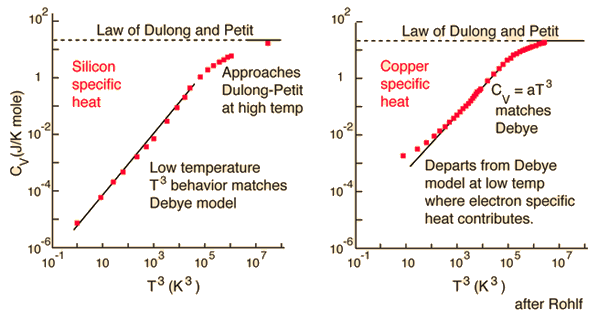
Note that the vibrational part is only the low temperature limit of the more general Debye specific heat. The data below show that the Debye phonon model with its cubic dependence on temperature matches the silicon data to very low temperatures. The copper shows a departure from the cubic dependence, showing evidence of electron specific heat.

The vibrational term here is only the low temperature limit of the Debye specific heat expression; the full expression includes an integral which must be evaluated numerically. It produces good agreement with the transition to the Dulong and Petit limit at high temperatures.

这里的振动项只是德拜比热表达式的低温极限;完整的表达式包含一个必须数值求解的积分。它在高温极限向杜隆-珀蒂极限过渡时表现出良好的一致性。

Note that the model for specific heat presented here uses both forms of quantum statistics. Bose-Einstein statistics is used to describe the contribution from lattice vibrations ( phonons), and Fermi-Dirac statistics must be used to describe the electron contribution to the specific heat.

需要注意的是,本节中提出的比热模型同时使用了两种量子统计形式。玻色-爱因斯坦统计用于描述晶格振动(声子)的贡献,而费米-狄拉克统计必须用于描述电子对比热的贡献。
需要注意的是,振动部分只是更一般的德拜比热容在低温极限下的表现。下图数据表明,德拜声子模型与其温度的立方依赖性在非常低的温度下能够很好地拟合硅的实验数据。而铜的数据则显示出偏离立方依赖性的趋势,这表明电子贡献的比热效应。
Index

References
Blatt
Sec 4.3.

Rohlf
Ch 14.
索引参考 Blatt 第4.3节,Rohlf 第14章。
 
HyperPhysics***** Thermodynamics
HyperPhysics ***** 热力学
R Nave
Go Back
返回