The Mpemba Effect?
迈珀姆巴效应?
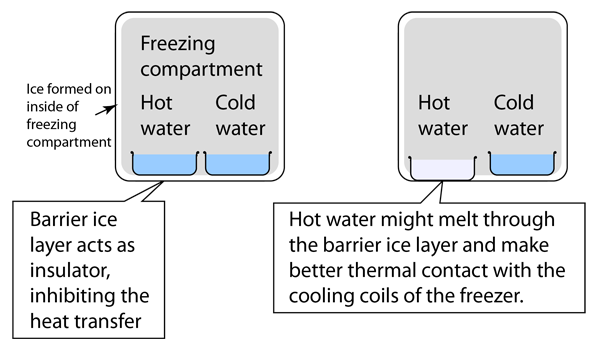
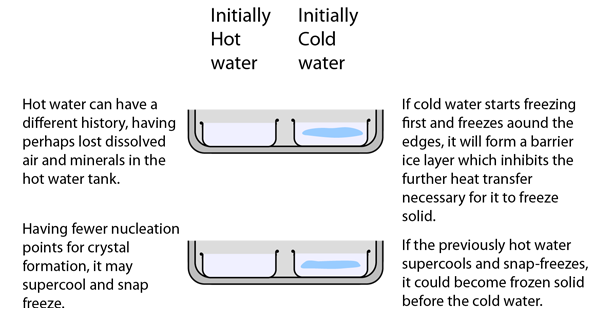
There is in fact a large body of literature about initially hot water freezing faster than cold water and this phenomenon has been labeled the "Mpemba effect" (see references). The literature cited here takes the position that the phenomenon of supercooling is the main mechanism involved and that the history (dissolved gases, etc.) is not crucial to the phenomenon. Supercooling to -5 C or lower is cited and it is suggested that both the initially hot and the initially cold water supercool. If the cold water supercools more below the normal 0°C than the hot water, that will delay its freezing transition. In that case, the hot water may in fact freeze more quickly with nothing more than the degree of supercooling to distinguish the two samples. It was also pointed out that the degree of supercooling is not easily predictable, since it probably depends upon tiny particles or bubbles which nucleate the crystal formation. Experiments showed different amounts of supercooling for the same sample when it was repeatedly liquified and refrozen.
事实上,有关初始温度较高的水比初始温度较低的水冻结更快的现象存在大量文献,这种现象被称为“Mpemba效应”(见参考文献)。此处引用的文献认为,过冷是主要的机制,而历史因素(如溶解气体等)对这一现象并不关键。过冷至-5°C或更低被提及,并建议初始温度较高的水和初始温度较低的水都会发生过冷。如果冷水比热水在0°C以下过冷更多,那么它的冻结过程会延迟。在这种情况下,热水可能实际上会更快冻结,仅凭过冷的程度即可区分两种样品。还指出,过冷的程度不容易预测,因为这可能取决于促成晶体形成的微小粒子或气泡。实验显示,同一样品在反复液化和重新冻结过程中表现出不同的过冷程度。
Some references are:
Knight, Charles A., The Mpemba Effect: The Freezing Times of Hot and Cold Water, Letter in Am J Phys, Vol 64, May 1996, p524
一些参考文献是:Knight, Charles A., 《Mpemba效应:热水和冷水的冻结时间》,《美国物理评论》1996年5月第64卷,第524页。
Auerbach, David, Supercooling and the Mpemba Effect: When Hot Water Freezes Faster Than Cold, Am J Phys. 63, 882-885, (1995)
阿乌尔巴赫,大卫,过冷与迈帕效应:当热水比冷水更快结冰时,《美国物理期刊》63,882-885,(1995)
Dorsey, N.E., Am. Philos. Soc. 38, 247-328, (1948).
Dorsey, N.E., Am. Philos. Soc. 38, 247-328, (1948).(专名或术语)
Dorsey, N.E., The Properties of Ordinary Water Substance, Reinhold, Scranton, PA., (1940).
Dorsey, N.E., 《普通水物质的性质》, Reinhold, Scranton, PA., (1940).
|
Index
Heat concepts
Heat transfer concepts
索引 热学概念 热传递概念 |