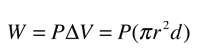
Heat and Work Example
热量与功的例子
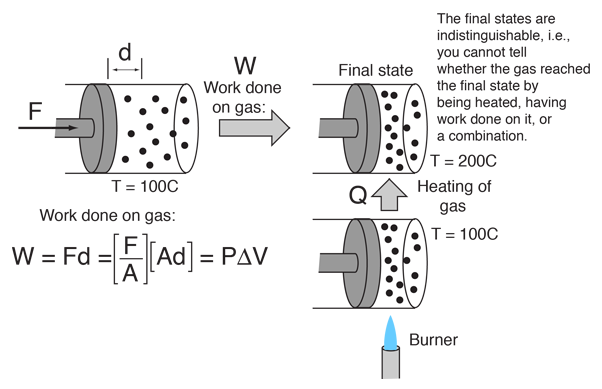
This example of the interchangeability of heat and work as agents for adding energy to a system can help to dispel some misconceptions about heat. I found the idea in a little article by Mark Zemansky entitled "The Use and Misuse of the Word 'Heat' in Physics Teaching". One key idea from this example is that if you are presented with a high temperature gas, you cannot tell whether it reached that high temperature by being heated, or by having work done on it, or a combination of the two.
这个热和功作为向系统添加能量的等效手段的例子,有助于消除关于热的一些误解。我在这个由Mark Zemansky撰写的短文中找到了这个想法,题为『物理学教学中‘热’这个词的使用与误用』。这个例子的一个关键思想是,如果你面对一个高温气体,你无法确定它是通过加热还是通过对外做功,或者两者的结合使它达到了如此高的温度。
To describe the energy that a high temperature object has, it is not a correct use of the word heat to say that the object "possesses heat" - it is better to say that it possesses internal energy as a result of its molecular motion. The word heat is better reserved to describe the process of transfer of energy from a high temperature object to a lower temperature one. Surely you can take an object at low internal energy and raise it to higher internal energy by heating it. But you can also increase its internal energy by doing work on it, and since the internal energy of a high temperature object resides in random motion of the molecules, you can't tell which mechanism was used to give it that energy.
要描述高温物体所具有的能量,说该物体‘具有热量’是不正确的——更准确的说法是,由于分子运动,该物体具有内能。‘热量’这个词更适合用来描述从高温物体向低温物体传递能量的过程。你当然可以通过加热一个内能较低的物体使其内能增加。你也可以通过对物体做功来增加其内能,而由于高温物体的内能储存在分子的无序运动中,因此无法确定是哪种机制提供了这种能量。
In warning teachers and students alike about the pitfalls of misusing the word "heat", Mark Zemansky advises reflecting on the jingle:
为警示教师和学生避免误用‘热量’一词,Mark Zemansky建议反思以下口诀:
|
"Teaching thermal physics
Is as easy as a song:
You think you make it simpler
When you make it slightly wrong."
教热力学就像唱一首歌一样简单:当你稍微错的时候,你反而觉得它更简单。
| Zemansky's plea
Don't refer to the "heat in a body", or say "this object has twice as much heat as that body". He also objects to the use of the vague term "thermal energy" and to the use of the word "heat" as a verb, because they feed the misconceptions, but it is hard to avoid those terms. He would counsel the introduction and use of the concept of internal energy as quickly as possible.
不要说‘物体中有多少热量’,也不要说‘这个物体的热量是那个物体的两倍。’他也反对使用模糊的术语‘热能’,以及将‘热量’作为动词使用,因为这些说法会加深误解。但他也很难避免使用这些术语。他建议尽快引入和使用‘内能’这一概念。
泽曼斯基的呼吁 |
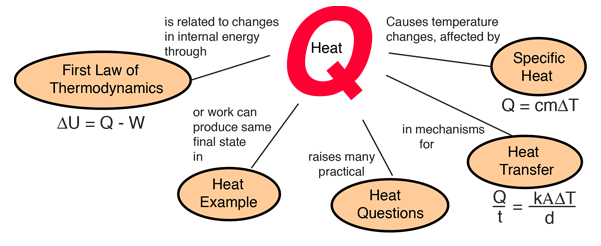
Zemansky points to the First Law of Thermodynamics as a clarifying relationship. The First Law identifies both heat and work as methods of energy transfer which can bring about a change in the internal energy of a system. After that, neither the words work or heat have any usefulness in describing the final state of the sytem - we can speak only of the internal energy of the system.
Zemansky指出热力学第一定律是一个澄清的关系。热力学第一定律将热量和功确定为能量传递的两种方法,可以引起系统内能的变化。之后,无论是热量还是功的词语在描述系统的最终状态时都没有用处——我们只能谈论系统的内能。
|