Heat Pump热泵
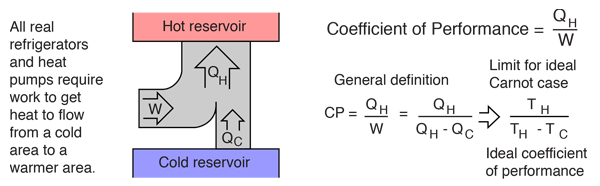
A heat pump is a device which applies external work to extract an amount of heat QC from a cold reservoir and delivers heat QH to a hot reservoir. A heat pump is subject to the same limitations from the second law of thermodynamics as any other heat engine and therefore a maximum efficiency can be calculated from the Carnot cycle. Heat Pumps are usually characterized by a coefficient of performance which is the number of units of energy delivered to the hot reservoir per unit work input. 热泵是一种装置,它通过外部做功从低温热源中提取一定量的热量Q_C,并将热量Q_H传递给高温热源。热泵受热力学第二定律的限制,与其他热机一样,因此可以从卡诺循环计算出最大效率。热泵通常由一个性能系数来表征,该系数是每单位输入功传递到高温热源的能源单位数。
![]() Note: In calculating the coefficient of performance, or any other heat-engine related quantities, the temperatures must be the values in Kelvins. 注意:在计算性能系数,或任何其他与热机相关的量时,温度必须以开尔文温度表示。
|
Index Heat engine concepts 热机概念索引 | ||
|
Go Back
返回 |
Air Conditioners and Heat Pumps空调与热泵
Air conditioners and heat pumps are heat engines like the refrigerator. They make good use of the high quality and flexibility of electric energy in that they can use one unit of electric energy to transfer more than one unit of energy from a cold area to a hot area. For example, an electric resistance heater using one kilowatt-hour of electric energy can transfer only 1 kWh of energy to heat your house at 100% efficiency. But 1 kWh of energy used in an electric heat pump could "pump" 3 kWh of energy from the cooler outside environment into your house for heating. The ratio of the energy transferred to the electric energy used in the process is called its coefficient of performance (CP). A typical CP for a commercial heat pump is between 3 and 4 units transferred per unit of electric energy supplied. 空调和热泵是像冰箱一样的热机。它们利用电能的高质量和灵活性,因为它们可以利用一单位的电能将多于一单位的能量从冷区转移到热区。例如,使用一千瓦时的电能的电阻加热器只能将1千瓦时的能量传送到100%效率的加热你的房子。但是,将1千瓦时的能量用于电热泵时,可以将3千瓦时的能量从较冷的室外环境“泵”入你的房子进行加热。能量转移量与过程中所用的电能的比率称为其性能系数(CP)。商用热泵的典型CP在每单位电能供给时转移3到4单位的能量之间。
|
Index PV diagram concepts Heat engine concepts 索引 PV 图概念 热机概念 | |||
|
Go Back
返回 |
Coefficient of Performance性能系数
The coefficient of performance (CP) for a heat pump is the ratio of the energy transferred for heating to the input electric energy used in the process. In reference to the standard heat engine illustration, the coefficient is defined by 热泵的性能系数(CP)是用于加热的热量与过程中所用的输入电能之比。参照标准热机示意图,该系数定义为
![]() There is a theoretical maximum CP, that of the Carnot cycle : 存在一个理论上的最大CP,即卡诺循环的CP:
![]() For a refrigerator, however, the useful quantity is the heat extracted, QC , not the heat exhausted. Therefore, the coefficient of performance of a refrigerator is expressed as 然而,对于冰箱来说,有用的量是从冷 reservoir 中提取的热量 Q_C,而不是排出的热量。因此,冰箱的性能系数表示为
![]() For consumer refrigerators in the U.S., the coefficient of performance for refrigerators is typically recast into a number called the Energy Efficiency Ratio. 对于美国的家用冰箱,制冷系数通常被转换为一个称为能源效率比的数值。
|
Index PV diagram concepts Heat engine concepts 索引 PV 图概念 热机概念 | ||
|
Go Back
返回 |
Energy Efficiency Ratio能量效率比
The efficiencies of air conditioners and heat pumps sold in the United States are often stated in terms of an energy efficiency ratio (EER): 美国市场上销售的空调和热泵的效率通常以能量效率比(EER)来表示:
![]() This peculiar ratio can be compared to the more straightforward coefficient of performance by converting BTU/hr to watts: 这个奇特的比值可以与更直观的性能系数进行比较,通过将BTU/hr转换为瓦特:
![]() Therefore CP = EER x 0.292. The range of EER's for air conditioners is typically about 5.5 to 10.5 with those units for which EER>7.5 being classified as "high efficiency" units. This is a range of 1.6 to 3.1 in CP. 因此,CP = EER × 0.292。空气调节器的EER范围通常为5.5到10.5,其中EER>7.5的单位被归类为“高效”单位。这一范围在CP上为1.6到3.1。
|
Index Heat engine concepts 热机概念索引 | ||
|
Go Back
返回 |
Heat Pump Energy Flow热泵能量流动
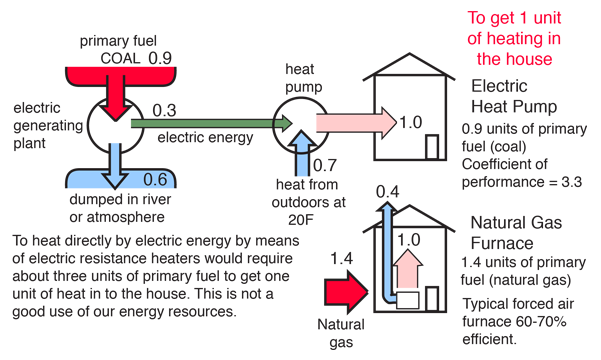
![]() The electric heat pump can overcome the thermal bottleneck imposed by the second law of thermodynamics for the purpose of heating a house. As the illustration shows, an electric heat pump can deliver more heat to a house than burning the primary fuel at 100% efficiency inside the house. That is higher efficiency than a typical forced-air natural gas furnace which brings the primary fuel to the house. This comparison is not quite fair to the natural gas, however, since you can purchase natural gas furnaces which deliver the gas energy into heating at over 90% efficiency. 电热泵可以克服热力学第二定律所施加的热瓶颈,以加热房屋的目的。如图所示,电热泵可以将比在房屋内燃烧初级燃料以100%效率产生的热量更多的热量传递到房屋中。这比典型的强制空气天然气炉将初级燃料带入房屋的效率要高。然而,这种比较对天然气来说并不完全公平,因为你可以购买天然气炉,其将气体能量以超过90%的效率用于供暖。
|
Index Heat engine concepts 热机概念索引 | ||
|
Go Back
返回 |