Heat Engine Cycle热机循环
A heat engine typically uses energy provided in the form of heat to do work and then exhausts the heat which cannot be used to do work. Thermodynamics is the study of the relationships between heat and work. The first law and second law of thermodynamics constrain the operation of a heat engine. The first law is the application of conservation of energy to the system, and the second sets limits on the possible efficiency of the machine and determines the direction of energy flow. 热机通常利用以热量形式提供的能量来做功,然后排出无法用于做功的热量。热力学研究的是热量与功之间的关系。热力学第一定律和第二定律限制了热机的运行。第一定律是能量守恒定律在系统中的应用,第二定律则对机器可能的效率设限,并确定能量流动的方向。
|
Index Heat engine concepts 热机概念索引 | ||||
|
Go Back
返回 |
PV DiagramsPV 图
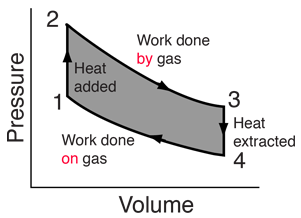
Pressure-Volume (PV) diagrams are a primary visualization tool for the study of heat engines. Since the engines usually involve a gas as a working substance, the ideal gas law relates the PV diagram to the temperature so that the three essential state variables for the gas can be tracked through the engine cycle. Since work is done only when the volume of the gas changes, the diagram gives a visual interpretation of work done. Since the internal energy of an ideal gas depends upon its temperature, the PV diagram along with the temperatures calculated from the ideal gas law determine the changes in the internal energy of the gas so that the amount of heat added can be evaluated from the first law of thermodynamics. In summary, the PV diagram provides the framework for the analysis of any heat engine which uses a gas as a working substance. 压力-体积(PV)图是研究热机的重要可视化工具。由于热机通常涉及气体作为工作物质,理想气体定律将PV图与温度联系起来,从而可以跟踪气体的三个基本状态变量在热机循环中的变化。由于只有在气体体积变化时才会做功,因此该图提供了对做功的直观解释。由于理想气体的内能取决于其温度,因此PV图与通过理想气体定律计算出的温度共同决定了气体内能的变化,从而可以利用热力学第一定律来评估加入的热量。总之,PV图为任何使用气体作为工作物质的热机分析提供了框架。
|
Index PV diagram concepts Heat engine concepts 索引 PV 图概念 热机概念 | ||
|
Go Back
返回 |
Heat Engines热机
A heat engine typically uses energy provided in the form of heat to do work and then exhausts the heat which cannot be used to do work. Thermodynamics is the study of the relationships between heat and work. The first law and second law of thermodynamics constrain the operation of a heat engine. The first law is the application of conservation of energy to the system, and the second sets limits on the possible efficiency of the machine and determines the direction of energy flow. 热机通常利用以热量形式提供的能量来做功,然后排出无法用于做功的热量。热力学研究的是热量与功之间的关系。热力学第一定律和第二定律限制了热机的运行。第一定律是能量守恒定律在系统中的应用,第二定律则对机器可能的效率设限,并确定能量流动的方向。
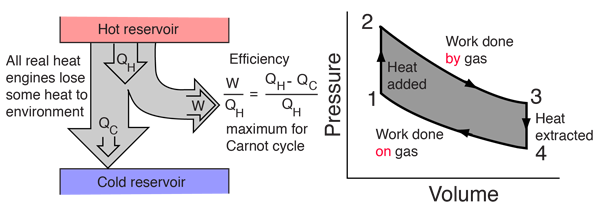
![]() General heat engines can be described by the reservoir model (left) or by a PV diagram (right) 一般热机可以用 reservoir 模型(左)或 P-V 图(右)来描述
|
Index PV diagram concepts Heat engine concepts 索引 PV 图概念 热机概念 | ||
|
Go Back
返回 |
Energy Reservoir Model能量储存模型
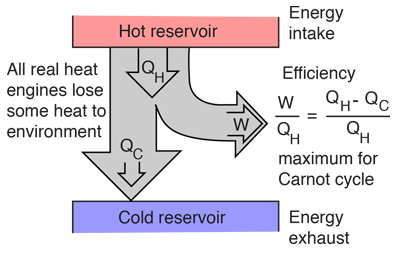
One of the general ways to illustrate a heat engine is the energy reservoir model. The engine takes energy from a hot reservoir and uses part of it to do work, but is constrained by the second law of thermodynamics to exhaust part of the energy to a cold reservoir. In the case of the automobile engine, the hot reservoir is the burning fuel and the cold reservoir is the environment to which the combustion products are exhausted. 展示热机的一种通用方法是能量库模型。发动机从热库获取能量,并利用其中一部分来做功,但受热力学第二定律的限制,必须将部分能量排放到冷库。在汽车发动机的情况下,热库是燃烧的燃料,而冷库则是废气排放到其中的环境。
Another common way to characterize heat engines is by a PV diagram 另一种表征热机的方法是通过P-V图
|
Index Heat engine concepts 热机概念索引 | ||
|
Go Back
返回 |