
    |
    |
| Heat
热 |
索引
HyperPhysics ***** 热力学
返回
|
Index
索引 | |||
| HyperPhysics***** Thermodynamics
HyperPhysics ***** 热力学 |
Go Back
返回 |
Water&Ice, Water&Steam水与冰,水与蒸汽
How can so much energy be put into a substance during a phase change without changing its temperature? 在相变过程中,如何将如此多的能注入物质而不改变其温度?
The key idea is that temperature does not measure the entire internal energy of a substance, only the translational kinetic energy part. During a phase change, the energy goes into the potential energy part, either taking from or adding to the energy associated with the molecular attractions. 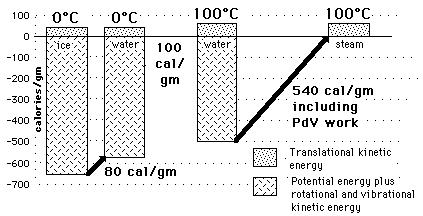 关键思想是温度并不测量物质的全部内能,只测量其中的平动动能部分。在相变过程中,能量进入势能部分,要么从分子间作用力相关的能量中取出,要么增加该部分的能量。
|
Index Internal energy concepts Heat questions 索引 内能概念 热学问题 | ||||
| HyperPhysics***** Thermodynamics
HyperPhysics ***** 热力学 |
Go Back
返回 |
Water and Ice at 0 C0°C的水和冰
The constancy of temperature when water is going through its phase changes at 0 C and 100 C provides some insight into the nature of the internal energy of water, ice, and steam and into the nature of temperature. The fact that large amounts of energy are added to accomplish melting or vaporization without a change in temperature shows that temperature does not measure all of the internal energy of the water - in fact it is only a measure of the translational kinetic energy of the water molecules. The large size of the phase change energy indicates that there is a large amount of potential energy associated with the intermolecular forces between the water molecules. During the melting and vaporization phase changes, the energy goes into the breaking down of the solid or liquid bonds, reducing the binding potential energy by the amount of the phase change energy and therefore not changing the average translational kinetic energy as reflected by the temperature. 当水在0°C和100°C发生相变时温度保持恒定,这为理解水、冰和蒸汽的内能以及温度的性质提供了一些见解。大量能量被加入以实现熔化或汽化而温度不发生变化,这表明温度并不能测量水的所有内能——事实上,它只反映了水分子的平动动能。相变能量的大小很大,表明水分子之间的分子间作用力存在大量的势能。在熔化和汽化过程中,能量用于打破固体或液体中的键,使结合势能减少相变能量的量,因此平均平动动能不发生变化,这反映在温度上。
|
Index Internal energy concepts Heat questions 索引 内能概念 热学问题 |
| HyperPhysics***** Thermodynamics
HyperPhysics ***** 热力学 |
Go Back
返回 |
Steel and Wood at 0 C零摄氏度的钢和木材
Your sense of touch is not a reliable thermometer because the sense of "hotness" or "coldness" of a surface depend upon other factors as well as the temperature. Most notably, the thermal conductivity of the object touched plays a part in how hot or cold it feels. With both objects at 0¡C, steel feels colder than wood because its thermal conductivity is much higher and it conducts energy away from your finger faster. If both objects are at 100¡C, much higher than body temperature, the steel will feel hotter than the wood because it will conduct energy to your finger much more rapidly. 你的触觉并不是一个可靠的温度计,因为表面的“热感”或“冷感”不仅取决于温度,还受到其他因素的影响。最明显的是,所接触物体的热导率会影响它感觉起来的冷热程度。当两个物体都处于0°C时,钢比木头感觉更冷,这是因为钢的热导率更高,能更快地将能量从你的手指传导出去。如果两个物体都处于100°C,远高于体温,钢会比木头感觉更热,因为它能更快地将能量传导到你的手指上。
|
Index Internal energy concepts Heat questions 索引 内能概念 热学问题 |
| HyperPhysics***** Thermodynamics
HyperPhysics ***** 热力学 |
Go Back
返回 |