Bilingual edition: English is preserved and Chinese follows each unit. Terminology uses the confirmed v20260916 glossary; automated semantic review remains traceable.
中英双语版:英文原文完整保留,中文紧随对应单元;术语采用 v20260916 确认表,自动语义审校结果可追溯。

Reverberation

混响

Reverberation is the collection of reflected sounds from the surfaces in an enclosure like an auditorium. It is a desirable property of auditoriums to the extent that it helps to overcome the inverse square law dropoff of sound intensity in the enclosure. However, if it is excessive, it makes the sounds run together with loss of articulation - the sound becomes muddy, garbled. To quantitatively characterize the reverberation, the paramater called the reverberation time is used.

混响是 auditorium 中由于表面反射而产生的声音的集合。混响是 auditorium 的一个 desirable 特性,因为有助于克服 enclosure 中声音强度因逆平方定律而产生的衰减。然而,如果混响过强,会使声音变得模糊、杂乱,失去清晰度。为了定量描述混响,使用了一个称为混响时间的参数。
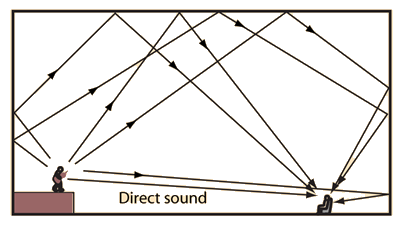
Reverberant sound is the collection of all the reflected sounds in an auditorium.
混响声是音乐厅中所有反射声的集合。
Reverberant sound field
回声声场
Reverberant sound decay
混响声衰减
Reverberation time
混响时间
Adding reverberation
加入混响
Index

Auditorium acoustics
索引 声学礼堂
 
HyperPhysics***** Sound
HyperPhysics ***** 声音
R Nave
Go Back
返回


Reverberant Sound Field

混响声场

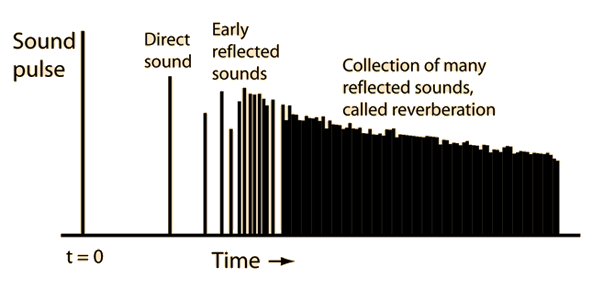
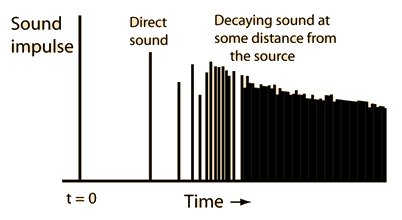
The sketch below depicts the sound received by a single listener as a function of time as a result of a sharp sound pulse some distance away. The direct sound received is followed by distinct reflected sounds and then a collection of many reflected sounds which blend and overlap into what is called reverberation. The delay between the direct sound and the first reflected sound is a significant characteristic for an auditorium, though not as important as the overall reverberation time.

下图展示了一个听众接收到的声波随时间变化的示意图,这是由于远处的一个尖锐声脉冲引起的。直接传来的声音之后是多个明显的反射声,然后是一系列相互重叠的反射声,这些声波融合在一起形成了所谓的混响。直接声与第一反射声之间的延迟是音响厅的一个重要特征,尽管不如整体的混响时间重要。
Modeling reverberant sound decay
建模回声声衰减
Index

Auditorium acoustics
索引 声学礼堂
 
HyperPhysics***** Sound
HyperPhysics ***** 声音
R Nave
Go Back
返回


Reverberant Sound Decay

混响声衰减

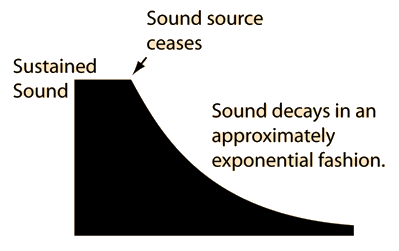
Whether from a sound impulse or a steady sound which ceases, the reverberant sound in an auditorium decays in an approximately exponential fashion.

无论是来自一个冲击声还是一个逐渐消失的持续声,礼堂中的混响声都近似按指数方式衰减。
Sample measurements show a straight line decrease of the decibel level, which permits determination of the reverberation time.
样本测量显示分贝电平呈直线下降,这使得可以确定混响时间。
Index

Auditorium acoustics

Reference
Backus
p. 165
索引 声学 参考 Backus p. 165
 
HyperPhysics***** Sound
HyperPhysics ***** 声音
R Nave
Go Back
返回


Sound Decay Measurements

声音衰减测量
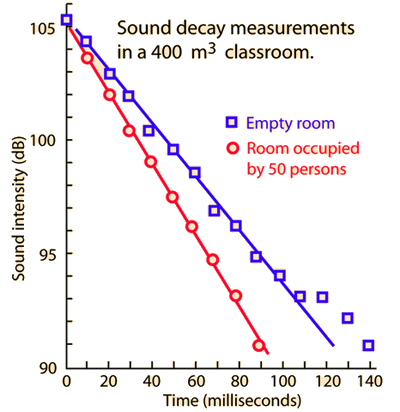
Measurements of sound decay in a classroom (Jesse, see ref) showed that the sound intensity in decibels dropped off linearly with time. Since decibels are a logarithmic quantity, this implies an exponential decay of the sound. These plots can be extrapolated to give reverberation times for the room, which amount to about 0.5 s for the empty room and about 0.4 s for the occupied room.
对教室中声音衰减的测量(Jesse,见参考文献)表明,声音的分贝数随时间线性下降。由于分贝是 logarithmic 量,这说明声音呈指数衰减。这些图可以外推得到房间的混响时间,空房间约为 0.5 s,有人房间约为 0.4 s。
Measured sound field of a small loudspeaker
小扬声器的声场测量
Estimating reverberation time from sound decay
从声音衰减估计混响时间
Index

Auditorium acoustics

Reference
Jesse
索引 声学参考 贾西
 
HyperPhysics***** Sound
HyperPhysics ***** 声音
R Nave
Go Back
返回