Bilingual edition: English is preserved and Chinese follows each unit. Terminology uses the confirmed v20260916 glossary; automated semantic review remains traceable.
中英双语版:英文原文完整保留,中文紧随对应单元;术语采用 v20260916 确认表,自动语义审校结果可追溯。

Reverberation Time

混响时间

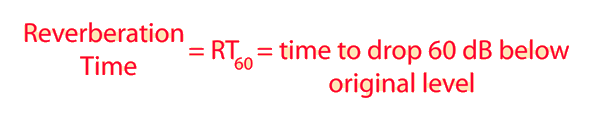
The reverberant sound in an auditorium dies away with time as the sound energy is absorbed by multiple interactions with the surfaces of the room. In a more reflective room, it will take longer for the sound to die away and the room is said to be 'live'. In a very absorbent room, the sound will die away quickly and the room will be described as acoustically 'dead'. But the time for reverberation to completely die away will depend upon how loud the sound was to begin with, and will also depend upon the acuity of the hearing of the observer. In order to provide a reproducible parameter, a standard reverberation time has been defined as the time for the sound to die away to a level 60 decibels below its original level. The reverberation time can be modeled to permit an approximate calculation. .
礼堂中的混响声会随着时间的推移逐渐消失,因为声音能量会通过与房间表面的多次相互作用而被吸收。在更反射的房间中,声音消失所需的时间会更长,这样的房间被称为‘活’。而在非常吸音的房间中,声音会迅速消失,这样的房间则被描述为‘死’。然而,混响完全消失所需的时间取决于声音最初有多大,也取决于观察者的听觉敏锐度。为了提供一个可重复的参数,已定义了一个标准的混响时间,即声音衰减到原始水平60分贝以下所需的时间。混响时间可以被建模以允许近似计算。
Why 60 dB?
为什么是60分贝?
What is a desirable reverberation time?
什么是理想的混响时间?
Calculation
计算
Index

Auditorium acoustics
索引 声学礼堂
 
HyperPhysics***** Sound
HyperPhysics ***** 声音
R Nave
Go Back
返回


Rationale for 60dB Reverberation Time

60dB混响时间的合理性

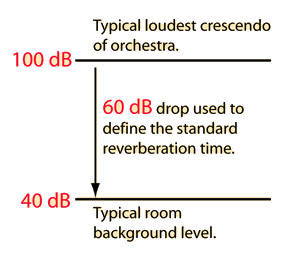
The reverberation time is perceived as the time for the sound to die away after the sound source ceases, but that of course depends upon the intensity of the sound. To have a reproducible parameter to characterize an auditorium which is independent of the intensity of the test sound, it is necessary to define a standard reverberation time in terms of the drop in intensity from the original level, i.e., to define it in terms of relative intensity.

混响时间被感知为声音在声源停止后衰减所需的时间,但这当然取决于声音的强度。为了获得一个与测试声音强度无关、能够表征一个音乐厅的可重复参数,有必要以声音从原始水平下降的幅度来定义标准的混响时间,即以相对强度来定义。
The choice of the relative intensity to use is of course arbitrary, but there is a good rationale for using 60 dB since the loudest crescendo for most orchestral music is about 100 dB and a typical room background level for a good music-making area is about 40 dB. Thus the standard reverberation time is seen to be about the time for the loudest crescendo of the orchestra to die away to the level of the room background. The 60 dB range is about the range of dynamic levels for orchestral music.
选择使用的相对强度当然是任意的,但使用60分贝是有充分理由的,因为大多数管弦乐的最响亮的高潮大约是100分贝,而一个良好的音乐演奏区域的典型背景水平大约是40分贝。因此,标准的混响时间被看作是管弦乐最响亮的高潮衰减到房间背景水平所需的时间。60分贝的范围大约是管弦乐音乐的动态水平范围。
What is a desirable reverberation time?
什么是理想的混响时间?
Index

Auditorium acoustics
索引 声学礼堂
 
HyperPhysics***** Sound
HyperPhysics ***** 声音
R Nave
Go Back
返回


What is a desirable reverberation time?

什么是理想的混响时间?

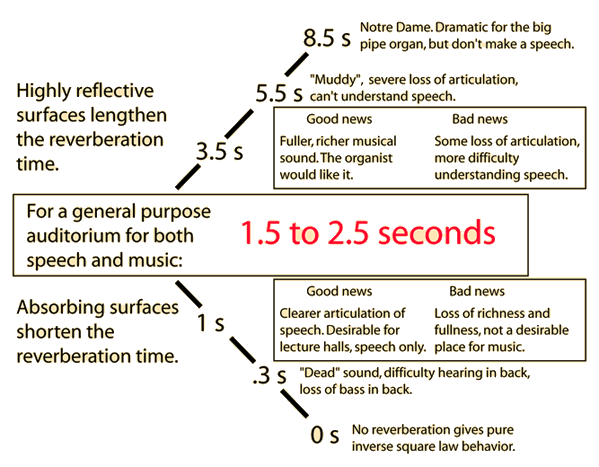
The optimum reverberation time for an auditorium or room of course depends upon its intended use. Around 2 seconds is desirable for a medium-sized, general purpose auditorium that is to be used for both speech and music. A classroom should be much shorter, less than a second. And a recording studio should minimize reverberation time in most cases for clarity of recording.

一个礼堂或房间的最优混响时间当然取决于其预定用途。对于一个中等大小、通用的礼堂,如果用于演讲和音乐,大约2秒是理想的。而教室应该明显更短,不到1秒。录音室应尽量减少混响时间,以保证录音的清晰度。

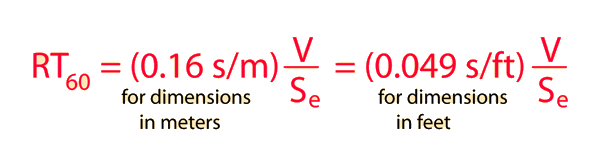
The reverberation time is strongly influenced by the absorption coefficients of the surfaces as suggested in the illustration, but it also depends upon the volume of the room as shown in the Sabine formula. You won't get a long reverberation time with a small room.

混响时间强烈地受到房间表面吸收系数的影响,如图所示,但它也取决于房间的体积,如萨宾公式所示。你不会在小房间中得到较长的混响时间。
Reverberation time definition
混响时间定义
Examples
示例
Index

Auditorium acoustics
索引 声学礼堂
 
HyperPhysics***** Sound
HyperPhysics ***** 声音
R Nave
Go Back
返回


Reverberation Time Calculation

混响时间计算

Approximate reverberation times can be calculated from the Sabine formula:

近似的混响时间可以用萨宾公式计算:
Modeling a room of

Height H =m = ft

高度 H = m = ft
中文译文中的待填/计算数值依次对应:1:h 2:hc。实际数值以上方原输入框为准。

Length L =m = ft

长度 L = m = ft
中文译文中的待填/计算数值依次对应:1:l 2:lc。实际数值以上方原输入框为准。

Width W =m = ft

宽度 W = m = ft
中文译文中的待填/计算数值依次对应:1:w 2:wc。实际数值以上方原输入框为准。

with absorption coefficients:

吸收系数:
建模一个房间的
awalls=,
a walls = ,(专名或术语)
中文译文中的待填/计算数值依次对应:1:aw。实际数值以上方原输入框为准。
afloor
地板
=,aceiling
天花板
= for average of
等于平均
中文译文中的待填/计算数值依次对应:1:ac。实际数值以上方原输入框为准。
aavg
平均加速度
=
gives an effective absorbing area of Se
提供有效的吸收面积 S e
=m2 = ft2
= m² = ft²
中文译文中的待填/计算数值依次对应:1:se 2:sec。实际数值以上方原输入框为准。
for a room of volume V =m3 = ft3.
对于体积为 V = m³ = ft³ 的房间。
中文译文中的待填/计算数值依次对应:1:v 2:vc。实际数值以上方原输入框为准。
The corresponding reverberation time is
相应的混响时间是
RT60
RT60
=seconds.
等于秒。
中文译文中的待填/计算数值依次对应:1:rt。实际数值以上方原输入框为准。
Reverberation time definition
混响时间定义
Table of absorption coefficients
吸收系数表
Examples
示例
Index

Auditorium acoustics
索引 声学礼堂
 
HyperPhysics***** Sound
HyperPhysics ***** 声音
R Nave
Go Back
返回


Examples of Reverberation Times

混响时间的例子

One way to respond to the question "What is a good range of reverberation times for concert halls?" is to give examples of some of the most famous halls in the world. For the overall average reverberation times:

回答“音乐会厅的混响时间应为多长”这个问题的一种方法是举例说明世界上一些最著名的厅。对于总体平均的混响时间:
  • Vienna, Musikvereinsaal : 2.05 seconds
    维也纳,音乐协会大厅:2.05秒
  • Boston, Symphony Hall: 1.8 seconds
    波士顿,交响乐大厅:1.8秒
  • New York, Carnegie Hall: 1.7 seconds
    纽约,卡内基音乐厅:1.7秒

But the overall average reverberation time does not tell the whole story. The variation of reverberation time with frequency is also important.:

但总体的混响时间并不能讲完全部故事。混响时间与频率的变化也很重要。
Examples of the variation of reverberation time with frequency
不同频率下混响时间变化的例子
Index

Auditorium acoustics
索引 声学礼堂
 
HyperPhysics***** Sound
HyperPhysics ***** 声音
R Nave
Go Back
返回


计算模块中未附着于文字的输入框:
中文译文中的待填/计算数值依次对应:1:af 2:aa。实际数值以上方原输入框为准。