Hydrogen-Helium Abundance
氢-氦丰度
Hydrogen and helium account for nearly all the nuclear matter in today's universe. This is consistent with the standard or "big bang" model. The process of forming the hydrogen and helium and other trace constituents is often called "big bang nucleosynthesis". Schramm's figures for relative abundances indicate that helium is about 25% by mass and hydrogen about 73% with all other elements constituting less than 2%. Carroll & Ostlie give 23 to 24% helium. There is a window of uncertainty, but it is clear that hydrogen and helium make up 98% plus of the ordinary matter in the universe. This high percentage of helium argues strongly for the big bang model, since other models gave very small percentages of helium. Since there is no known process which significantly changes this H/He ratio, it is taken to be the ratio which existed at the time when the deuteron became stable in the expansion of the universe. This ratio is significant as a test of cosmological models since it will be affected by the time period from the time when the temperature dropped below that necessary to produce neutrons from protons to the time when the deuteron became stable, halting the decay of the free neutrons.
氢和氦几乎构成了今天宇宙中所有的核物质。这与标准或“大爆炸”模型是一致的。形成氢、氦和其他痕量成分的过程通常被称为“大爆炸核合成”。Schramm的相对丰度数据表明,氦约占质量的25%,氢约占73%,其他所有元素加起来不到2%。Carroll和Ostlie给出的氦比例是23%到24%。存在一定的不确定性范围,但可以明确的是,氢和氦构成了宇宙中普通物质的98%以上。这种高比例的氦强烈支持大爆炸模型,因为其他模型给出的氦比例非常小。由于目前没有已知的过程能显著改变这个H/He比例,因此认为这个比例是在宇宙膨胀过程中氘变得稳定的时刻存在的比例。这个比例对于检验宇宙学模型具有重要意义,因为它会受到从温度下降到足以从质子中产生中子的时刻到氘变得稳定的时刻之间的时期的影响。
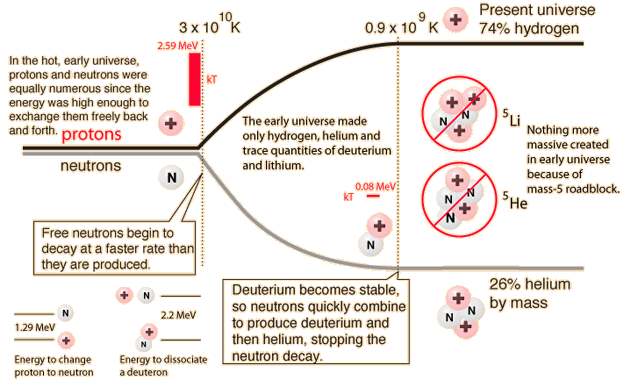
Basically , the hydrogen-helium abundance helps us to model the expansion rate of the early universe. If it had been faster, there would be more neutrons and more helium. If it had been slower, more of the free neutrons would have decayed before the deuterium stability point and there would be less helium.
基本上,氢和氦的丰度帮助我们建模早期宇宙的膨胀速率。如果膨胀得更快,就会有更多中子和更多氦。如果膨胀得更慢,自由中子会在氘稳定点之前更多地衰变,从而导致氦更少。

|
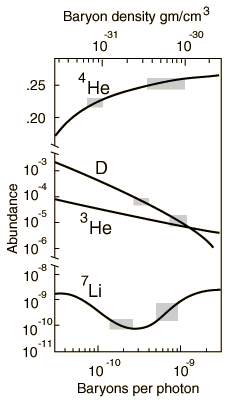
The modeling of the production of helium and the hydrogen-helium ratio also makes predictions about other nuclear species, particularly 7Li, 2H(deuterium) and 3He. These observed abundances simultaneously fit the big bang model within a narrow range. The shaded areas represent measurements from regions which have a very small abundance of heavy elements, so that they seem to be good samples of primordial abundances. Besides being a sensitive test of the big bang model, the abundance of helium also correlates best with three types of neutrinos, rather than two or four. The presence of another neutrino species, and thus another round of leptons would give a higher helium abundance by about a percent.
氦的产生模型以及氢-氦比值的预测也涉及其他核种,特别是7Li、2H(氘)和3He。这些观测到的丰度同时符合大爆炸模型在一个狭窄的范围内。阴影区域代表的是重元素非常稀少的区域,因此似乎能很好地代表原初丰度。除了对大爆炸模型的敏感检验外,氦的丰度还最好地与三种中微子类型相关联,而不是两种或四种。另一种中微子种类的存在,以及由此带来的额外莱pton,会使氦的丰度增加约1%。
The ratio of the number of baryons per photon was one of the contributions of the discovery of the 3K background radiation. Those measurements permitted a calculation of the photon energy density in the universe and the range of estimates for baryon density gave a baryon/photon ration of about 10-9.
重子与光子的数量比是发现3K背景辐射的一项贡献。这些测量结果允许计算宇宙中的光子能量密度,而重子密度的估计范围给出了重子/光子比约为10⁻⁹。
Data from Boesgaard, A. M. and Steigman, G., "Big Bang nucleasynthesis: Theories and Observations", Ann. Rev. Astron. and Astrophys. 23, 319 (1985).
Boesgaard, A. M. 和 Steigman, G. 的数据来自『大爆炸核合成:理论与观测』,Ann. Rev. Astron. and Astrophys. 23, 319 (1985)。
|
|
Index
References
Trefil
Schramm
Big Bang ...
Harwit
Ch 12
Carroll & Ostlie
Ch 29
索引 参考文献 Trefil Schramm 大爆炸 ... Harwit 第12章 Carroll & Ostlie 第29章 |
