Physical Keys to Cosmology宇宙学的物理钥匙
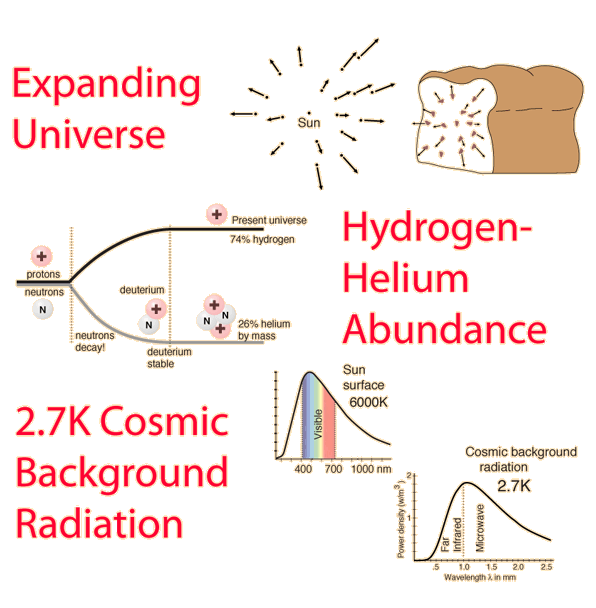
Only in the latter half of the 20th Century was enough physical evidence accumulated to make reasonable models of the formation process of the universe. The present standard model, the "big bang" model, was developed around three major pieces of experimental evidence: 只有到20世纪后期,才积累了足够的物理证据,使得能够建立合理的宇宙形成过程模型。目前的标准模型——“大爆炸”模型,是在三大主要实验证据的基础上发展的:
![]() As with most models of nature, it has seen successive refinements and has presented significant difficulties which fuel further investigation. 如同大多数自然模型一样,它经历了不断的完善,并提出了重大挑战,从而推动了进一步的研究。
One of the fascinating aspects of cosmological modeling is that it reveals a number of balances of parameters which must be maintained quite precisely for the universe as we know it to exist. Some of these balances are explored in an open-ended section on the "windows of creation". 宇宙学建模的一个引人入胜之处在于,它揭示了若干必须精确维持的参数平衡,这些平衡对于我们所知的宇宙存在至关重要。其中一些平衡在“创世之窗”开放性章节中得到了探讨。
|
Index Reference Weinberg 索引 参考 Weinberg | ||
|
Go Back
返回 |
Cosmology宇宙学
The standard cosmological model is the "big bang", and while the evidence supporting that model is enormous, it is not without problems. Trefil in The Moment of Creation does a nice job of pointing out those problems. 标准的宇宙模型是‘大爆炸’,尽管支持该模型的证据极为充分,但它也并非没有问题。Trefil在《创造之刻》中很好地指出了这些问题。
|
Index Reference Trefil 索引参考 Trefil | ||||
|
Go Back
返回 |
The Antimatter Problem反物质问题
Why such a predominance of matter over antimatter in the universe? From Trefil, pg 38. "after the beginning of the particle era. there is no known process which can change the net particle number of the universe" " ..by the time the universe is a millisecond old, the balance between matter and antimatter is fixed forever." 为什么宇宙中物质多于反物质?引自Trefil,第38页。'在粒子时代开始之后,目前尚无已知的过程能够改变宇宙中粒子总数。' '到宇宙年龄为毫秒的时候,物质与反物质之间的平衡将永远固定。
A basic part of the Standard Model for matter in the universe is the idea of pair-production. It is demonstrated by electron-positron pair production. A common type of interaction between high energy X-rays or gamma-rays and ordinary atoms converts most of the energy of the photon into an electron and its antiparticle, the positron. The masses of the particles follow the Einstein relationship E=mc2. The mass produced has an exactly equal number of electrons and positrons, so if all the processes of mass production were such pair production processes, there would be exactly the same amount of matter and antimatter in the universe. Clearly there is some asymmetry in the way nature treats matter and antimatter. One promising line of investigation is that of CP symmetry violations in the decay of particles by the weak interaction. The main expermental evidence comes from the decay of neutral kaons, which shows a small violation of CP symmetry. In the decay of the kaons to electrons, we have a clear distinction between matter and antimatter, and this could be at least one of the keys to the predominance of matter over antimatter in the universe. 显然,自然界在对待物质和反物质的方式上存在某种不对称性。一个有希望的研究方向是弱相互作用中粒子衰变的CP对称性破缺。主要的实验证据来自中性K介子的衰变,这显示出对CP对称性的轻微破缺。在K介子衰变为电子的过程中,我们可以清楚地区分物质和反物质,这可能是物质在宇宙中占主导地位的一个关键因素。
A new discovery at the Large Hadron Collider is a 0.8% difference in the decay rate of the D-meson and its antiparticle, which could be another contribution to the solution of the antimatter problem. 在大型强子对撞机上的一项新发现显示,D介子及其反粒子的衰变率存在0.8%的差异,这可能是解决反物质问题的一个贡献。
宇宙中物质的标准模型的一个基本部分是反物质对产生这一概念。这一概念通过电子-正电子对产生来演示。高能X射线或伽马射线与普通原子之间的常见相互作用,将光子的大部分能量转化为一个电子及其反粒子——正电子。粒子的质量遵循爱因斯坦关系E=mc²。产生的质量中电子和正电子的数量完全相等,因此如果所有质量产生过程都是这种对产生过程,那么宇宙中物质和反物质的数量将完全相同。 |
Index Reference Trefil CERN 索引参考Trefil CERN | ||
|
Go Back
返回 |
The Galaxy Formation Problem星系形成问题
Random nonuniformities in the expanding universe are not sufficient to allow the formation of galaxies. In the presence of the rapid expansion, the gravitational attraction is too slow for galaxies to form with any reasonable model of turbulence created by the expansion itself. "..the question of how the large-scale structure of the universe could have come into being has been a major unsolved problem in cosmology" Trefil p43 "we are forced to look to the period before 1 millisecond to explain the existence of galaxies." 在宇宙膨胀过程中,随机的非均匀性不足以使星系形成。在快速膨胀的背景下,引力作用太弱,无法用由膨胀自身产生的湍流模型合理地形成星系。‘‘如何解释宇宙大尺度结构的形成’’一直是宇宙学中一个主要的未解问题’’Trefil p43’’‘‘我们必须追溯到大爆炸后1毫秒之前的时代来解释星系的存在。
|
Index Reference Trefil 索引参考 Trefil | ||
|
Go Back
返回 |
The Horizon Problem视界问题
The microwave background radiation from opposite directions in the sky is characterized by the same temperature within 0.01%, but the regions of space from which they were emitted at 500,000 years were more than light transit time apart and could not have "communicated" with each other to establish the apparent thermal equilibrium - they were beyond each other's "horizon". 来自天空相反方向的微波背景辐射在温度上相差不超过0.01%,但它们在50万年时发出的空间区域相距超过光传播时间,无法相互“通信”以建立看似热平衡的外观——它们彼此处于对方的“视界”之外。
This situation is also referred to as the "isotropy problem", since the background radiation reaching us from all directions in space is so nearly isotropic. One way of expressing the problem is to say that the temperature of parts of space in opposite directions from us is almost exactly the same, but how could they be in thermal equilibrium with each other if they cannot communicate with each other? If you considered the ultimate lookback time as 14 billion years (14 thousand million ) as obtained from a Hubble constant of 71 km/s per megaparsec as suggested by WMAP , then these remote parts of the universe are 28 billion light years apart, so why do they have exactly the same temperature? 这种情形也被称为“各向同性问题”,因为来自空间各个方向的背景辐射几乎呈各向同性。一种表达这个问题的方式是说,相对于我们来说,在相反方向的空间部分的温度几乎完全相同,但它们如何能相互热平衡呢?如果考虑到最终的回溯时间是140亿年(14000万年),如由WMAP建议的哈勃常数71 km/s per megaparsec得出的数值,那么宇宙中这些遥远的部分相距280亿光年,那么为什么它们的温度却完全相同?
Being twice the age of the universe apart is enough to make the point about the horizon problem, but as Schramm points out, if you look at this problem from earlier perspectives it is even more severe. At the time the photons were actually emitted, they would have been 100 times the age of the universe apart, or 100 times causally disconnected. 与宇宙年龄相差两倍的距离足以说明视界问题,但如Schramm指出的,如果从更早的视角来看,这个问题更为严重。当光子实际被发射时,它们之间的距离将是宇宙年龄的100倍,或者说它们之间有100倍的因果断开。
This problem is one of the lines of thought which led to the inflationary hypothesis put forth by Alan Guth in the early 1980's. The answer to the horizon problem from the inflationary point of view is that there was a period of incredibly rapid inflation very early in the big bang process which increased the size of the universe by 1020 or 1030, and that the present observable universe is "inside" that expansion. The radiation we see is isotropic because all that space "inflated" from a tiny volume and had essentially identical initial conditions. This is a way to explain why parts of the universe so distant that they could never have communicated with each other look the same. 这个问题是导致1980年代初阿尔文·古特提出的暴胀假说的若干思路之一。从暴胀的观点来看,解决视界问题的答案是,在大爆炸过程的早期有一个极其迅速的暴胀时期,使宇宙的尺寸增加了10²⁰或10³⁰倍,并且当前可观测的宇宙位于该膨胀过程中。我们所看到的辐射是各向同性的,因为所有那个空间从一个极小的体积膨胀而来,并且具有基本上相同的初始条件。这是解释为什么那些彼此距离如此之远以至于从未能够相互通信的宇宙部分看起来却如此相似的一种方式。
|
Index Reference Trefil Kaufmann Guth Schramm 索引参考 Trefil Kaufmann Guth Schramm | ||
|
Go Back
返回 |
The Flatness Problem平坦性问题
Observations indicate that the amount of matter in the universe is surely greater than one-tenth and surely less than ten times the critical amount needed to stop the expansion. It is either barely open or barely closed, or "very nearly flat". There is a good analogy here - a ball thrown up from the earth slows down. With the same velocity from a small asteroid, it might never stop (Trefil pp46-47). Early in this theoretical toss from the asteroid, it might appear that you have thrown it with just the right velocity to go on forever, slowing toward zero velocity at infinite time and distance. But as time progressed, it would become more and more evident if you had missed the velocity window even a small amount. If after 20 billion years of travel, it still appeared that you had thrown it with the right velocity, then that original throw was precise indeed. 观测表明,宇宙中的物质总量肯定大于十分之一,肯定少于十倍的临界量,这是阻止膨胀所需的量。它要么略微开放,要么略微封闭,或者“非常接近平坦”。这里有一个很好的类比——从地球抛出一个球,它会逐渐减速。如果从一个小天体以同样的速度抛出,它可能永远不会停止(Trefil pp46-47)。在从天体开始的理论投掷早期,它可能看起来像是你以恰好正确的速度投出,使它永远持续下去,逐渐减速至无限时间与距离下趋于零速度。但随着时间推移,会越来越明显,如果你甚至稍微偏离了速度窗口,就会被察觉。如果在200亿年旅行后,它仍然看起来像是你以正确速度投出,那么最初的投掷确实非常精确。
Any departures from "flatness" should become exaggerated with time, and at this stage of the universe, tiny irregularities should have been much amplified. If the density of the present universe appears to be very close to the critical density, then it must have been even closer to "flat" in earlier epochs. Alan Guth credits a lecture by Robert Dicke as one influence which put him on the "inflationary" path; Dicke pointed out that the flatness of todays universe would require that the universe be flat to one part in 1014 at one second after the big bang. Kaufmann suggests that right after the big bang, the density must have been equal to the critical density to 50 decimal places! 任何偏离“平坦性”的现象都应随着时间的推移而被放大,而在宇宙的这一阶段,微小的不规则性应当已经被显著放大。如果当前宇宙的密度看起来非常接近临界密度,那么在更早的时期它必须更接近“平坦”。阿兰·古特认为,罗伯特·迪克的一次讲座是他走上“暴胀”之路的一个影响因素;迪克指出,今天宇宙的平坦性要求在大爆炸后一秒钟时,宇宙的平坦性必须精确到小数点后10¹⁴位。卡夫曼则建议,大爆炸之后的瞬间,密度必须精确等于临界密度到小数点后50位。
In the early 1980's, Alan Guth proposed that there was a brief period of extremely rapid expansion following the Planck time of 10-43 seconds. This "inflationary model" was a way of dealing with both the flatness problem and the horizon problem. If the universe inflated by 20 to 30 orders of magnitude, then the properties of an extremely tiny volume which could have been considered to be intimately connected were spread over the whole of the known universe today, contributing both extreme flatness and the extremely isotropic nature of the cosmic background radiation. 20世纪80年代初,Alan Guth提出,在普朗克时间(10^-43秒)之后,有一个短暂的极快速膨胀期。这个"膨胀模型"是解决平坦性问题和视界问题的一种方法。如果宇宙膨胀了20到30个数量级,那么一个极小的体积的性质,原本可以被认为与整个已知宇宙今天所具有的性质密切相关,从而导致了极端的平坦性和宇宙背景辐射的极端各向同性。
|
Index Reference Trefil Guth Kaufmann Ch. 29 索引 参考 Trefil Guth Kaufmann 第29章 | ||
|
Go Back
返回 |