Bilingual edition: English is preserved and Chinese follows each unit. Terminology uses the confirmed v20260916 glossary; automated semantic review remains traceable.
中英双语版:英文原文完整保留,中文紧随对应单元;术语采用 v20260916 确认表,自动语义审校结果可追溯。

The Friedmann Equation

弗里德曼方程

Alexander Friedmann of Russia is credited with developing a dynamic equation for the expanding universe in the 1920s. This was a time when Einstein, Willem de Sitter of the Netherlands, and Georges Lemaitre of Belgium were also working on equations to model the universe. Friedmann developed it as a relativistic equation in the framework of general relativity, but the description here will be limited to a simplified, non-relativistic version based on Newton's laws.

俄罗斯的亚历山大·弗里德曼被公认为在20世纪20年代发展了描述膨胀宇宙的动态方程。当时,爱因斯坦、荷兰的威廉·德·西特和比利时的乔治·勒梅特也在研究用于建模宇宙的方程。弗里德曼是在广义相对论的框架内发展出这一方程的,但此处的描述将基于牛顿运动定律的简化非相对论版本进行限制。

Convenient forms of Friedmann's equation with which to examine the expansion time and temperature for a big bang model of the universe are
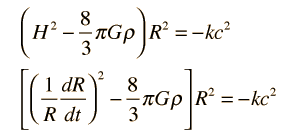
便于研究宇宙大爆炸模型中宇宙的膨胀时间与温度的弗里德曼方程的便捷形式是

Besides the density and gravitation constant G, the equation contains the Hubble parameter H, a scaling parameter R, and a factor k which is called the curvature parameter. The curvature parameter indicates whether the universe is open or closed. The above equations do not specify the nature of the density ρ. They do not include any particle interactions other than gravitational attraction. Such particle interactions, like collisions, could be specified in terms of pressure, so the model above is sometimes referred to as a "pressureless" universe. More detailed versions of the Friedman equation include such effects.

除了密度和引力常数G外,方程中还包含哈勃参数H,一个尺度参数R,以及一个称为曲率参数的因子k。曲率参数表明宇宙是开放的还是封闭的。上述方程未指定密度ρ的性质。它们不包含除引力作用以外的任何粒子相互作用。像碰撞这样的粒子相互作用可以以压力来表示,因此上述模型有时被称为“无压力”宇宙。更详细的弗里德曼方程则包括此类效应。

Einstein considered adding another term, the famous (or infamous) cosmological constant which would produce a static universe.

爱因斯坦考虑加入另一个项,即著名的(或臭名昭著的)宇宙常数,它将产生一个静态的宇宙。
Relate to temperature and expansion time
与温度和膨胀时间相关
Index

References
Rohlf
Ch. 19
Kaufmann
Ch. 28
索引参考Rohlf第19章和Kaufmann第28章
 
HyperPhysics***** Astrophysics
HyperPhysics ***** 天体物理学
R Nave
Go Back
返回


The Curvature Parameter

曲率参数

The Friedmann equation which models the expanding universe has a parameter k called the curvature parameter which is indicative of the rate of expansion and whether or not that expansion rate is increasing or decreasing. It indicates the future fate of the universe.

  • If k = 0 then the density is equal to a critical value at which the universe will expand forever at a decreasing rate. This is often referred to as the Einstein-de Sitter universe in recognition of their work in modeling it. This k = 0 condition can be used to express the critical density in terms of the present value of the Hubble parameter.
    如果k = 0,则密度等于一个临界值,此时宇宙将永远膨胀,但膨胀速率不断减小。这通常被称为爱因斯坦-德·西特宇宙,以纪念他们对这一模型的研究。这个k = 0条件可以用来用当前哈勃参数的值来表达临界密度。

    弗里德曼方程描述的是膨胀的宇宙,其中有一个称为曲率参数k的参数,它反映了膨胀的速率以及该膨胀速率是增加还是减少。它也指示了宇宙的未来命运。
  • For k > 0 the density is high enough that the gravitational attraction will eventually stop the expansion and it will collapse backward to a "big crunch". This kind of universe is described as being a closed universe, or a gravitationally bound universe.
  • For k < 0 the universe expands forever, there not being sufficient density for gravitational attraction to stop the expansion.

    当k < 0时,宇宙将永远膨胀,因为引力无法阻止膨胀,因为密度不足以使膨胀停止。
当k>0时,密度高到足以使引力最终阻止膨胀,使宇宙坍缩回一个‘大挤压’。这种宇宙被称为闭合宇宙,或引力束缚的宇宙。
Relate to temperature and expansion time
与温度和膨胀时间相关
Index

References
Rohlf
Ch. 19
Kaufmann
Ch. 28
索引参考Rohlf第19章和Kaufmann第28章
 
HyperPhysics***** Astrophysics
HyperPhysics ***** 天体物理学
R Nave
Go Back
返回


The Cosmological Constant

宇宙常数

Einstein proposed a modification of the Friedmann equation which models the expanding universe. He added a term which he called the cosmological constant, which puts the Friedmann equation in the form

爱因斯坦对弗里德曼方程提出了修改,该方程描述了膨胀的宇宙。他加入了一个他称为宇宙常数的项,使弗里德曼方程呈现出以下形式

The original motivation for the cosmological constant was to make possible a static universe which was isotropic and homogeneous. When the expansion of the universe was established without doubt, Einstein reportedly viewed the cosmological constant as the "worst mistake I ever made". But the idea of a cosmological constant is still under active discussion. Rohlf suggests that the physical interpretation of the cosmological constant was that vacuum fluctuations affected space time. A non-zero value for the cosmological constant could be implied from measurements of the volume densities of distant galaxies, but such measurements give a negative result, showing an upper bound of

宇宙学常数最初被提出是为了使一个静态、各向同性和各向均匀的宇宙成为可能。当宇宙膨胀的发现得到确认后,爱因斯坦据说将宇宙学常数视为‘我一生中最糟糕的错误’。但宇宙学常数的概念仍处于积极讨论之中。Rohlf认为,宇宙学常数的物理解释是真空涨落影响了时空。非零的宇宙学常数值可以从遥远星系体积密度的测量中推断出来,但这样的测量结果为负,表明了一个上限。

This implies that on the scale of the whole universe, vacuum fluctuation effects cancel out. This assessment comes at a time when theoretical calculations suggest vacuum fluctuation contributions from quarks on the order of 10-6 m-2.

这表明,在整个宇宙的尺度上,真空涨落效应会相互抵消。这一结论是在理论计算表明夸克的真空涨落贡献约为10^-6 m^-2的时期得出的。
Index

References
Rohlf
Ch. 19
Kaufmann
Ch. 28
索引参考Rohlf第19章和Kaufmann第28章
 
HyperPhysics***** Astrophysics
HyperPhysics ***** 天体物理学
R Nave
Go Back
返回


Critical Density for the Expanding Universe

膨胀宇宙的临界密度

If the curvature parameter in the Friedmann equation which models the expanding universe has the value k = 0, then the universe will expand forever with a decreasing rate of expansion. Under this condition, the Friedmann equation can be used to express the critical density of matter in the universe in terms of the current value of the Hubble parameter. The present value H0 is commonly called the Hubble constant.

如果弗里德曼方程中描述膨胀宇宙的曲率参数k取0值,那么宇宙将永远膨胀,且膨胀速率逐渐减小。在此条件下,弗里德曼方程可以用来将宇宙中物质的临界密度表示为当前哈勃参数的函数。当前值H₀通常称为哈勃常数。

It is common practice to express the density in terms of a density parameter Ω which is the ratio of density ρ to the critical density ρc. Currently quoted values are based on the WMAP results. More recent studies were made by the Planck satellite.

通常将密度表示为一个密度参数Ω,它等于密度ρ与临界密度ρ_c的比值。目前引用的值基于WMAP的结果。更近期的研究由普朗克卫星完成。
Density of luminous matter
光物质密度
Dark matter?
暗物质?
Index

References
Rohlf
Ch. 19
Kaufmann
Ch. 28
索引参考Rohlf第19章和Kaufmann第28章
 
HyperPhysics***** Astrophysics
HyperPhysics ***** 天体物理学
R Nave
Go Back
返回