Division of Energy Between Photons and Massive Particles光子与质量粒子之间的能量分配
One of the ideas associated with modeling the Big Bang is that the further back in time you project, the more the universe is dominated by photons. We think of today's universe as mostly matter, but the energy of the early universe was mostly photon energy with massive particles playing a very small role. 与大爆炸模型相关的概念之一是,当你向更早的时间回溯时,宇宙中光子占据主导地位。我们今天认为宇宙主要由物质组成,但早期宇宙的能量主要由光子能量构成,而大量粒子的作用则非常有限。
The amount of energy in radiation in today's universe can be estimated with the use of the Stefan- Boltzmann law, considering that the universe is filled with blackbody radiation at a temperature of 2.7 K. The energy density in this equilibrium radiation is given by 当今宇宙中辐射的能量量可以通过斯蒂芬-玻尔兹曼定律估算,考虑到宇宙中充满了温度为2.7 K的黑体辐射。这种平衡辐射的能量密度由
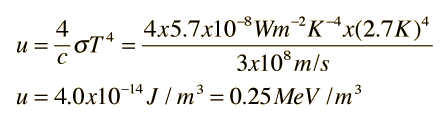
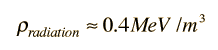
![]() There is also a background energy in neutrinos which is expected to have a temperature of about 1.9 K, and there are 7/4 as many of them as photons according to the standard model. Treating them as massless particles would give an energy density of about 0.11 MeV/m3, so the total energy density in photons and neutrinos is about 中微子中还存在一种背景能量,其温度预计为约1.9 K,并且根据标准模型,中微子的数量是光子的7/4倍。若将它们视为无质量粒子,则其能量密度约为0.11 MeV/m³,因此光子和中微子的总能量密度约为
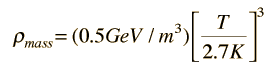
One current estimate of the amount of mass in the current universe is 当前宇宙中质量的当前估计值为

,Note that this energy in massive particles is that of ordinary baryonic matter, but the associated density falls far short of the critical density that apparently characterizes the universe. The density is typically expressed in terms of a density parameter, Ω.
需要注意的是,这些能量属于普通重子物质,但相应的密度远低于似乎特征化宇宙的临界密度。密度通常用密度参数 Ω 来表示。
因此,当前的估算表明,巨量粒子中的能量超过辐射中的能量一千倍。 |
Index Reference Rohlf Ch. 19 索引参考Rohlf第19章 | ||||
|
Go Back
返回 |
Temperature and Expansion Time in the Standard Big Bang Model标准大爆炸模型中的温度与膨胀时间
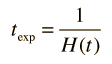
In the big bang model of the expansion of the universe, the expansion time can be expressed in terms of the Hubble parameter 在宇宙膨胀的大爆炸模型中,膨胀时间可以表示为哈勃参数的函数
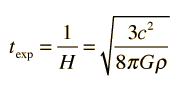
,and the Hubble parameter can be related to a model of expansion with the use of the Friedmann equation. 哈勃参数可以通过弗里德曼方程与膨胀模型相关联。
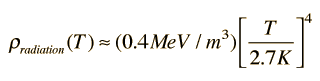
.For early stages of the expansion of the universe, it's energy density was dominated by radiation, with matter present only as a negligible contaminant. Under those conditions, the density in the Friedmann equation can be taken as that associated with the radiation field and related to the ratio of the temperature at a given time and the current temperature of the cosmic background radiation. This gives 在宇宙扩张的早期阶段,能量密度主要由辐射主导,物质仅作为可忽略的杂质存在。在这些条件下,弗里德曼方程中的密度可以视为与辐射场相关的密度,并与某一时刻温度与宇宙背景辐射当前温度的比值有关。这给出了
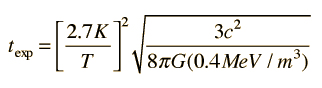
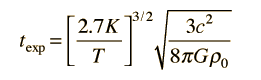
.The dependence on the fourth power of the temperature comes from the Stefan- Boltzmann law. Substituting into the Friedmann equation gives an expression of the expansion time as a function of temperature in the radiation-dominated early universe. 温度的四次方依赖性来源于斯特凡-玻尔兹曼定律。将其代入弗里德曼方程,可得到辐射主导早期宇宙中膨胀时间与温度的函数关系。
.The energy densities of radiation and matter are about equal at the temperature of the transparency point, about 3000 K. At much lower temperatures, the energy is dominated by matter. The energy density of the matter as a function of temperature is given by 在透明点温度,即约3000 K时,辐射和物质的能量密度大致相等。在远较低的温度下,能量主要由物质贡献。物质的能量密度随温度的变化关系如下:
.The resulting expression for expansion time from the Friedmann equation is then 从弗里德曼方程得出的膨胀时间的表达式然后是
.
|
Index Reference Rohlf Ch. 19 索引参考Rohlf第19章 | ||
|
Go Back
返回 |
Temperature, Expansion Time, and Energy Density in the Expanding Universe温度、膨胀时间与宇宙中的能量密度
In the radiation-dominated early universe where T>>3000K, the expansion time can be related to the temperature in the relationship: 在辐射占主导的早期宇宙中,当温度T远大于3000K时,膨胀时间可以与温度之间建立如下关系:
.
|
Index References Rohlf Ch. 19 Weinburg 索引参考Rohlf第19章和Weinburg | ||
|
Go Back
返回 |