H II Regions
H II 区域
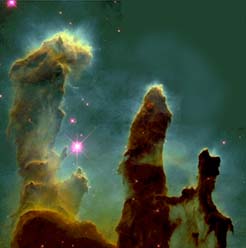
Areas in space which are luminous with the emission spectrum of ionized hydrogen are called H II regions. They are associated with the presence of massive O-type and B-type stars. Such stars, having surface temperatures in the range 15,000 - 30,000K, have characteristic blackbody radiation curves which peak in the ultraviolet. These stars will often be surrounded by vast clouds of hydrogen gas, and the uv can ionize the hydrogen atoms. These hydrogen atoms tend to attract electrons and reassemble, with the captured electrons cascading down through the quantum states of the hydrogen atom, emitting characteristic photons of light upon each downward jump. A characteristic visible color from such emission is red light at 656 nm associated with the n=3 to n=2 transition which is called H-alpha. Depending upon the recession velocity of the nebula, the light will be red-shifted, but many regions like the M16 region show a red glow characteristic of the hydrogen emissions. H II regions are associated with young star clusters, and are useful as a part of astronomical distance measurement.
在空间中,发出氢离子化发射谱的区域被称为H II区域。这些区域与大量O型和B型恒星的存在有关。这类恒星的表面温度在15,000 - 30,000K之间,具有特征性的黑体辐射曲线,其峰值在紫外光区。这些恒星常常被巨大的氢气云包围,紫外光可以电离氢原子。这些氢原子倾向于吸引电子并重新组合,捕获的电子会通过氢原子的量子态逐级跃迁,每次向下跃迁时都会发射特征性的光子。这种发射中的一种可见光是红光,波长为656 nm,对应n=3到n=2的跃迁,称为H-alpha。根据星云的退行速度,光会发生红移,但许多区域如M16区域显示出红光特征,这与氢的发射有关。H II区域与年轻星团有关,并且是天文学距离测量的重要工具。
|
Index
Star concepts
索引星概念 |