Bilingual edition: English is preserved and Chinese follows each unit. Terminology uses the confirmed v20260916 glossary; automated semantic review remains traceable.
中英双语版:英文原文完整保留,中文紧随对应单元;术语采用 v20260916 确认表,自动语义审校结果可追溯。

Microphones

麦克风

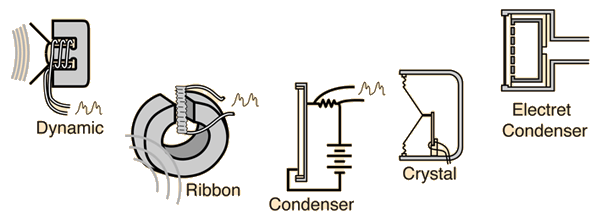
Microphones are transducers which detect sound signals and produce an electrical image of the sound, i.e., they produce a voltage or a current which is proportional to the sound signal. The most common microphones for musical use are dynamic, ribbon, or condenser microphones. Besides the variety of basic mechanisms, microphones can be designed with different directional patterns and different impedances.


This is an active graphic. Click for more detail.
麦克风是将声音信号转换为电信号的换能器,即它们产生一个电压或电流,该电压或电流与声音信号成正比。用于音乐的最常见麦克风是动圈式、ribbon式或电容器式麦克风。除了基本机制的多样性外,麦克风还可以设计成不同的指向性和不同的阻抗。这是一个主动图形。点击获取更多详情。
Index

Sound reproduction concepts
索引 声学再现概念
 
HyperPhysics***** Sound
HyperPhysics ***** 声音
R Nave
Go Back
返回


Dynamic Microphones

动态电容麦克风
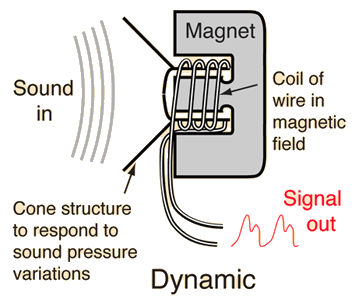
Principle: sound moves the cone and the attached coil of wire moves in the field of a magnet. The generator effect produces a voltage which "images" the sound pressure variation - characterized as a pressure microphone.

原理:声音使锥体移动,附加的线圈在磁体的磁场中运动。发电机效应产生一个电压,该电压‘映射’声音压力的变化——这被描述为一种压力麦克风。
Advantages:
  • Relatively cheap and rugged.
    相对便宜且耐用。
  • Can be easily miniaturized.
    可以很容易地微型化。
Disadvantages:
  • The uniformity of response to different frequencies does not match that of the ribbon or condenser microphones.
    对不同频率的响应均匀性与ribbon或电容式麦克风不一致。
优点:缺点:

The geometry of a dynamic microphone is like that of a tiny loudspeaker, and that is not just a coincidence. A dynamic microphone is essentially the inverse of a dynamic loudspeaker. In a dynamic microphone, the sound pressure variations move the cone, which moves the attached coil of wire in a magnetic field, which generates a voltage. In the loudspeaker, the inverse happens: the electric current associated with the electrical image of the sound is driven through the coil in the magnetic field, generating a force on that coil. The coil moves in response to the audio signal, moving the cone and producing sound in the air.

动态麦克风的结构类似于一个小扬声器,这并非巧合。动态麦克风本质上是动态扬声器的逆过程。在动态麦克风中,声压的变化使锥体运动,这会带动附着的线圈在磁场中运动,从而产生电压。在扬声器中,情况相反:与声音的电信号图像相关的电流被驱动通过线圈在磁场中,从而对线圈产生力。线圈响应音频信号运动,带动锥体并产生空气中的声音。
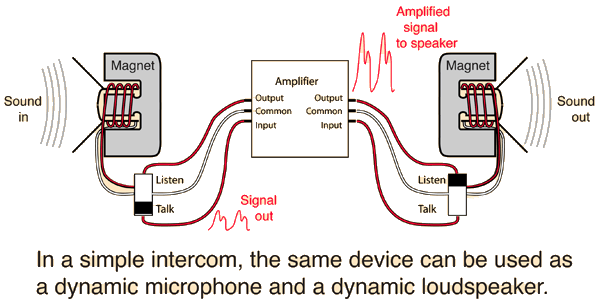
A small loudspeaker can be used as a dynamic microphone, and this fact is exploited in the construction of small intercom systems. Depending upon the position of the Talk-Listen switch, the device on either end of the intercom system can be used as a microphone or a loudspeaker. Of course, this is not a high fidelity process, and for commercial dynamic microphones, the device is optimized for use as a microphone, not a loudspeaker.

一个小扬声器可以作为动态麦克风使用,这一特性被用于构建小型对讲机系统。根据对讲机开关的位置,系统两端的设备可以作为麦克风或扬声器使用。当然,这并不是高保真过程,对于商用动态麦克风而言,该设备是优化用于作为麦克风,而非扬声器。
Microphone discussion
麦克风讨论
Index

Sound reproduction concepts
索引 声学再现概念
 
HyperPhysics***** Sound
HyperPhysics ***** 声音
R Nave
Go Back
返回


Ribbon Microphones

ribbon 麦克风

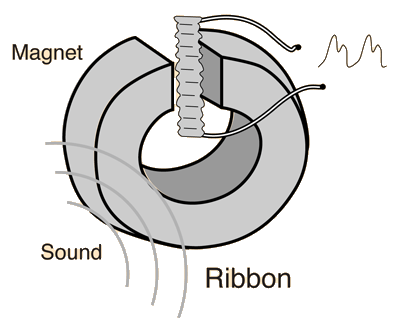
Principle: the air movement associated with the sound moves the metallic ribbon in the magnetic field, generating an imaging voltage between the ends of the ribbon which is proportional to the velocity of the ribbon - characterized as a "velocity" microphone.

原理:与声音相关的空气运动使金属带在磁场中移动,在金属带两端产生与带片速度成正比的感应电压,这种麦克风被称为'速度'麦克风。
Advantages:
  • Adds "warmth" to the tone by accenting lows when close-miked.
    通过强调低频声音来增强温暖感。
  • Can be used to discriminate against distant low frequency noise in its most common gradient form.
    可用于在最常见的梯度形式中区分远处的低频噪声。
Disadvantages:
  • Accenting lows sometimes produces "boomy" bass.
    强调低音有时会产生“浑厚”的低音。
  • Very susceptible to wind noise. Not suitable for outside use unless very well shielded.
    非常容易受到风噪的影响。除非有很好的屏蔽,否则不适合在户外使用。
Example of use
示例用法
优点:缺点:
Microphone discussion
麦克风讨论
Index

Sound reproduction concepts
索引 声学再现概念
 
HyperPhysics***** Sound
HyperPhysics ***** 声音
R Nave
Go Back
返回


Condenser Microphones

电容式麦克风

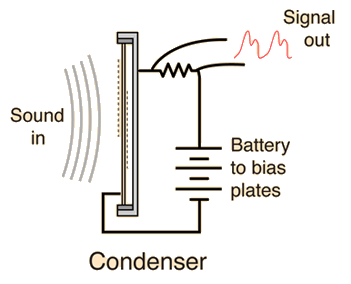
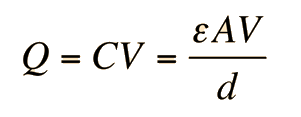
Principle: sound pressure changes the spacing between a thin metallic membrane and the stationary back plate. The plates are charged to a total charge

原理:声压会改变薄金属膜与静止后背板之间的间距。两块板均被充电至总电荷

where C is the capacitance, V the voltage of the biasing battery, A the area of each plate and d the separation of the plates.

其中,C 是电容,V 是偏压电池的电压,A 是每块板的面积,d 是板间的距离。
Advantages:
  • Best overall frequency response makes this the microphone of choice for many recording applications.
    整体频率响应最佳,因此这种麦克风成为许多录音应用的首选。
Disadvantages:
  • Expensive
    昂贵的
  • May pop and crack when close miked
    靠近麦克风时可能发出爆裂声
  • Requires a battery or external power supply to bias the plates.
    需要电池或外部电源来偏压板

A change in plate spacing will cause a change in charge Q and force a current through resistance R. This current "images" the sound pressure, making this a "pressure" microphone.

板间距的变化将导致电荷Q的变化,并迫使电流通过电阻R。这个电流‘映射’了声压,使这成为一个‘压力’麦克风。
Further discussion
进一步讨论
优点:缺点:
Pressure Zone Microphone Application
压力区麦克风应用
Microphone discussion
麦克风讨论
Index

Sound reproduction concepts
索引 声学再现概念
 
HyperPhysics***** Sound
HyperPhysics ***** 声音
R Nave
Go Back
返回