Bilingual edition: English is preserved and Chinese follows each unit. Terminology uses the confirmed v20260916 glossary; automated semantic review remains traceable.
中英双语版:英文原文完整保留,中文紧随对应单元;术语采用 v20260916 确认表,自动语义审校结果可追溯。

Potential Acoustic Gain

潜在声增益

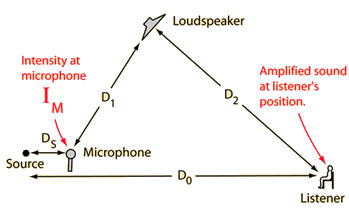
For a simple sound reinforcement system where the sound is assumed to drop off according to the inverse square law and the microphones and speakers are assumed to be omnidirectional, then the maximum achievable gain is determined by strictly geometric considerations. This simple case provides the framework for assessing what can be done in a real auditorium to increase the possible gain before feedback takes control.

对于一个简单的音响强化系统,假设声音按照反平方定律衰减,且麦克风和扬声器均为全向性,则最大可实现的增益由严格的几何考虑决定。这一简单情况为评估在实际礼堂中如何在反馈控制之前提高可能的增益提供了框架。
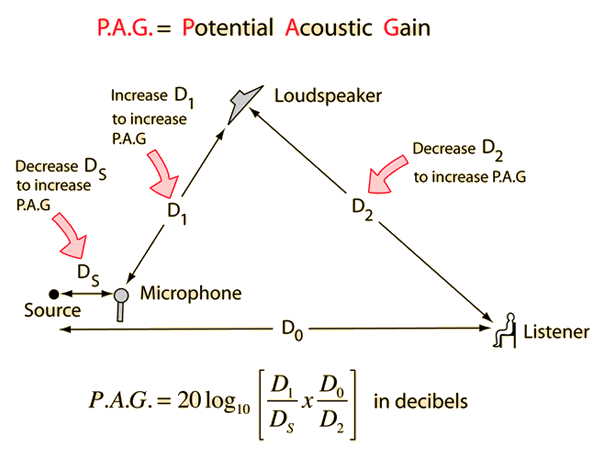
Calculation
计算
Derivation of expression
表达式的推导
More detail about how to increase P.A. G.
关于如何提高P.A. G.的更多细节
Index

Sound reproduction concepts
索引 声学再现概念
 
HyperPhysics***** Sound
HyperPhysics ***** 声音
R Nave
Go Back
返回


Developing the Potential Acoustic Gain Expression

发展潜在声增益表达式

The maximum amplified level at the listener is

听众处的最大放大电平
Show
显示

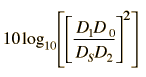
so the maximum gain in decibels is

因此,最大增益以分贝为单位是

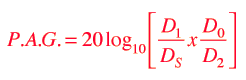
and bringing out the exponent gives

并带出指数得到
Calculate
计算
Index

Sound reproduction concepts
索引 声学再现概念
 
HyperPhysics***** Sound
HyperPhysics ***** 声音
R Nave
Go Back
返回


P.A.G. Expression Development

P.A.G. 表达式发展

According to the inverse square law, the sound intensity at the listener without amplification is

根据反平方定律,未经放大时听众处的声强是

and level at the listener which corresponds to giving a feedback level equal to the input is shown below.

并显示了听众处的电平,该电平对应于提供等于输入的反馈电平。

This inverse square law expression gives the level at the listener if the loudspeaker is returning exactly the same level IM to the microphone that was originally produced at the microphone by the sound source. That is, it is returning exactly as much as it got as input so that there is a closed loop of signal returning to the microphone.

这个反平方定律表达式给出了当扬声器将恰好与麦克风最初接收到的相同电平IM返回给麦克风时,听众处的电平。也就是说,它返回的信号量恰好等于输入的信号量,从而形成一个信号闭环返回到麦克风。

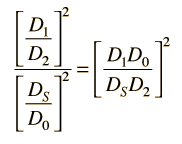
The ratio of these two levels is the maximum gain before reaching the feedback condition. This ratio is used to develop the P.A.G. expression.

这两个能级的比值是在达到反馈条件前的最大增益。这个比值用于推导P.A.G.表达式。
Potential Acoustic Gain
潜在声增益
Calculation
计算
Index

Sound reproduction concepts
索引 声学再现概念
 
HyperPhysics***** Sound
HyperPhysics ***** 声音
R Nave
Go Back
返回


Potential Acoustic Gain Calculation

声学增益计算

For distance values

对于距离值

DS =m=ft
D S = m= ft(专名或术语)
中文译文中的待填/计算数值依次对应:1:ds 2:dsc。实际数值以上方原输入框为准。

D1 =m=ft
D 1 = m= ft(专名或术语)
中文译文中的待填/计算数值依次对应:1:d1 2:d1c。实际数值以上方原输入框为准。

D0 =m=ft
D 0 = m= ft(专名或术语)
中文译文中的待填/计算数值依次对应:1:d0 2:d0c。实际数值以上方原输入框为准。

D2 =m=ft
D 2 = m= ft(专名或术语)
中文译文中的待填/计算数值依次对应:1:d2 2:d2c。实际数值以上方原输入框为准。

= dB

You may enter values for the relevant distances in the simplified sound amplification system. Unspecified values will default to the values in the example model. You can change any values to convince yourself that the P.A.G. can be increased by increasing the distance from microphone to loudspeaker. The gain can also be increased by decreasing the distance from loudspeaker to listener or the distance from the source to the microphone.

您可以输入相关距离的值进入简化的声放大系统。未指定的值将默认为示例模型中的值。您可以更改任何值以验证自己,即通过增加麦克风到扬声器的距离可以提高P.A.G.。此外,通过减少扬声器到听众的距离或声源到麦克风的距离也可以提高增益。
Simplified Amplification System
简化放大系统
Potential Acoustic Gain
潜在声增益
Index

Sound reproduction concepts
索引 声学再现概念
 
HyperPhysics***** Sound
HyperPhysics ***** 声音
R Nave
Go Back
返回


计算模块中未附着于文字的输入框:
中文译文中的待填/计算数值依次对应:1:pag。实际数值以上方原输入框为准。