The Limitation of Feedback反馈的局限性
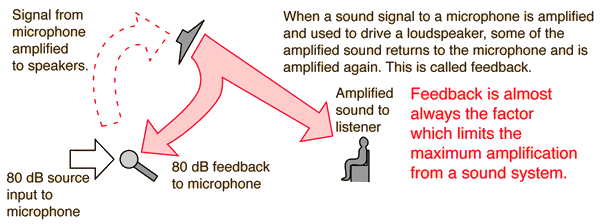
![]() If you speak one word at the microphone at a level of 80 dB and the loudspeaker returns that word to the microphone at 80 dB, then you can go home. The sound system will repeat the sound all day, "chasing its tail" from microphone to loudspeaker. 如果你在麦克风前说一个词,音量为80 dB,而扬声器将这个词再传回麦克风,音量仍为80 dB,那么你可以回家。声系统会全天重复播放,像在麦克风和扬声器之间来回追逐尾巴。
The situation depicted here is the theoretical maximum gain where the feedback signal is equal to the input signal. It is not practical to get this kind of gain, so you seek to stay considerably below this - at least 3dB is a common rule. Any time the feedback signal is comparable to the input signal, it represents a distortion or degradation of the signal. The amplified signal is coming back to the microphone with a delay and with whatever "coloring" the sound system and the room give to it. 这里所描绘的情况是理论上的最大增益,其中反馈信号等于输入信号。要达到这种增益在实际中是不现实的,因此你应尽量保持在这一水平以下——至少3dB是一个常见的规则。只要反馈信号与输入信号相当,就表示信号出现了失真或退化。放大后的信号会以延迟的方式返回到麦克风,并带有声音系统和房间所赋予的任何“色彩”。
|
Index Sound reproduction concepts 索引 声学再现概念 | ||
|
Go Back
返回 |
"Ringing the System"系统振铃
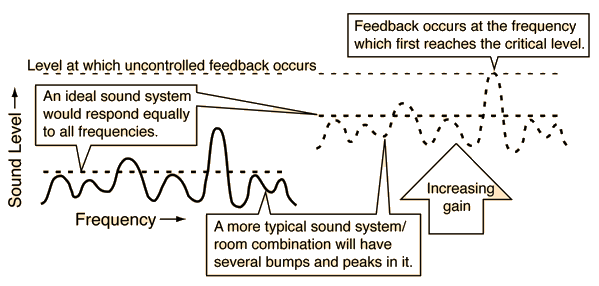
When the gain on a sound amplification system is turned too high, the output from the loudspeaker changes to an unpleasant, loud, usually high-pitched sound. This is the result of too much feedback, but instead of reproducing the sound being amplified, it usually produces a single pitch at the frequency which is amplified the most by the sound system/room combination. 当声音放大系统的增益调得过高时,扬声器会发出一种不愉快的、响亮的、通常为高频的声响。这是过多反馈的结果,但不同于再现被放大声音,它通常会产生一个频率,该频率是声系统/房间组合最显著放大频率的单一音调。
![]() Note that an ideal sound system responds equally to all frequencies. This not only gives a high fidelity reproduction of the sound, it also gives a higher potential acoustic gain from the amplifier system. The horizontal dashed line which represents the ideal system on the right above is still well short of the feedback level when the other system begins to ring. The procedure for filtering the frequency response to approach the ideal flat response is called equalization. 注意,一个理想的音响系统对所有频率都有相同响应。这不仅能够提供高保真的声音再现,还能使放大系统的声学增益潜力更高。右上方图中表示理想系统的水平虚线,当其他系统开始振铃时,仍远低于反馈电平。将频率响应过滤以接近理想平坦响应的程序称为均衡。
|
Index Sound reproduction concepts 索引 声学再现概念 | ||
|
Go Back
返回 |
Inverse Square Law Assumption平方反比定律假设
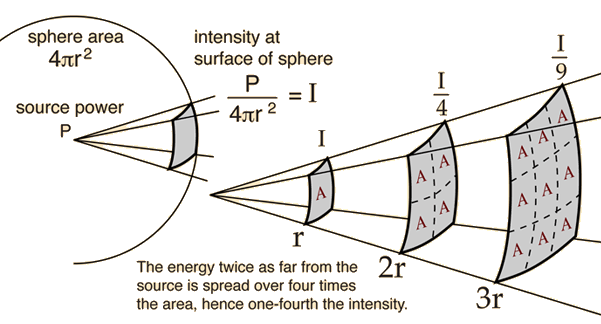
In the development of a simplified model for a sound amplification system, a starting assumption is that the sound drops off according to the inverse square law. Of course this is not true in the real auditorium because one of the primary goals in auditorium acoustics is to overcome the inverse square law with natural reverberation. Nevertheless, this assumption permits the calculation of an important limiting case so that the reverberation effects in real auditoriums can be assessed by comparison. 在开发一个简化的声音放大系统模型时,一个初始假设是声音的衰减遵循平方反比定律。当然,这在实际的音乐厅中并不成立,因为音乐厅声学的一个主要目标就是利用自然的混响来克服平方反比定律。然而,这一假设允许计算一个重要的极限情况,从而通过与实际音乐厅中的混响效果进行比较,来评估这些效果。
![]() |
Index Sound reproduction concepts 索引 声学再现概念 | ||
|
Go Back
返回 |
Omnidirectional Assumption全向假设
In the development of a simplified model for a sound amplification system, a starting assumption is that the microphones and loudspeakers are omnidirectional, i.e., their response is equal in all directions. Of course no real microphones or loudspeakers are truly omnidirectional, but this assumption permits the calculation of an important limiting case. Under this assumption, the potential acoustic gain of an amplification system can be calculated geometrically. Such a model forms a good base for assessing the improvements which can be made with directional microphones and directional speakers. 在建立一个简化的声音放大系统模型时,一个初始假设是麦克风和扬声器是全向的,即它们在各个方向上的响应都相同。当然,真实的麦克风或扬声器并非真正全向的,但这一假设允许计算一个重要极限情况。在这一假设下,可以几何地计算放大系统的潜在声学增益。这样的模型为评估使用定向麦克风和定向扬声器所能带来的改进提供了良好的基础。
|
Index Sound reproduction concepts 索引 声学再现概念 | ||
|
Go Back
返回 |