Bilingual edition: English is preserved and Chinese follows each unit. Terminology uses the confirmed v20260916 glossary; automated semantic review remains traceable.
中英双语版:英文原文完整保留,中文紧随对应单元;术语采用 v20260916 确认表,自动语义审校结果可追溯。

Back-to-Front Cancelation
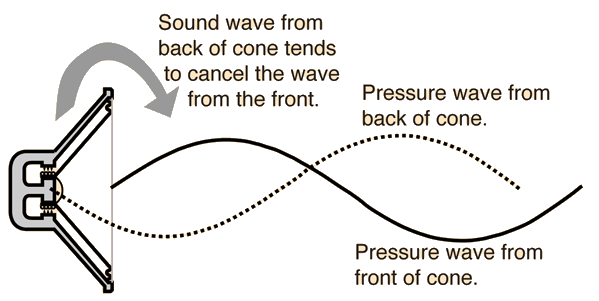
反向抵消

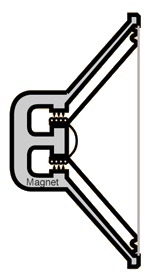
While the front surface of the cone of a loudspeaker is pushing forward to create a sound wave by increasing air pressure, the back surface of the cone is lowering the air pressure. Since the wavelengths of low frequency sound are large compared to the size of the speaker, and since those low frequencies readily diffract around the speaker cone, the sound wave from the back of the cone will tend to cancel that from the front of the cone. For most bass frequencies, the wavelength is so much longer than the speaker diameter that the phase difference approaches 180°, so there is severe loss of bass from this back-to-front cancelation.

当扬声器锥体的前表面推动空气以增加气压从而产生声波时,锥体的后表面则会降低气压。由于低频声波的波长远大于扬声器的尺寸,且这些低频声波容易绕过扬声器锥体发生衍射,因此从锥体后表面发出的声波倾向于与从前表面发出的声波相消。对于大多数低频声音,其波长远大于扬声器直径,因此相位差接近180°,由此导致严重的低音损失。

This is one of the reasons why even the best cone-type loudspeaker must have an enclosure to produce good sound.

这是即使最好的锥型扬声器也必须配备外壳以产生良好声音的原因之一。
Loudspeaker basics
扬声器基础
Index

Sound reproduction concepts

Loudspeaker concepts
索引 声学再现概念 扬声器概念
 
HyperPhysics***** Sound
HyperPhysics ***** 声音
R Nave
Go Back
返回


Loudspeaker Resonance

扬声器共振

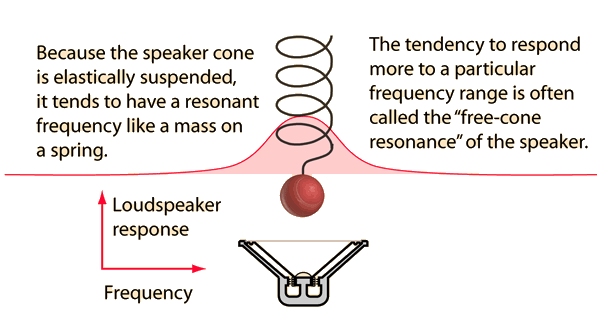
Direct-radiating cone-type loudspeakers must be mounted so that they are free to vibrate. This mounting is elastic, so there is an inherent resonant frequency of the speaker cone assembly -- like a mass on a spring. This free cone resonant frequency distorts the sound by responding more strongly to signals near its natural vibration frequency. This non-uniform response changes the frequency content in terms of the relative intensities of the harmonics and thus changes the timbre of the sound. Since the cone is undamped, it tends to produce "ringing" or "hangover" with frequencies near resonance. If the resonance is in the bass range, the bass will be "boomy".

直接辐射的锥形扬声器必须安装成可以自由振动。这种安装是弹性的,因此扬声器锥体组件有一个固有的共振频率——就像质量挂在弹簧上一样。这种自由锥体的共振频率会使声音产生失真,因为它对接近其自然振动频率的信号响应更强烈。这种非均匀的响应会改变频率成分,以相对谐波的强度变化而变化,从而改变声音的音色。由于锥体是无阻尼的,它倾向于在共振附近产生“回响”或“余音”。如果共振在低音范围,低音会显得“浑厚”。

Because of this inherent non-uniformity in frequency response, it is common practice to use two or three loudspeakers connected together by a crossover network to achieve a more-nearly uniform frequency response.

Loudspeaker basics
扬声器基础
由于频率响应的固有非均匀性,通常采用两个或三个扬声器通过滤波器网络连接,以实现更接近均匀的频率响应。
Index

Sound reproduction concepts

Loudspeaker concepts
索引 声学再现概念 扬声器概念
 
HyperPhysics***** Sound
HyperPhysics ***** 声音
R Nave
Go Back
返回


Coupling Loudspeaker to Air

将扬声器耦合到空气中

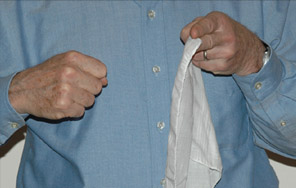
How hard can you punch a handkerchief? Not very hard, because it offers so little resistance. A loudspeaker has a similar problem when it tries to punch sound energy into the air. The usual language is that the speaker has a poor "impedance match" to the air.

你能有多大力气打一个手帕?并不大,因为它提供的阻力很小。当扬声器试图将声能注入空气中时,也有类似的问题。通常的说法是,扬声器与空气之间的‘阻抗匹配’较差。

A loudspeaker without an enclosure does a very poor job of producing sounds whose wavelengths are longer than the diameter of the loudspeaker. For an 8-inch speaker, diameter of speaker equals wavelength at about 1700 Hz. Even for a 16-inch speaker, the diameter equals the wavelength at 850 Hz.

没有 enclosure 的扬声器在产生波长比扬声器直径大的声音时表现非常差。对于一个8英寸的扬声器,其直径在约1700 Hz时等于波长。即使对于一个16英寸的扬声器,其直径在850 Hz时也等于波长。

Besides the severe bass loss, the overall efficiency of such loudspeakers is low, about 3-5% compared to 25-50% for well designed horn type loudspeakers.

除了低频响应严重衰减外,这类扬声器的总体效率也很低,仅为 horn 型扬声器(设计良好的)25-50% 的3-5%。
Loudspeaker basics
扬声器基础
Index

Sound reproduction concepts

Loudspeaker concepts
索引 声学再现概念 扬声器概念
 
HyperPhysics***** Sound
HyperPhysics ***** 声音
R Nave
Go Back
返回


Impedance Match to Air

与空气的阻抗匹配

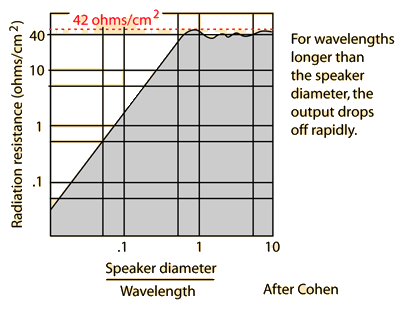
One of the reasons for the low efficiency of direct-radiating cone-type loudspeakers is the poor impedance match to the air that they are driving. The impedance which the air offers to the motion of a speaker cone can be mechanically modeled. The specific acoustic impedance of free air is approximately 42 ohms per square cm. For optimum efficiency the radiation resistance of the speaker cone should also be 42 ohms/cm2 , but for sound wavelengths longer than the diameter of the speaker, this impedance drops rapidly . The smaller the speaker, the poorer its low frequency production.

直接辐射锥形扬声器效率低的一个原因是其与所驱动的空气之间的阻抗不匹配。空气对扬声器振膜运动所呈现的阻抗可以机械地进行建模。自由空气的具体声阻抗约为42欧姆每平方厘米。为了获得最佳效率,扬声器振膜的辐射电阻也应为42欧姆每平方厘米,但当声波波长大于扬声器直径时,这种阻抗会迅速下降。扬声器越小,其低频表现越差。

A loudspeaker without an enclosure does a very poor job of producing sounds whose wavelengths are longer than the diameter of the loudspeaker. For an 8-inch speaker, diameter of speaker equals wavelength at about 1700 Hz. Even for a 16-inch speaker, the diameter equals the wavelength at 850 Hz.

没有 enclosure 的扬声器在产生波长比扬声器直径大的声音时表现非常差。对于一个8英寸的扬声器,其直径在约1700 Hz时等于波长。即使对于一个16英寸的扬声器,其直径在850 Hz时也等于波长。

This is one of the reasons why even the best cone-type loudspeaker must have an enclosure to produce good sound. The enclosure increases the effective size of the loudspeaker.

这是即使最好的锥型扬声器也必须配备外壳以产生良好声音的原因之一。外壳可以增加扬声器的有效尺寸。
Loudspeaker basics
扬声器基础
Index

Sound reproduction concepts

Loudspeaker concepts

Reference
Cohen
索引 声音再现概念 扬声器概念 参考 Cohen
 
HyperPhysics***** Sound
HyperPhysics ***** 声音
R Nave
Go Back
返回