Cyclic Electron Transport in Photosynthesis
Photophosphorylation refers to the use of light energy to ultimately provide the energy to convert ADP to ATP, thus replenishing the universal energy currency in living things. In the simplest systems in prokaryotes, photosynthesis is used just for the production of energy, and not for the building of any biological molecules. In these systems there is a process called cyclic photophosphorylation, which just accomplishes the ADP to ATP process for immediate energy for these cells. This process uses only Photosystem I and the chlorophyll P700.
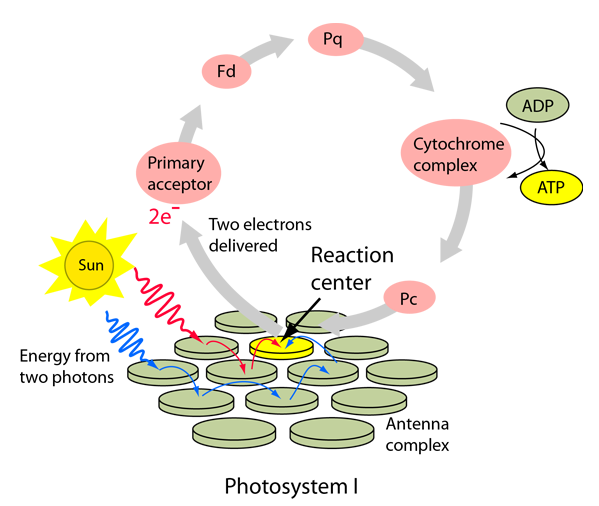
The above sketch of the cyclic process is patterned after a visualization in Moore, et al. Two photons from either the red or blue end of the spectrum fit the sensitive response of the pigments. They are captured by the antenna complex and transferred to the Photosystem I reaction center, which contributes two high energy electrons to the primary electron receptor. They are passed to ferrodoxin (Fd), an iron containing protein which acts as an electron carrier. A second electron carrier plastoquinone (Pq) carries the electrons to a complex of two cytochromes. In the process, energy is provided to produce a proton gradient across the membrane which can be used for the ADP to ATP conversion. The electrons are returned by plastocyanin (Pc) to the P700 pigment in the reaction center to complete the cycle.
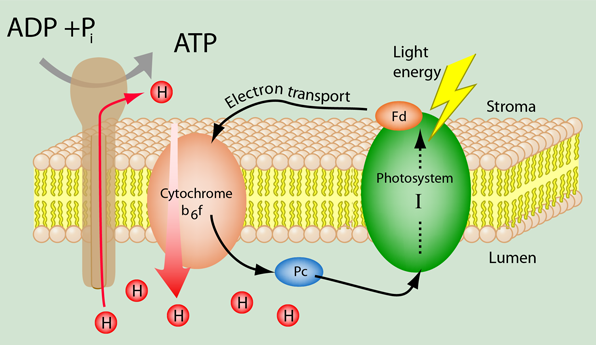
This sketch follows the lead of Karp to place the events relative to the membrane. This makes it clearer that the process of producing the ATP is driven by the proton gradient. Karp points out that this cyclic photophosphorylation also takes place in isolated chloroplasts and can provide additional ATP to aid the carbohydrate synthesis taking place as result of the non-cyclic electron transport.
| Energy cycle in living things
生物体的能量循环 |
Photosynthesis Concepts
Reference
Moore, et al.
Ch 7
Karp
Ch 6
| HyperPhysics***** Biology
HyperPhysics ***** 生物学 | R Nave |