Non-cyclic Electron Transport in Photosynthesis
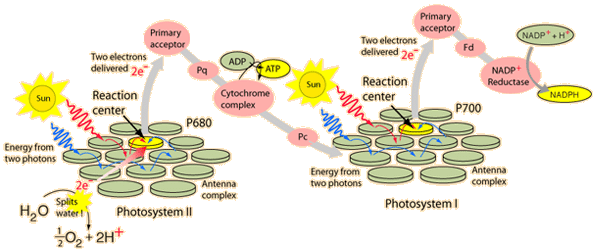
Photophosphorylation refers to the use of light energy to ultimately provide the energy to convert ADP to ATP, thus replenishing the universal energy currency in living things. In the simplest systems in prokaryotes, photosynthesis is used just for the production of energy, and not for the building of any biological molecules. But in plants the photosynthesis process also provides energy in the form of reduced coenzymes which drive the process of biochemical synthesis culminating in the production of glucose and other sugars. This process uses both Photosystem II and Photosystem I acting in series. The above illustration is patterned after Moore and shows some of the steps of the non-cyclic electron transport process.
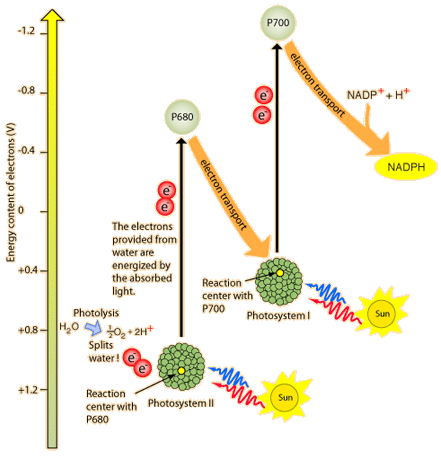 |
Another way to look at this two-stage process for providing the energy for building molecules is in terms of the electron energies measured in units of the redox potential in volts. This illustration, patterned after Karp, outlines the steps in the process with the position on the vertical axis indicating the level of energy attained. 另一种看待通过两阶段过程为分子构建提供能量的方式,是通过电子能量以伏特为单位的氧化还原电势来衡量。这种示意图借鉴了Karp的模式,以垂直轴上的位置表示所达到的能量水平。
The thylakoid membranes are the location for the electron transport interactions that make available the light energy for chemical processes. 类囊体膜是电子传递相互作用发生的地方,使光能可用于化学过程。
|
| How can a leaf split a water molecule!?
叶子如何分裂水分子!? |
| Energy cycle in living things
生物体的能量循环 |
Photosynthesis Concepts
Reference
Moore, et al.
Ch 7
Karp
Ch 6
| HyperPhysics***** Biology
HyperPhysics ***** 生物学 | R Nave |