Antenna Complexes for Photosynthesis光合作用中的天线复合体
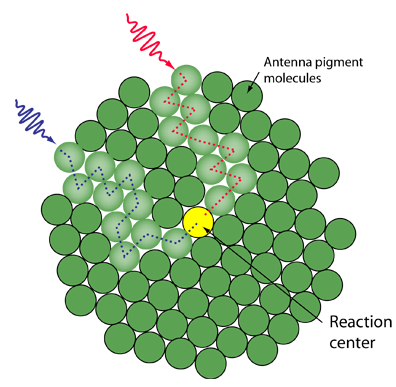
The capture of light energy for photosynthesis is enhanced by networks of pigments in the chloroplasts arranged in aggregates on the thylakoids. These aggregates are called antennae complexes. Evidence for this kind of picture came from research by Robert Emerson and William Arnold in 1932 when they measured the oxygen released in response to extremely bright flashes of light. They found that some 2500 molecules of chlorophyll was required to produce one molecule of oxygen, and that a minimum of eight photons of light must be absorbed in the process. 光能的捕获对于光合作用而言,通过叶绿体中色素网络在类囊体上形成聚集体而得到增强。这些聚集体被称为天线复合体。这种图像的证据来自1932年罗伯特·埃默森和威廉·阿诺德的研究,当时他们测量了对极亮光脉冲的响应所释放的氧气。他们发现,产生一个氧气分子需要约2500个叶绿素分子,并且在这一过程中至少需要吸收八个光子。
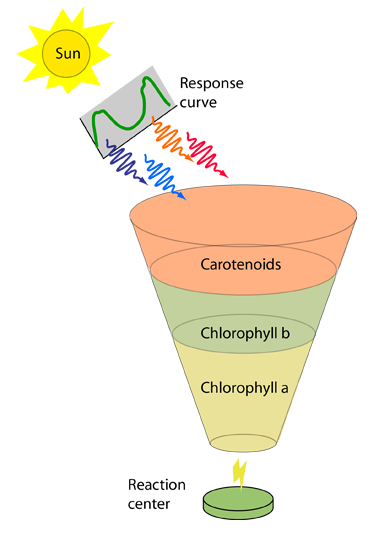
When a photon reaches the chlorophyll a in the reaction center, that chlorophyll can receive the energy because it absorbs photons of longer wavelengths than the other pigments. Two types of chlorophyll centers have been identified, and are associated with two protein complexes identified as Photosystem I and Photosystem II. 当光子到达反应中心的叶绿素a时,该叶绿素可以接收能量,因为它吸收的光子波长比其他色素更长。已鉴定出两种类型的叶绿素中心,并与两种蛋白质复合物相关联,这两种复合物分别称为光系统I和光系统II。
|
Index Photosynthesis Concepts Reference Moore, et al. Ch 7 Karp Ch 6 索引 光合作用概念 参考 Moore 等,第7章 Karp 第6章 | |||||
|
Go Back
返回 |
Photosystem I光系统I
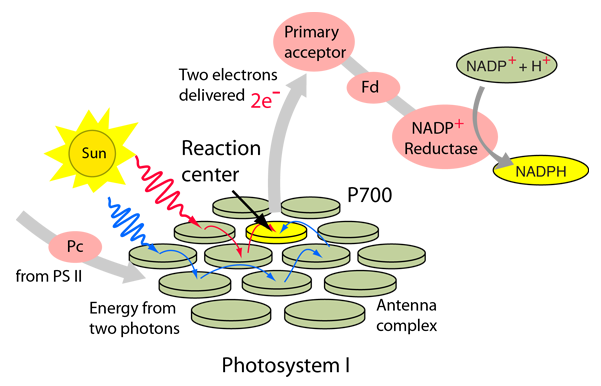
The light absorption processes associated with photosynthesis take place in large protein complexes known as photosystems. The one known as Photosystem I contains a chlorophyll dimer with an absorption peak at 700 nm known as P700. ![]() Photosystem I makes use of an antenna complex to collect light energy for the second stage of non-cyclic electron transport. It collects energetic electrons from the first stage process which is powered through Photosystem II and uses the light energy to further boost the energy of the electrons toward accomplishing the final goal of providing energy in the form of reduced coenzymes to the Calvin cycle. 光系统I利用一个天线复合物收集光能,用于非循环电子传递的第二阶段。它从第一阶段过程收集高能电子,该过程通过光系统II供电,并利用光能进一步提升电子的能量,以实现最终目标,即为卡尔文循环提供以还原辅酶形式的能量。
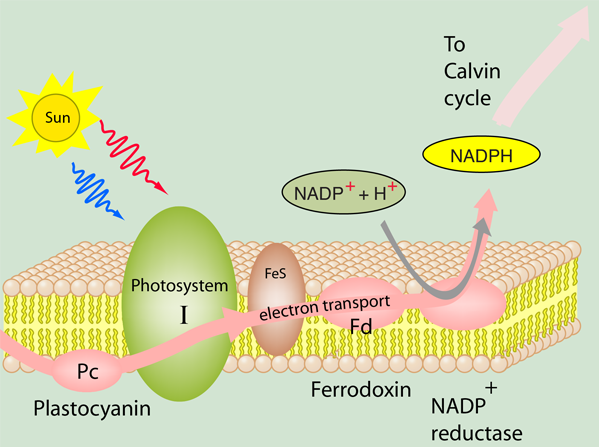
![]() The above sketch depicts the setting of Photosystem I in the electron transport process which provides energy resources for the Calvin cycle. 上述示意图展示了光系统I在电子传递过程中的位置,该过程为卡尔文循环提供能量资源。
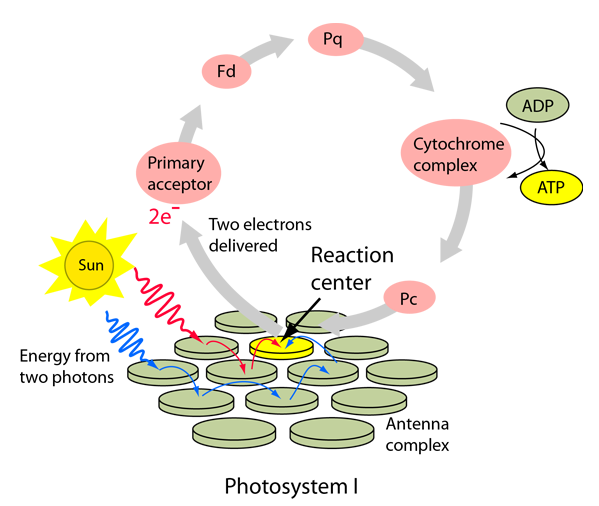
![]() Photosystem I is the light energy complex for the cyclic electron transport process used in some photosynthetic prokaryotes. 光合系统I是用于某些光合原核生物中循环电子传递过程的光能复合体。
The protein complex that constitutes Photosystem I contains eleven polypeptides, six of which are coded in the nucleus and five are coded in the chloroplast. The core of Photosystem I contains about 40 molecules of chlorophyll a, several molecules of beta carotene, lipids, four manganese, one iron, several calcium, several chlorine, two molecules of plastoquinone, and two molecules of pheophytin, a colorless form of chlorophyll a .(Moore, et al.) 构成光系统I的蛋白质复合物包含十一种多肽,其中六种在细胞核中编码,五种在叶绿体中编码。光系统I的核心包含约40个叶绿素a分子,几个β-胡萝卜素分子,脂质,四个锰原子,一个铁原子,几个钙原子,几个氯原子,两个分子的叶绿体醌,以及两个分子的叶绿素a无色衍生物(Moore等,)。
与光合作用相关的光吸收过程发生在称为光系统的大蛋白质复合物中。其中称为光系统I的含有一个叶绿素二聚体,其吸收峰在700纳米处,称为P700。 |
Index Photosynthesis Concepts Reference Moore, et al. Ch 7 索引 光合作用概念 参考 Moore 等人 第7章 | ||
|
Go Back
返回 |
Photosystem II光系统II
The light absorption processes associated with photosynthesis take place in large protein complexes known as photosystems. The one known as Photosystem II contains the same kind of chlorophyll a as Photosystem I but in a different protein environment with an absorption peak at 680 nm. (It is designated P680). The binding protein for PSII is much smaller than that for PSI, about 47,000 compared to 110,000. It resonates from energy transmitted by about 250 chlorophyll a and b in equal numbers. Its core contains xanthophylls but no beta carotene (Moore). 与光合作用相关的光吸收过程发生在称为光系统的大蛋白质复合物中。其中称为光系统II的含有与光系统I相同的叶绿素a,但处于不同的蛋白质环境中,其吸收峰在680纳米处(称为P680)。光系统II的结合蛋白比光系统I的小,约为47,000 compared to 110,000。它通过约250个叶绿素a和b(数量相等)传递的能量共振。其核心含有类胡萝卜素但不含β-胡萝卜素(Moore)。
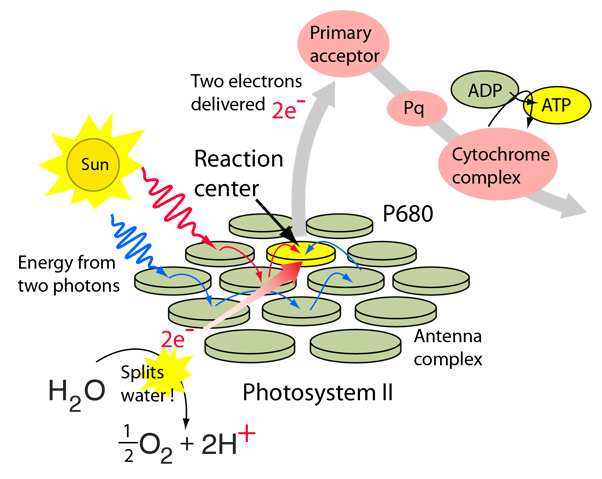
![]() Photosystem II makes use of an antenna complex to collect light energy for the first stages of non-cyclic electron transport. 光系统II利用光合反应中心收集光能,用于非循环电子传递的第一阶段。
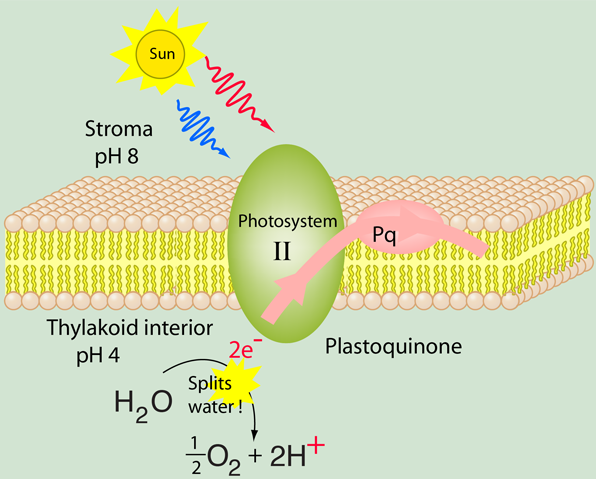
![]() This sketch shows some of the context of Photosystem II in the electron transport process in the thylakoid membrane. It is part of the process of splitting water and providing the electrons to plastoquinone for further transport to the cytochrome complex and then to Photosystem I. 这幅图展示了光系统II在类囊体膜中电子传递过程中的部分背景。它是水裂解和将电子提供给质体醌以进一步传递到细胞色素复合体,然后传递到光系统I的过程的一部分。
|
Index Photosynthesis Concepts Reference Moore, et al. Ch 7 索引 光合作用概念 参考 Moore 等人 第7章 | ||
|
Go Back
返回 |