Light Absorption for Photosynthesis光吸收用于光合作用
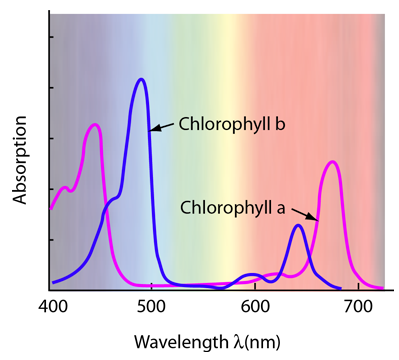
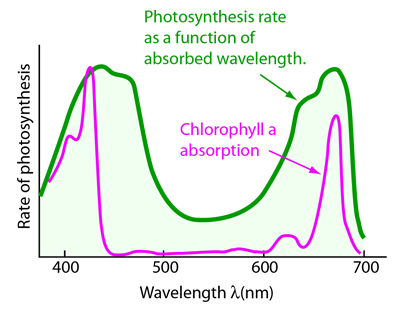
![]() The plot of the absorption spectra of the chlorophylls plus beta carotene correlates well with the observed photosynthetic output. The measure of photochemical efficiency is made by meauring the amount of oxygen produced by leaves following exposure to various wavelengths. 叶绿素加β-胡萝卜素的吸收光谱图与观察到的光合作用输出相吻合。光化学效率的测定是通过测量叶片在不同波长光照下产生的氧气量来实现的。
It is evident from these absorption and output plots that only the red and blue ends of the visible part of the electromagnetic spectrum are used by plants in photosynthesis. The reflection and transmission of the middle of the spectrum gives the leaves their green visual color. 从这些吸收和输出曲线可以看出,植物在光合作用中仅利用电磁谱可见部分的红端和蓝端。谱中中间部分的反射和透射使叶子呈现出绿色。
|
Index Photosynthesis Concepts Reference Moore, et al. Ch 7 Karp Ch 6 索引 光合作用概念 参考 Moore 等,第7章 Karp 第6章 | |||||||
|
Go Back
返回 |
Why are Leaves not Black?为什么树叶不是黑色的?
Light must be absorbed for nutrients to be created by Photosynthesis. So why reflect the green and waste the whole middle part of the spectrum? According to Moore, et al., this is a long story; in fact ancient history! 光必须被吸收才能通过光合作用生成营养物质。那么为什么反射绿色光并浪费整个光谱的中间部分呢?根据Moore等人的说法,这是一个很长的故事;事实上,这是古老的历史!
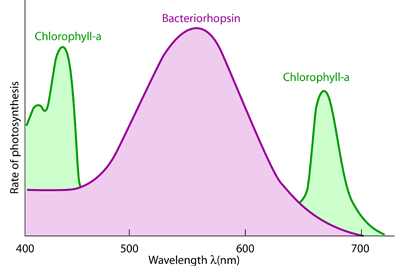
Current understanding is that the earliest photosynthetic organisms were aquatic bacteria, some of which are still around today. One of these, halobacterium halobium, grows in extremely salty water. It makes use of the bacteriorhodopsin pigment. The chlorophyll system developed to use the available light, as if it developed in strata below the purple bacteria and had to use what it could get. 目前的共识是,最早的光合作用生物是水生细菌,其中一些至今仍然存在。其中一种,嗜盐菌Halobacterium halobium,生长在极咸的水中。它利用细菌视黄素色素。叶绿素系统的发展是为了利用可用的光,仿佛它是在紫细菌之下形成的层次中发展起来的,必须利用所能获得的光。
That being said, there is some extension toward the middle of the spectrum with the beta carotene and other pigments. 尽管如此,β-胡萝卜素和其他色素在光谱的中间部分有所延伸。
|
Index Photosynthesis Concepts Reference Moore, et al. Ch 7 Karp Ch 6 索引 光合作用概念 参考 Moore 等,第7章 Karp 第6章 | ||||||
|
Go Back
返回 |
Photosynthetic Efficiency光合作用效率
The energy derived from light absorption is used in particular pathways to achieve the final result of synthesis of sugars. Since the pathways are known, a theoretical maximum efficiency can be calculated. It is known that a total of 8 photons of light must be absorbed to reduce two molecules of NADP+. Operating in the Calvin cycle, the resulting two molecules of NADPH can produce one hexose molecule. The photon energy of a median energy photon at 600nm is 2.07 eV, and for 8 moles of such photons the energy absorbed is 来自光吸收的能量被用于特定的途径,以实现糖合成的最终结果。由于这些途径是已知的,因此可以计算出理论最大效率。已知总共需要吸收8个光子来还原两个NADP+分子。在卡尔文循环中,产生的两个NADPH分子可以生成一个六碳分子。波长为600nm的中等能量光子的光子能量为2.07 eV,对于8摩尔这样的光子,所吸收的能量为
It takes 114 Kcal to reduce one mole of CO2 to hexose, so the theoretical efficiency is 114/381 or 30%. Remarkably, Moore, et al. report that 25% has been achieved under laboratory conditions. The top efficiency they reported under natural growing conditions was the winter-evening primrose growing in Death Valley at 8% (if you can call Death Valley natural conditions!). Sugarcane has registered 7% , which is very important for a food crop. Sugarcane is a C4 plant, and under high sunlight conditions they will usually outperform C3 plants and others. 将一摩尔二氧化碳还原为己糖需要114千卡,因此理论效率为114/381或30%。令人惊讶的是,Moore等人报告在实验室条件下已实现25%的效率。他们在自然生长条件下报告的最高效率是死亡谷冬季傍晚的油菜花,仅8%(如果能称死亡谷为自然条件的话)。甘蔗达到了7%,这对于一种食物作物来说非常重要。甘蔗是C4植物,在强阳光条件下通常会优于C3植物和其他植物。
The intensively cultivated agricultural plants average about 3% in photosynthetic efficiency, and most crops range from 1-4%. This is also typical of algae. 广泛栽培的农作物的光合效率平均约为3%,大多数作物的范围在1-4%之间。这同样适用于藻类。
(8摩尔)(6.022×10²³/摩尔)(2.07eV)(1.6×10⁻¹⁹J/eV)/(4184J/Kcal) = 381Kcal |
Index Photosynthesis Concepts Reference Moore, et al. Ch 7 Karp Ch 6 索引 光合作用概念 参考 Moore 等,第7章 Karp 第6章 | ||
|
Go Back
返回 |