Electron Transport in Photosynthesis
 This is an active graphic.
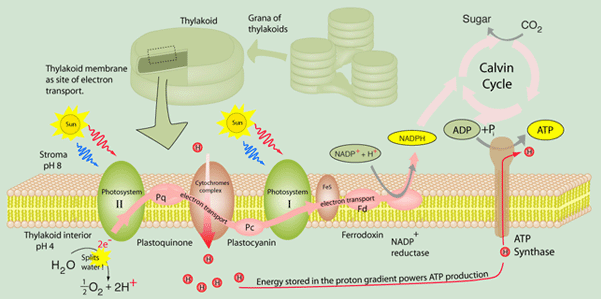
The above illustration draws from ideas in both Moore, et al. and Karp to outline the steps in the electron transport process that occurs in the thylakoid membranes of chloroplasts during photosynthesis. Both Photosystems I and II are utilized to split water to get electrons. Electron transport helps establish a proton gradient that powers ATP production and also stores energy in the reduced coenzyme NADPH. This energy is used to power the Calvin Cycle to produce sugar and other carbohydrates.
The electron transport process outlined here is characteristic to the approach to photophosphorylation called "non-cyclic electron transport". There is also an electron transport process in the cyclic electron transport process which uses only Photosystem I to produce ATP without providing the reduced coenzymes necessary to proceed with further biosynthesis.
| Electron transport in the mitochondria for oxidative phosphorylation
线粒体中电子运输用于氧化磷酸化 |
| Energy cycle in living things
生物体的能量循环 |
Photosynthesis Concepts
Reference
Moore, et al.
Ch 7
Karp
Ch 6
| HyperPhysics***** Biology
HyperPhysics ***** 生物学 | R Nave |