Gluconeogenesis
The synthesis of molecules on the chain from pyruvate to glucose is called gluconeogenesis. It is largely the reverse of the successive chain of events of glycolysis, but there are some differences which will be noted here.
Glucose is made from pyruvate in gluconeogenesis at the cost of 4 ATP, 2 GTP, and 2 NADH. The breakdown pathway of glucose in glycolysis yields 2 ATP and 2 NADH. So it takes 4 more energetic triphosphates of energy to make each molecule of glucose than can be obtained from glucose breakdown. But keeping the supply of glucose nearly constant is so essential that many routes to pyruvate are used to feed into the process. The most common feeder molecules are alanine and lactate, which can be converted to pyruvate in a single step.
The final step to glucose is made with the use of the enzyme glucose-6-phosphatase, which clips off a phosphate group. 将葡萄糖转化为葡萄糖-6-磷酸的最后一步是利用葡萄糖-6-磷酸酶完成的,该酶会去除一个磷酸基团。 | 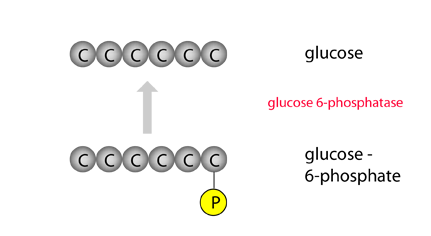 |
A rearrangement of the molecule forms glucose-6-phosphate. 分子的重新排列形成葡萄糖-6-磷酸。 | 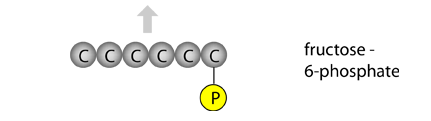 |
Departing from the reverse of glycolysis, a different enzyme, fructose 1,6-biphosphatase, is used to snip off a phosphate. 脱离糖酵解的逆过程,另一种酶——果糖1,6-二磷酸酶被用来去除一个磷酸基团。 | 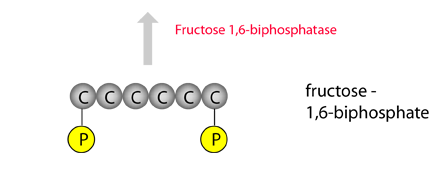 |
Following the reverse of the glycolysis steps, we reach fructose-1,6-biphosphate. 遵循糖解作用步骤的逆过程,我们得到果糖-1,6-二磷酸。 | 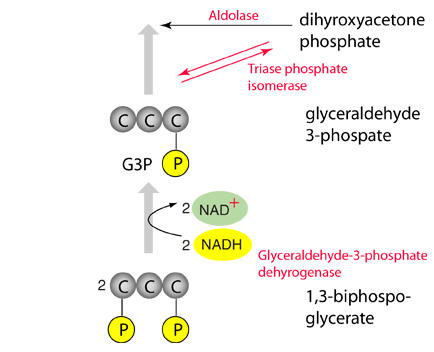 |
Two molecules of high energy ATP are used to accomplish the reversal of the glycolysis reactions to produce 2 molecules of 1,3-biphosphoglycerate. 两个高能ATP分子被用来逆转糖解反应,生成2分子1,3-二磷酸甘油酸。 | 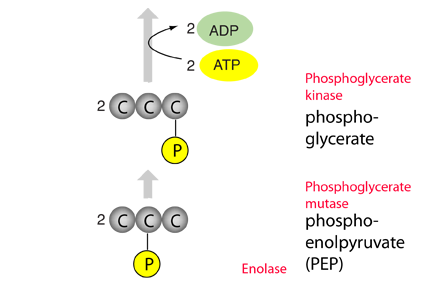 |
In the first step, pyruvate combines with carbon dioxide in the mitochondria to make oxaloacetate, catalyzed by pyruvate carboxylase. The oxaloacetate is transported out to the cytoplasm. Oxaloacetate is converted into PEP by the enzyme abbreviated PEPCK 第一步,丙酮酸在线粒体中与二氧化碳结合生成草酰乙酸,这一反应由丙酮酸羧化酶催化。草酰乙酸被转运到细胞质中。草酰乙酸通过酶促反应转化为磷酸烯醇丙酮酸(PEP),该酶简称PEPCK。 | 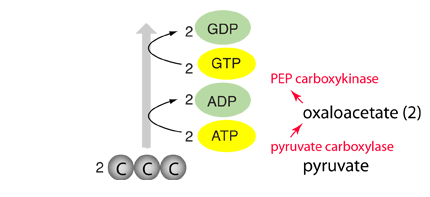 |
| Cellular Respiration
细胞呼吸 |
Reference
Enger & Ross
Ch 6
Audesirk & Audesirk
Ch 8
Ahern , Ch 15.
| HyperPhysics***** Biology
HyperPhysics ***** 生物学 | R Nave |