Steps of Glycolysis
糖酵解步骤

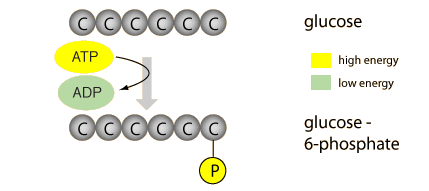
Glycolysis is a series of reactions which starts with glucose and has the molecule pyruvate as its final product. Pyruvate can then continue the energy production chain by proceeding to the TCA cycle, which produces products used in the electron transport chain to finally produce the energy molecule ATP. The first step in glycolysis is the conversion of glucose to glucose 6-phosphate (G6P) by adding a phosphate, a process which requires one ATP molecule for energy and the action of the enzyme hexokinase. Each step of glycolysis operates with the aid of an enzyme, which greatly speeds up the reactions to allow the process to proceed fast enough for metabolic needs. Ahearn comments that enzymes allow reactions to run at the "speed of life".

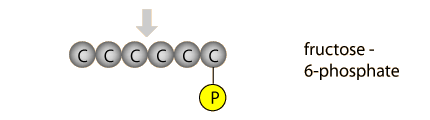
糖酵解是一系列反应,它以葡萄糖开始,最终产物是丙酮酸分子。丙酮酸随后可以继续能量生产链,通过进入柠檬酸循环(TCA循环),该循环产生的产物用于电子传递链,最终生成能量分子ATP。糖酵解的第一步是将葡萄糖转化为葡萄糖-6-磷酸(G6P),这一过程通过添加一个磷酸基团实现,该过程需要一个ATP分子提供能量,并需要酶己糖激酶的作用。糖酵解的每一步都依赖于酶的催化,酶显著加快了反应速率,使这一过程能够以足够快的速度满足代谢需求。Ahearn指出,酶使反应能够在“生命的速度”下进行。 This step involves a simple rearrangement of G6P to produce Fructose 6-phosphate (F6P). It forms the substrate for the next step which is crucial control point.

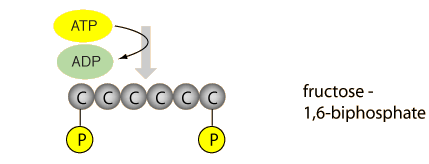
这一步涉及将G6P简单重排生成果糖-6-磷酸(F6P)。它为下一步提供底物,而这一步是关键的调控点。 In this step a second ATP is required to add a second phosphate to F6P. This forms Fructose 1,6-biphosphate (F1,6BP). The enzyme involved is Phosphofructokinase (PFK). This enzyme is capable of controlling the entire pathway as seen below. To this point, the process involves rearrangement with the investment of two ATP. This energy is used to add two phosphates, and marks the end of the energy investment phase.

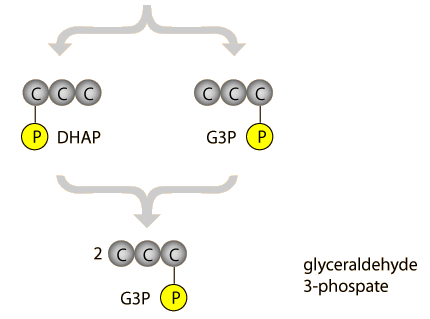
在此步骤中,需要另一个ATP来向F6P添加第二个磷酸基团。这形成了果糖1,6-二磷酸(F1,6BP)。参与此反应的酶是磷酸果糖激酶(PFK)。此酶能够控制整个途径,如下所示。到目前为止,该过程涉及通过消耗两个ATP进行重排。此能量用于添加两个磷酸基团,并标志着能量投资阶段的结束。 Catalyzed by the enzyme aldolase, the F1,6BP is split into two three-carbon molecules, Dihydroxyacetone phosphate (DHAP) and Glyceraldehyde 3-phosphate (G3P). These two molecules are isomers, and each can be easily rearranged into the other.

在醛缩酶的催化下,果糖-1,6-二磷酸(F1,6BP)分解为两个三碳分子,即二羟基丙酮磷酸(DHAP)和甘油醛-3-磷酸(G3P)。这两种分子是同分异构体,彼此之间可以很容易地相互转化。 Catalyzed by Triose phosphate isomerase, the DHAP is quickly rearranged to produce a second G3P. The process to this point has converted one 6-carbon molecule of glucose into two 3-carbon G3P molecules.

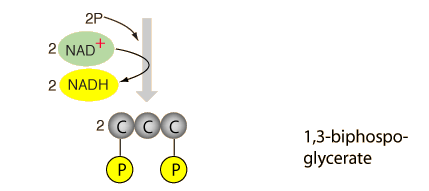
在三碳磷酸异构酶的催化下,DHAP迅速重新排列,生成第二个G3P。到目前为止,这个过程已将一个六碳分子的葡萄糖转化为两个三碳的G3P分子。 Starting at this step, glycolysis becomes a process of energy generation where ATP is made. At the beginning of this process, the G3P is converted to 1,3-bisphosphoglycerate. This involves the addition of another phosphate. In this process the adehyde molecule is converted into an acid.This process of conversion of the aldehyde to an acid is an oxidation. In the process the molecule being oxidized loses two electrons, and it gives those two electrons to NAD+ which accepts them plus a proton to produce NADH. We had two G3P molecules, so we we get two molecules of 1,3 bisphosphoglycerate, and gain two NADHs out of this reaction. These will be used in the electron transport chain to provide a much bigger energy payoff. The acid group created by the oxidation reaction gives a phosphate to 1,3 bisphosphoglycerate. This phosphate addition is different from the ones seen so far which required ATP energy. This phosphate is not from ATP, but is a free phosphate added onto the acid. The energy for doing this comes from the oxidation of the same step. That's why we don't need ATP energy to add the phosphate. The net output from this step is two 1,3 bisphosphoglycerates and two NADHs.

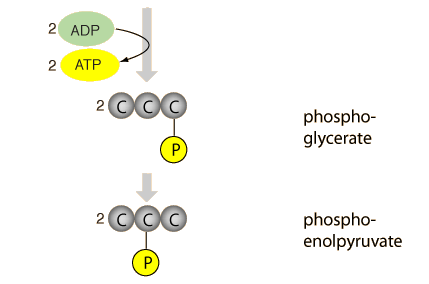
从这一步开始,糖酵解成为生成能量的过程,其中生成ATP。在这个过程中,G3P被转化为1,3-二磷酸甘油酸。这个过程涉及添加另一个磷酸基团。在这个过程中,醛分子被转化为酸。这种将醛转化为酸的转化过程是一种氧化。在这一过程中,被氧化的分子失去两个电子,并将这两个电子交给NAD+,NAD+接受这些电子并结合一个质子生成NADH。我们有两个G3P分子,因此得到两个1,3-二磷酸甘油酸分子,并从这一反应中获得两个NADH。这些将用于电子传递链,以提供更大的能量收益。由氧化反应产生的酸基团向1,3-二磷酸甘油酸提供一个磷酸基团。这种磷酸基团的添加与之前所见的有所不同,这些之前所需的能量来自ATP。而这次的磷酸基团并非来自ATP,而是直接添加到酸基团上的。这种磷酸基团的添加所需能量来自同一步骤的氧化反应。这就是为什么我们不需要ATP能量来添加磷酸基团的原因。这一步的净产物是两个1,3-二磷酸甘油酸和两个NADH。 This step begins the part of glycolysis where ATP is made. First, a phosphate is transferred away from each of the two 1,3 Bisphosphoglycerates to add to ADP and make ATP. This leaves behind two molecules of 3-Phosphoglycerate.

这一步标志着糖解作用中ATP生成的开始。首先,每个1,3二磷酸甘油酸各失去一个磷酸,将其转移给ADP,从而生成ATP。这一步骤后,剩下两个3-磷酸甘油酸分子。 The two molecules of 3-Phosphoglycerate undergo rearrangement to produce 2-Phosphoglycerate.

3-磷酸甘油酸的两个分子发生重排,生成2-磷酸甘油酸。 The two 2-Phosphoglycerate molecules with the action of the enolase enzyme form two molecules of phosphoenylpyruvate (PEP). PEP is the substrate for the final step of glycolysis.

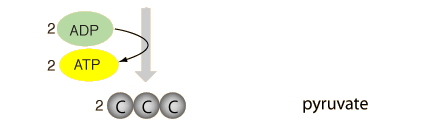
在酶烯醇酶的作用下,两个2-磷酸甘油酸分子形成两个磷酸烯醇丙酮酸(PEP)分子。PEP是糖酵解最后一步的底物。 With the aid of the enzyme pyruvate kinase, the final step produces two ATPs and two molecules of pyruvate. There is enough energy left over to almost produce two more ATPs, but since it falls short, this energy is given off as heat.

借助酶丙酮酸激酶的作用,最后一步反应产生两个ATP和两个丙酮酸分子。剩余的能量足以几乎再合成两个ATP,但由于不足,这部分能量以热量形式释放出来。 |