Bernoulli or Newton's Laws for Lift?伯努利方程或牛顿运动定律用于解释升力?
Which is best for describing how aircraft get the needed lift to fly? Bernoulli's equation or Newton's laws and conservation of momentum? This has been an extremely active debate among those who love flying and are involved in the field. If the question is "Which is physically correct?" then the answer is clear -- both are correct. Both are based on valid principles of physics. The Bernoulli equation is simply a statement of the principle of conservation of energy in fluids. Conservation of momentum and Newton's 3rd law are equally valid as foundation principles of nature - we do not see them violated. This physical validity will undoubtedly not quell the debate, and this treatment will not settle it. But perhaps it can at least indicate the lines of the discussion. 哪种更适合描述飞机如何获得飞行所需的升力?伯努利方程还是牛顿运动定律和动量守恒?这在热爱飞行和从事相关领域的人群中一直是一个非常活跃的讨论话题。如果问题是‘哪一种在物理上是正确的’,答案是明确的——两者都正确。两者都基于物理学的合理原理。伯努利方程只是对流体中能量守恒原理的陈述。动量守恒和牛顿第三定律同样是自然基础原理——我们没有观察到它们被违反。这种物理上的正确性无疑不会平息这场争论,这种论述也无法解决争议。但或许至少可以指出讨论的范围。
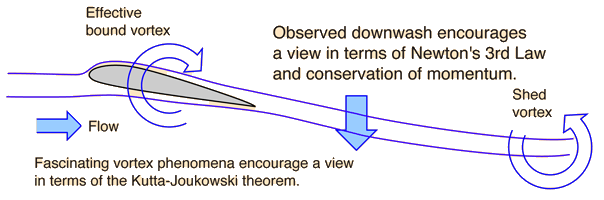
![]() Those who advocate an approach to lift by Newton's laws appeal to the clear existance of a strong downwash behind the wing of an aircraft in flight. The fact that the air is forced downward clearly implies that there will be an upward force on the airfoil as a Newton's 3rd law reaction force. From the conservation of momentum viewpoint, the air is given a downward component of momentum behind the airfoil, and to conserve momentum, something must be given an equal upward momentum. Those who prefer to discuss lift in these terms often invoke the Kutta-Joukowski theorem for lift on a rotating cylinder. The lift on a spinning cylinder has been clearly demonstrated, and its discussion includes a vortex in the circulating air. Many discussions of airfoil lift invoke such a vortex in the effective circulation of air around the moving airfoil. Conservation of angular momentum in the fluid requires an opposite circulation in the air shed from the trailing edge of the wing, and such vortex motion has been observed. 那些主张用牛顿定律来解释升力的人,会引用飞行中飞机机翼后方明显存在的强向下涡流。空气被向下强迫的事实清楚地表明,空气翼面将产生一个向上的力,作为牛顿第三定律的反作用力。从动量守恒的观点来看,空气在空气翼面后方获得了一个向下的动量分量,为了保持动量守恒,必须有另一部分获得相等的向上的动量。那些倾向于用这种术语讨论升力的人往往引用库塔-约当定理来解释旋转圆柱体上的升力。旋转圆柱体上的升力已被清楚地证明,其讨论包括循环空气中的涡流。许多关于空气翼面升力的讨论都涉及这种涡流,它存在于围绕移动空气翼面的有效循环中。流体中角动量守恒要求在机翼后缘的涡流中产生相反的循环,这种涡流运动已被观察到。
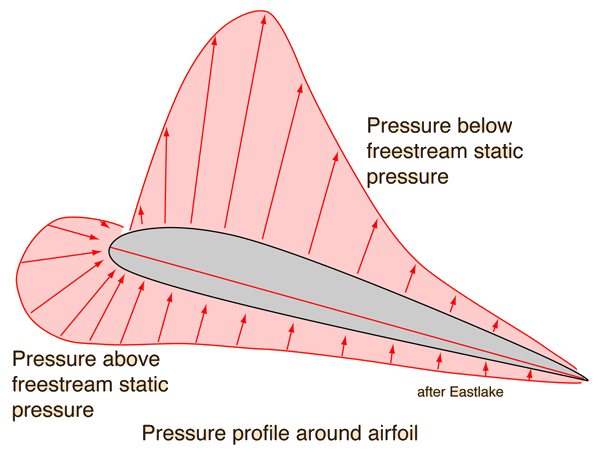
![]() Those who advocate the Bernoulli approach to lift point to detailed measurement of the pressures surrounding airfoils in wind tunnels and in flight. Such pressure measurements are typically done with Pitot tubes. Correlating the pressures with the Bernoulli equation gives reasonable agreement with observations. 主张采用伯努利方程来解释升力的人指出,在风洞和飞行中对机翼周围压力的详细测量。这些压力测量通常使用皮托管进行。将这些压力与伯努利方程相关联,可以与观测结果取得合理的一致。
Those who argue against modeling the lift process with the Bernoulli equation point to the fact that the flow is not incompressible, and therefore the density changes in the air should be taken into account. This is true -- the ideal gas law should be obeyed and density changes will inevitably result. This does not render the Bernoulli equation invalid, it just makes it harder to apply. But the pragmatic success of modeling the lift with Bernoulli, neglecting density changes, suggests that the density changes are small. Pragmatic difficulties exist also for those who would model the lift from Newton's third law -- it is difficult to measure the downward force associated with the downwash because is is distributed in the airstream leaving the trailing edge of the airfoil. Detractors from the Bernoulli approach often make calculations using the Kutta-Joukowski theorem (see Craig). 那些反对用伯努利方程来建模升力过程的人指出,流动不是不可压缩的,因此空气中的密度变化应当被考虑进去。这是正确的——理想气体定律应当被遵守,密度变化不可避免地会发生。这并不使伯努利方程失效,只是使其应用起来更加困难。但用伯努利方程建模升力的实用成功,表明密度变化是微小的。对于那些试图用牛顿第三定律建模升力的人而言,也存在实际困难——因为难以测量与尾涡相关的向下力,因为这种力分布在离开机翼后缘的气流中。反对伯努利方法的人常常使用库塔-儒可夫斯基定理(见Craig)进行计算。
|
Index Bernoulli concepts References Eastlake Craig ![]() NASA Aerodynamics 索引伯努利概念参考文献 Eastlake Craig NASA 流体力学 | ||
|
Go Back
返回 |
Flying Upside-Down倒飞
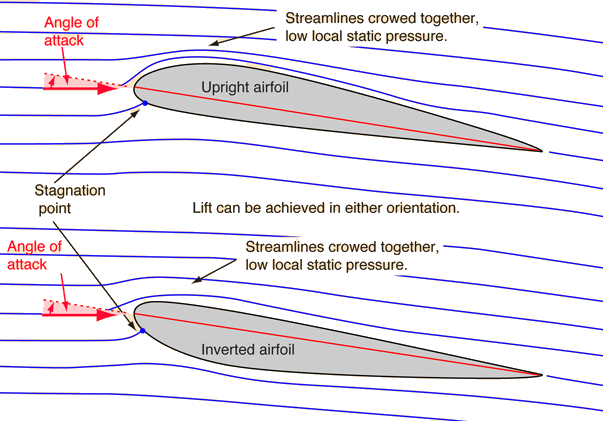
Part of the fascination of an aerobatics display is that with loops and upside-down flight. If the greater curvature on top of the wing and the Bernoulli effect are evoked to explain lift, how is this possible? The illustrations below attempt to show that an increase in airstream velocity over the top of the wing can be achieved with airfoil surface in the upright or inverted position. It requires adjustment of the angle of attack, but as clearly demonstrated in almost every air show, it can be done. 空中特技表演的一部分魅力在于其翻滚和倒飞的表演。如果用机翼上方的曲率增加和伯努利效应来解释升力,这怎么可能实现呢?下面的插图试图展示,通过将机翼表面保持在直立或倒立位置,可以实现机翼上方气流速度的增加。这需要调整迎角,但如几乎所有空中表演都清楚地展示的那样,这是可以做到的。
![]() Similar sketches can show the conditions for lift on a symmetric airfoil. While the typical asymmetric shape of an airfoil make increase efficiency of lift production in its upright position, the asymmetry of the airfoil is not essential for producing lift. 类似的示意图可以展示对称机翼产生升力的条件。虽然典型不对称机翼在直立位置能提高升力生成的效率,但机翼的不对称性并不是产生升力所必需的。
|
Index Bernoulli concepts Reference Eastlake 索引伯努利概念参考Eastlake | ||
|
Go Back
返回 |
Airfoil Terminology机翼术语
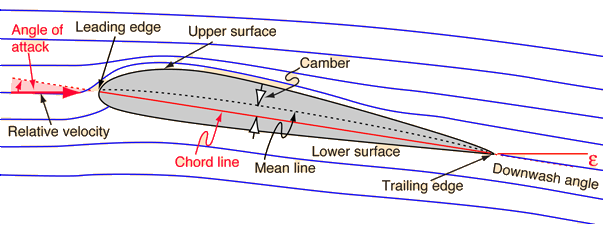
![]() Based on Eastlake, Charles N., "An Aerodynamicist's View of Lift, Bernoulli, and Newton", The Physics Teacher 40, 166 (March 2002). 根据Eastlake的论述,Charles N. Eastlake的《一名空气动力学家对升力、伯努利原理和牛顿的看法》,发表于《物理教师》40卷,第166页(2002年3月)。
It is useful to be aware of some of the terms used in the aerodynamic field when discussing airfoil lift. Critical to lift is the angle of attack, which is the angle between the relative velocity and the chord line of the airfoil. The chord line is the straight line from the leading edge to the trailing edge of the airfoil. Although the relative velocity is shown as horizontal in the illustration, that is for level flight only. If the aircraft is ascending or descending, the relative velocity will not be horizontal, but the angle of attack would still be defined as the angle between the relative velocity of the air and the chord line of the airfoil. The mean line of the airfoil is the line equidistant from the lower and upper surfaces, measured perpendicular to the chord line. The camber of the airfoil is the maximum distance between the chord line and the mean line and is usually a few percent of the length of the chord. Aerodynamicists usually measure angles relative to the relative velocity of the air, sometimes referred to as the "relative wind". Lift and drag are then measured perpendicular and parallel to the relative wind, respectively. In that context, "lift" is not generally vertical, and not generally perpendicular to the chord of the wing -- it is the component of force perpendicular to the relative velocity of the air or the "relative wind". 在讨论机翼升力时,了解气动领域的一些术语是有帮助的。升力的关键在于攻角,即相对速度与机翼弦线之间的角度。弦线是从机翼前缘到后缘的直线。虽然图中相对速度被显示为水平方向,但这仅适用于平飞状态。如果飞机在爬升或下降,相对速度将不再是水平的,但攻角仍然定义为相对速度与机翼弦线之间的角度。机翼的平均线是距离上下表面等距的线,且垂直于弦线测量。机翼的弯度是弦线与平均线之间的最大距离,通常为弦长的几个百分比。气动工程师通常以相对速度(有时称为“相对风”)为基准来测量角度。在这种情况下,升力和阻力分别垂直于和平行于相对风测量。在这种语境下,‘升力’通常不垂直,也不通常垂直于机翼的弦线——它实际上是与空气的相对速度或“相对风”垂直的力的分量。
The general shape of the airfoil above is patterned after the NACA 2412 airfoil. According to Eastlake, this airfoil has been used on most single-engine Cessna aircraft since the 1940s. It is likely the most widely used airfoil in the world, so it has been thoroughly studied. 上述机翼的总体形状模仿的是NACA 2412机翼。根据Eastlake的说法,这种机翼自20世纪40年代以来已被广泛用于大多数单引擎塞斯纳飞机。它很可能是在世界上使用最广泛的机翼,因此已被深入研究。
|
Index Bernoulli concepts References Eastlake 索引伯努利概念参考文献 Eastlake | ||
|
Go Back
返回 |