How much moisture can the air "hold"?
空气能容纳多少水分?
| Careful! There are dangers and possible misconceptions in these common statements about relative humidity.
小心!这些关于相对湿度的常见陈述中存在危险和可能的误解。 |
| Relative humidity is the amount of moisture in the air compared to what the air can "hold" at that temperature. When the air can't "hold" all the moisture, then it condenses as dew.
相对湿度是空气中所含的水分与该温度下空气所能容纳的水分之比。当空气无法容纳所有水分时,水分会凝结成露。 |
|
Of all the statements about relative humidity that I have heard in everyday conversation, the above is probably the most common. It may represent understanding of the phenomenon, and has some common sense utility, but it may represent a complete misunderstanding of what is going on physically. The air doesn't "hold" water vapor in the sense of having some attractive force or capturing influence. Water molecules are actually lighter and higher speed than the nitrogen and oxygen molecules that make up the bulk of the air, and they certainly don't stick to them and are not in any sense held by them. If you examine the thermal energy of molecules in the air at a room temperature of 20°C, you find that the average speed of a water molecule in the air is over 600 m/s or over 1400 miles/hr! You are not going to "hold" that molecule!
在日常对话中,我听到的所有关于相对湿度的陈述中,上述说法可能是最常见的。它可能反映了对这一现象的理解,也具有一定的常识实用性,但也可能完全误解了物理上的实际情况。空气并不像有某种吸引力或捕获作用那样“持有”水蒸气。水分子实际上比组成空气主要成分的氮气和氧气分子更轻,速度也更高,它们显然不会粘附在这些分子上,也绝不可能被它们所束缚。如果你检查空气中20°C时分子的热能,你会发现空气中水分子的平均速度超过600米/秒或1400英里/小时!你不可能“抓住”那个分子!
Another possibly helpful perspective would be to consider the space between air molecules under normal atmospheric conditions. From knowledge of atomic masses and gas densities and the modeling of the mean free path of gas molecules, we can conclude that the separation between air molecules at atmospheric pressure and 20°C is about 10 times their diameter. They will typically travel on the order of 30 times that separation between collisions. So water molecules in the air have a lot of room to move about and are not "held" by the air molecules.
另一种可能有帮助的视角是考虑在正常大气条件下空气分子之间的空间。根据对原子质量、气体密度以及气体分子平均自由程的建模,我们可以得出结论:在大气压和20°C下,空气分子之间的分离距离大约是它们直径的10倍。它们通常在碰撞之间旅行的距离大约是这个分离距离的30倍。因此,空气中的水分子有大量空间可以移动,不会被空气分子“束缚”。
When one says that the air can "hold" a certain amount of water vapor, the fact that is being addressed is that a certain amount of water vapor can be resident in the air as a constituent of the air. The high speed water molecules act, to a good approximation, as particles of an ideal gas. At an atmospheric pressure of 760 mm Hg, you can express the amount of water in the air in terms of a partial pressure in mm Hg which represents the vapor pressure contributed by the water molecules. For example at 20°C, the saturation vapor pressure for water vapor is 17.54 mm Hg, so if the air is saturated with water vapor, the dominant atmospheric constituents nitrogen and oxygen are contributing most of the other 742 mm Hg of the atmospheric pressure.
当人们说空气能“容纳”一定量的水蒸气时,所指的事实是一定量的水蒸气可以作为空气的组成部分存在于空气中。高速的水分子可以近似地被视为理想气体的粒子。在大气压为760 mm Hg时,你可以用mm Hg单位的分压来表示空气中水的含量,该分压代表水分子贡献的蒸气压。例如,在20°C时,水蒸气的饱和蒸气压为17.54 mm Hg,因此如果空气被水蒸气饱和,氮气和氧气作为主要大气成分,将贡献其余的742 mm Hg大气压。
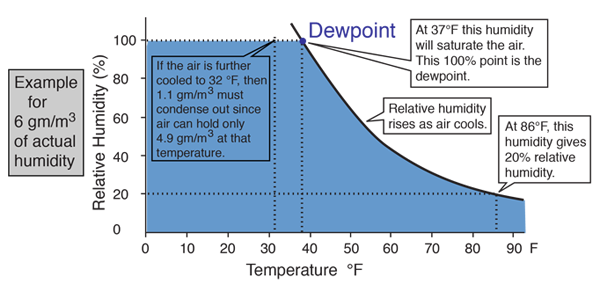
But water vapor is a very different type of air constituent than oxygen and nitrogen. Oxygen and nitrogen are always gases at Earth temperatures, having boiling points of 90K and 77K respectively. Practically, they always act as ideal gases. But extraordinary water has a boiling point of 100°C= 373.15K and can exist in solid, liquid and gaseous phases on the Earth. It is essentially always in a process of dynamic exchange of molecules between these phases. In air at 20°C, if the vapor pressure has reached 17.54 mm Hg, then as many water molecules are entering the liquid phase as are escaping to the gas phase, so we say that the vapor is "saturated". It has nothing to do with the air "holding" the molecules, but common usage often suggests that. As the air approaches saturation, we say that we are approaching the "dewpoint". The water molecules are polar and will exhibit some net attractive force on each other and therefore begin to depart from ideal gas behavior. By collecting together and entering the liquid state they can form droplets in the atmosphere to make clouds, or near the surface to form fog, or on surfaces to form dew.
但是水蒸气是一种与氧和氮气完全不同的空气成分。氧和氮气在地球温度下总是以气体形式存在,它们的沸点分别为90K和77K。实际上,它们总是表现出理想气体的行为。然而,水的沸点为100°C=373.15K,可以在地球上以固体、液体和气体三种形式存在。它基本上总是处于固体、液体和气体之间分子动态交换的过程中。在20°C的空气中,如果蒸汽压达到17.54 mm Hg,那么进入液体相的水分子数量与逃逸到气体相的水分子数量相等,因此我们说蒸汽是“饱和”的。这与空气“容纳”分子无关,但日常用语常常暗示这一点。当空气接近饱和时,我们说我们接近“露点”。水分子是极性的,会对彼此产生一些净吸引力,因此开始偏离理想气体行为。通过聚集并进入液态,它们可以在大气中形成云,或接近地表形成雾,或在表面形成露水。
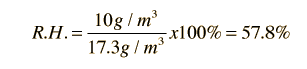
Another approach which might help clarify the point that air does not actually "hold" water is to note that the relative humidity really has nothing to do with the air molecules (i.e., N2 and O2). If a closed flask at 20°C had liquid water in it but no air at all, it would reach equilibrium at the saturated vapor pressure 17.54 mm Hg. At that point it would have a vapor density of 17.3 gm/m3 of pure water vapor in the gas phase above the water surface. But if you had just removed the air and sealed the container with liquid water in it, you might have a situation where there was only 8.65 gm/m3 resident in the gas phase at that particular moment. We would say that the relative humidity in the flask is 50% at that point because the resident water vapor density is half its saturation density. That is exactly the same thing we would say if the air were present - 8.65 gm/m3 of water vapor in the air at 20°C represents 50% relative humidity. Under these conditions, water molecules would be evaporating from the surface into the gas phase faster than they would be entering the water surface, so the vapor pressure of the water vapor above the surface would be rising toward the saturation vapor pressure.
另一种可能有助于澄清空气实际上并不“容纳”水的观点是注意到相对湿度实际上与空气分子(即N₂和O₂)无关。如果一个在20°C时封闭的烧瓶内有液态水但完全没有空气,它会达到饱和蒸气压17.54 mm Hg的平衡。此时,水蒸气的密度为17.3 gm/m³,纯水蒸气在水面上的气相中。但如果你只是移除了空气并密封了含有液态水的容器,你可能会处于一种情况,此时气相中仅存在8.65 gm/m³的水蒸气。我们说此时烧瓶中的相对湿度为50%,因为气相中的水蒸气密度是饱和密度的一半。这与空气存在时的情况完全相同——在20°C时,气相中8.65 gm/m³的水蒸气代表50%的相对湿度。在这些条件下,水分子会以比进入水面更快的速度从水面蒸发到气相,因此水蒸气在水面上方的蒸汽压会逐渐上升,趋向于饱和蒸气压。
|