Bilingual edition: English is preserved and Chinese follows each unit. Terminology uses the confirmed v20260916 glossary; automated semantic review remains traceable.
中英双语版:英文原文完整保留,中文紧随对应单元;术语采用 v20260916 确认表,自动语义审校结果可追溯。

Specific Heats of Gases

气体的比热容

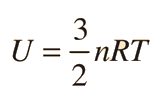
The specific heats of gases are generally expressed as molar specific heats. For a monoatomic ideal gas the internal energy is all in the form of kinetic energy, and kinetic theory provides the expression for that energy, related to the kinetic temperature. The expression for the internal energy is

气体的定压比热和定容比热通常表示为摩尔比热。对于单原子理想气体,内能全部以动能形式存在,而气体动理论提供了该能量的表达式,该能量与动能温度相关。内能的表达式为

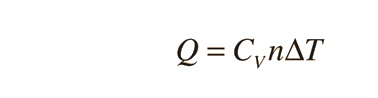
Two specific heats are defined for gases, one for constant volume (CV) and one for constant pressure (CP). For a constant volume process with a monoatomic ideal gas the first law of thermodynamics gives:
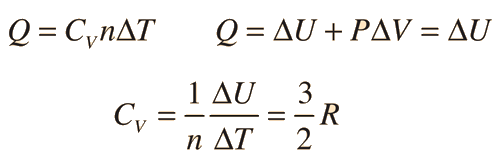
对于气体,定义了两种特定热容,一种是体积恒定情况下的(C_V),另一种是压强恒定情况下的(C_P)。对于体积恒定过程中的单原子理想气体,第一热力学定律给出:
More general case
更一般的情况

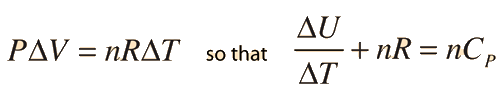
Further application of the ideal gas law and first law gives the relationship

进一步应用理想气体定律和第一定律可得到关系式
Show
显示

The ratio of the specific heats γ = CP/CV is a factor in adiabatic engine processes and in determining the speed of sound in a gas. This ratio γ = 1.66 for an ideal monoatomic gas and γ = 1.4 for air, which is predominantly a diatomic gas.

比热比γ = C_P / C_V是绝热发动机过程和确定气体中声速的一个因素。对于理想单原子气体,γ = 1.66,而对于空气,γ = 1.4,因空气主要由双原子气体组成。
Index

Gas law concepts

Kinetic theory concepts
索引 气体定律概念 气体动理论概念
 
HyperPhysics***** Thermodynamics
HyperPhysics ***** 热力学
R Nave
Go Back
返回


Constant Volume Specific Heat

定容比热容

The molar specific heat at constant volume is defined by

在恒定体积下的摩尔定容比热容由
Constant volume
定容

Using the first law of thermodynamics this can be put in the form

利用热力学第一定律,这可以表示为
but since ΔV = 0, the expression for CV becomes
但由于ΔV = 0,C V的表达式变为
For a monoatomic ideal gas,
对于单原子理想气体,
, so
,因此

This value agrees well with experiment for monoatomic noble gases such as helium and argon, but does not describe diatomic or polyatomic gases since their molecular rotations and vibrations contribute to the specific heat. The equipartition of energy predicts

这个值与实验结果对氦和氩等单原子惰性气体相符,但无法描述双原子或多原子气体,因为它们的分子旋转和振动会贡献于定压比热容。能量均分定理预测

Index

Gas law concepts

Kinetic theory concepts
索引 气体定律概念 气体动理论概念
 
HyperPhysics***** Thermodynamics
HyperPhysics ***** 热力学
R Nave
Go Back
返回


Constant Pressure Specific Heat

定压定容热容
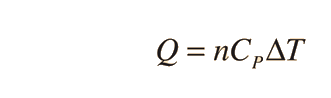
The molar specific heat at constant pressure is defined by
Constant pressure
恒压
Using the first law of thermodynamics for a constant pressure process this can be put in the form
From the ideal gas law (PV=nRT) under constant pressure conditions it can be seen that

Since the constant volume specific heat is

it follows that

For an ideal monoatomic gas

在定压过程中,摩尔定压热容由第一定律热力学定义,可以表示为。从理想气体定律(PV=nRT)可知,在定压条件下,有。由于定体积热容是,因此可以得出。对于理想单原子气体,
Index

Kinetic theory concepts
索引 气体动理论概念
 
HyperPhysics***** Thermodynamics
HyperPhysics ***** 热力学
R Nave
Go Back
返回


Molar Specific Heats of Gases

气体的摩尔比热
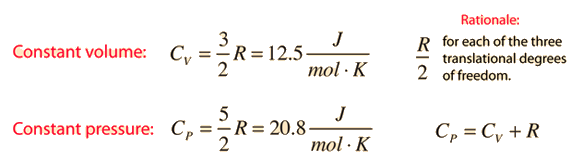
The molar specific heats of ideal monoatomic gases are:

For diatomic or linear polyatomic molecules, two rotational degrees of freedom are added, corresponding to the rotation about two perpendicular axes through the center of the molecule. This would be expected to give CV = 5/2 R, which is borne out in examples like nitrogen and oxygen. A nonlinear polyatomic molecule will be able to rotate about three perpendicular axes, which would be expected to give CV = 3R. The departure from this value which is observed indicates that vibrational degrees of freedom must also be included for a complete description of specific heats of gases.

对于双原子或线性多原子分子,会增加两个转动自由度,对应于通过分子中心的两个垂直轴的转动。这应导致C V = 5/2 R,这在氮气和氧气等例子中得到了验证。非线性多原子分子可以绕三个垂直轴转动,这应导致C V = 3R。观察到的偏离此值表明,为了完整描述气体的定压热容,还必须包括振动自由度。
Examples
示例
Table of molar heat capacities
摩尔热容表
理想单原子气体的摩尔定容比热容为:
Index

Kinetic theory concepts

Sears & Salinger, Sec 9-7
索引 气体动理论概念 Sears & Salinger,第9-7节
 
HyperPhysics***** Thermodynamics
HyperPhysics ***** 热力学
R Nave
Go Back
返回


Selected Specific Heats

选定的特定比热

The models of constant-volume specific heat based on equipartition of energy and including rotational degrees of freedom as well as translational are able to explain specific heats for diatomic molecules. The departure from this model in the case of non-linear polyatomic molecules indicates vibrational involvement.

基于能量均分定理并包括旋转自由度和翻译自由度的定容比热模型能够解释双原子分子的比热。非线性多原子分子的情况偏离该模型,表明振动自由度的参与。

The constant pressure specific heat is related to the constant volume value by CP = CV + R. The ratio of the specific heats γ = CP/CV is a factor in adiabatic engine processes and in determining the speed of sound in a gas.

定压比热容与定容比热容之间的关系为 C_P = C_V + R。比热容比 γ = C_P / C_V 是绝热发动机过程和确定气体中声速的一个因素。

Hydrogen as example of diatomic molecule

氢作为双原子分子的例子
Index

Kinetic theory concepts

Sears & Salinger, Sec 9-7
索引 气体动理论概念 Sears & Salinger,第9-7节
 
HyperPhysics***** Thermodynamics
HyperPhysics ***** 热力学
R Nave
Go Back
返回


Hydrogen Specific Heat

氢的定压热容

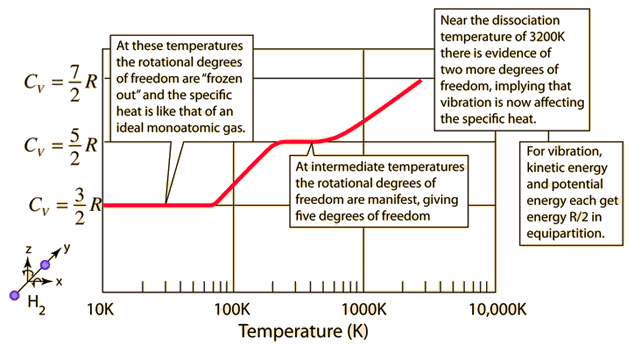
The behavior of the specific heat of hydrogen with changing temperature was extremely puzzling early in the 20th century. At low temperatures it behaved like a monoatomic gas, but at higher temperatures its specific heat took on a value similar to other diatomic molecules. It took the development of the quantum theory to show that diatomic hydrogen, with its tiny rotational inertia, required a large amount of energy to excite its first excited molecular rotation quantum state. Since it could not get that amount of energy at low temperatures, it acted like a monoatomic gas.

20世纪初,氢气的比热容随温度变化的行为非常令人困惑。在低温下,它表现出像单原子气体一样的特性,但在较高温度下,其比热容却接近其他双原子分子的值。只有量子理论的发展才表明,由于双原子氢分子具有极小的旋转惯性,要使其第一个激发的分子旋转量子态发生跃迁需要大量的能量。由于在低温下它无法获得如此多的能量,因此它表现出像单原子气体一样的行为。
Specific heats of gases
气体的定压比热和定容比热
Equipartition of energy
能量均分
Index

Kinetic theory concepts
索引 气体动理论概念
 
HyperPhysics***** Thermodynamics
HyperPhysics ***** 热力学
R Nave
Go Back
返回