Bilingual edition: English is preserved and Chinese follows each unit. Terminology uses the confirmed v20260916 glossary; automated semantic review remains traceable.
中英双语版:英文原文完整保留,中文紧随对应单元;术语采用 v20260916 确认表,自动语义审校结果可追溯。

Kinetic Temperature

动能温度

The expression for gas pressure developed from kinetic theory relates pressure and volume to the average molecular kinetic energy. Comparison with the ideal gas law leads to an expression for temperature sometimes referred to as the kinetic temperature.

从气体动理论推导出的气体压强表达式将压强与体积联系起来,与平均分子动能有关。与理想气体定律的比较得出一个有时称为动能温度的温度表达式。

This leads to the expression

where N is the number of molecules, n the number of moles, R the gas constant, and k the Boltzmann constant. The more familiar form expresses the average molecular kinetic energy:

Show
显示

It is important to note that the average kinetic energy used here is limited to the translational kinetic energy of the molecules. That is, they are treated as point masses and no account is made of internal degrees of freedom such as molecular rotation and vibration. This distinction becomes quite important when you deal with subjects like the specific heats of gases. When you try to assess specific heat, you must account for all the energy possessed by the molecules, and the temperature as ordinarily measured does not account for molecular rotation and vibration. The kinetic temperature is the variable needed for subjects like heat transfer, because it is the translational kinetic energy which leads to energy transfer from a hot area (larger kinetic temperature, higher molecular speeds) to a cold area (lower molecular speeds) in direct collisional transfer.

需要注意的是,这里所指的平均动能仅限于分子的平动动能。也就是说,分子被当作质点处理,不考虑内部自由度,如分子的旋转和振动。这种区别在处理像气体比热这样的主题时变得非常重要。当你试图评估比热时,必须考虑分子所拥有的所有能量,而通常测量的温度并不包括分子的旋转和振动。用于热传递等主题的动能温度是需要考虑的变量,因为正是平动动能导致了从热区域(较高的动能温度,较高的分子速度)到冷区域(较低的分子速度)的直接碰撞传递的能量转移。
Define constants
定义常量
Equipartition of energy
能量均分
Thermal energy
热能
这导出了一个表达式,其中N是分子数目,n是摩尔数,R是气体常数,k是玻尔兹曼常数。更熟悉的表达形式表示平均分子动能:
Index

Gas law concepts

Kinetic theory concepts
索引 气体定律概念 气体动理论概念
 
HyperPhysics***** Heat and Thermodynamics
HyperPhysics ***** 热与热力学
R Nave
Go Back
返回


Molecular Speeds

分子速度
From the expression for kinetic temperature

Calculation

计算

substitution gives the root mean square (rms) molecular velocity:

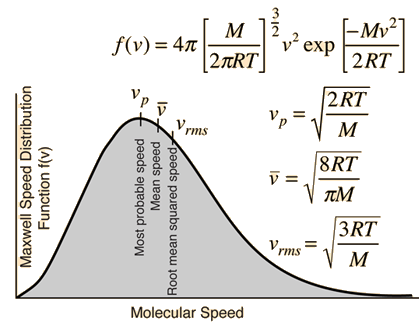
From the Maxwell speed distribution this speed as well as the average and most probable speeds can be calculated.
从动能温度的表达式代入可得到根均方分子速度:根据麦克斯韦速率分布,也可以计算出速度、平均速度和最可能速度。
Index

Kinetic theory concepts
索引 气体动理论概念
 
HyperPhysics***** Heat and Thermodynamics
HyperPhysics ***** 热与热力学
R Nave
Go Back
返回


Maxwell Speed Distribution

麦克斯韦速度分布
The speed distribution for the molecules of an ideal gas is given by
From this function can be calculated several characteristic molecular speeds, plus such things as the fraction of the molecules with speeds over a certain value at a given temperature. It is used in calculating the rates of many phenomena.

Calculation

计算
从这个函数可以计算出几种特征分子速度,以及在给定温度下速度超过某值的分子分数。它被用于计算许多现象的速率。

Note that M is the molar mass and that the gas constant R is used in the expression. If the mass m of an individual molecule were used instead, the expression would be the same except that Boltzmann's constant k would be used instead of the molar gas constant R.

注意,M 是摩尔质量,而气体常数 R 在表达式中被使用。如果使用单个分子的质量 m 代替,表达式将保持相同,只是会使用玻尔兹曼常数 k 而不是摩尔气体常数 R。
Why does the probability peak at some finite value, when the average velocity is zero?
为什么概率在某个有限值处达到峰值,当平均速度为零时?
Development of Maxwell speed distribution from Boltzmann distribution
从玻尔兹曼分布导出麦克斯韦速度分布
Some comments about developing the relationship
关于建立关系的一些评论
理想气体分子的速度分布由
Index

Kinetic theory concepts
索引 气体动理论概念
 
HyperPhysics***** Heat and Thermodynamics
HyperPhysics ***** 热与热力学
R Nave
Go Back
返回


Molecular Speed Calculation

分子速度计算
The speed distribution for the molecules of an ideal gas is given by
The calculation of molecular speed depends upon the molecular mass and the temperature. For mass
m= amu
M= kg/mol
and temperature
T=K
T= C
the three characteristic speeds may be calculated.
The nominal average molecular mass for dry air is 29 amu.
分子速率的计算取决于分子质量和温度。对于质量 m = amu 转换为 M = kg/mol,温度 T = K(T = C)时,可以计算出三种特征速率。干空气的名义平均分子质量为 29 amu。
中文译文中的待填/计算数值依次对应:1:m 2:mb 3:t 4:tc。实际数值以上方原输入框为准。
Most probable speed = vp = m/s = km/hr = mi/hr
Mean speed==m/s = km/hr = mi/hr
RMS speed = vrms = m/s = km/hr = mi/hr
Frequency of collisions
碰撞频率
Mean free path
平均自由程
理想气体分子的速度分布由以下内容给出:最可能速度 = v_p = m/s = km/hr = mi/hr 平均速度= = m/s = km/hr = mi/hr 方均根速度 = v_rms = m/s = km/hr = mi/hr
中文译文中的待填/计算数值依次对应:1:vp 2:vpk 3:vpc 4:vm 5:vmk 6:vmc 7:vr 8:vrk 9:vrc。实际数值以上方原输入框为准。
Index

Kinetic theory concepts
索引 气体动理论概念
 
HyperPhysics***** Heat and Thermodynamics
HyperPhysics ***** 热与热力学
R Nave
Go Back
返回


Development of the Boltzmann Distribution

玻尔兹曼分布的发展

Statistical methods become a more precise way to study nature when the number of particles is large. So we expect that the description of the velocities of molecules in a gas will in fact be the most probable distribution, since we are dealing with particle numbers in the range of Avogadro's number. But this most probable distribution (the Maxwell-Boltzmann distribution) is subject to constraints, namely that the number of particles is constant and that the total energy is constant (conservation of energy). Maximizing the probability distribution subject to those constraints in general is a formidable mathematical task (see Richtmyer, et al., for example). One way to approach the solution in a more intuitive way is to deal with a physical example which we know - namely the physics of an atmosphere under the influence of gravity as reflected in the barometric formula. The following treatment follows the development by Rohlf.

当粒子数量很大时,统计方法成为研究自然的一种更精确的方式。因此,我们期望气体分子的速度分布确实是最可能的分布,因为我们在处理阿伏伽德罗常数范围内的粒子数。但这种最可能的分布(麦克斯韦-玻尔兹曼分布)受到一些约束,即粒子数目保持不变,总能量保持不变(能量守恒)。一般而言,在这些约束条件下最大化概率分布是一个艰巨的数学任务(例如参见Richtmyer等人的工作)。一种更直观地解决方法是通过一个我们已知的物理例子来处理——即在重力作用下的大气物理,如气压公式所反映的。以下的处理方法遵循Rohlf的发展。

In this approach we make use of the fact that the average kinetic energy of the molecules can be expressed in terms of the kinetic temperature. In addition, we know that conservation of energy in this case involves just the balancing of kinetic energy and gravitational potential energy so long as we treat the atmosphere as an ideal gas.

在这一方法中,我们利用了一个事实:分子的平均动能可以表示为动能温度的函数。此外,我们知道在这种情况下,能量守恒仅涉及动能与引力势能之间的平衡,只要我们将大气视为理想气体。

From the expression for kinetic temperature


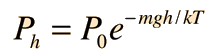
we have an experimentally tested expression for molecular kinetic energy. In the barometric formula:

从分子动能温度的表达式我们得到了一个经过实验验证的分子动能表达式。在巴雷公式中:

we have a description of an ideal gas system which can be used to help develop a plausibility argument for the Maxwell velocity distribution. The steps in this process are as follows:

我们有一个理想气体系统的描述,可以用来帮助为麦克斯韦速度分布提出一个合理的论据。该过程的步骤如下:
Relate particle velocity to height.
将粒子速度与高度联系起来
Relate particle flux to the velocity distribution.
将粒子通量与速度分布联系起来
Relate velocity distribution to the barometric formula.
将速度分布与巴雷公式联系起来。
Calculate the velocity distribution and normalize it.
计算速度分布并进行归一化

For one direction in space this process yields the expression:

对于空间中的一个方向,这个过程得出的表达式为:

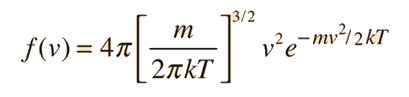
and when all directions of velocity are included, it becomes the Maxwell speed distribution relationship:

当所有速度方向都包括在内时,它就变成了麦克斯韦速率分布关系:
Why is this relationship skewed toward higher speeds while the one directly above is not?
为什么这种关系更偏向于高速度,而上面那种直接的关系却不是这样?

It should be noted that although we used a gravity-dependent physical situation to obtain the velocity distribution, gravity does not appear in the final result. That is, the result obtained is a general one, not containing g. The barometric formula was simply used as a construct to relate the velocity distribution to energy and particle number constraints.

应注意的是,尽管我们使用了一个依赖重力的物理情境来获得速度分布,但最终结果中并未出现重力。也就是说,所得结果是一个普遍的结论,不包含g。巴雷特公式只是被用作一个构造,用来将速度分布与能量和粒子数约束联系起来。
Index

Kinetic theory concepts

Reference
Rohlf
Sec 2-3
索引 气体动理论概念 参考 Rohlf 第2-3节
 
HyperPhysics***** Heat and Thermodynamics
HyperPhysics ***** 热与热力学
R Nave
Go Back
返回