Bilingual edition: English is preserved and Chinese follows each unit. Terminology uses the confirmed v20260916 glossary; automated semantic review remains traceable.
中英双语版:英文原文完整保留,中文紧随对应单元;术语采用 v20260916 确认表,自动语义审校结果可追溯。

First Law of Thermodynamics

热力学第一定律

The first law of thermodynamics is the application of the conservation of energy principle to heat and thermodynamic processes:
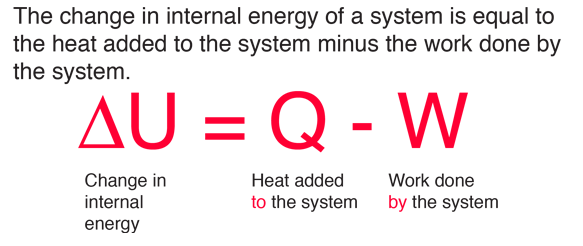
热力学第一定律是将能量守恒原理应用于热力学和热过程的体现:

The first law makes use of the key concepts of internal energy, heat, and system work. It is used extensively in the discussion of heat engines. The standard unit for all these quantities would be the joule, although they are sometimes expressed in calories or BTUs.

第一定律使用了内能、热量和系统功这几个关键概念。它在热机讨论中被广泛应用。这些量的标准单位是焦耳,尽管有时也用卡路里或英热单位来表示。

It is typical for chemistry texts to write the first law as ΔU=Q+W. It is the same law, of course - the thermodynamic expression of the conservation of energy principle. It is just that W is defined as the work done on the system instead of work done by the system. In the context of physics, the common scenario is one of adding heat to a volume of gas and using the expansion of that gas to do work, as in the pushing down of a piston in an internal combustion engine. In the context of chemical reactions and processes, it may be more common to deal with situations where work is done on the system rather than by it.

化学教材通常将第一定律写成ΔU=Q+W。当然,这仍然是同一定律——热力学中能量守恒原理的表达。不同之处在于,W被定义为系统所受的功,而不是系统对外做的功。在物理的语境中,常见的情况是向一定体积的气体加热,并利用该气体的膨胀来做功,例如内燃机中活塞的下行。而在化学反应和过程中,更常见的情况可能是处理系统所受的功,而不是系统对外做的功。
Internal Energy in the Thermodynamic Identity
热力学恒等式中的内能
Index

Heat engine concepts
热机概念索引
 
HyperPhysics***** Thermodynamics
HyperPhysics ***** 热力学
R Nave
Go Back
返回


Enthalpy

焓

Four quantities called "thermodynamic potentials" are useful in the chemical thermodynamics of reactions and non-cyclic processes. They are internal energy, the enthalpy, the Helmholtz free energy and the Gibbs free energy. Enthalpy is defined by

四个称为“热力学势”的量在化学热力学中用于反应和非循环过程的分析。它们是内能、焓、亥姆霍兹自由能和吉布斯自由能。焓定义为
H = U + PV

where P and V are the pressure and volume, and U is internal energy. Enthalpy is then a precisely measurable state variable, since it is defined in terms of three other precisely definable state variables. It is somewhat parallel to the first law of thermodynamics for a constant pressure system

其中P和V是压强和体积,U是内能。焓则是一个可以精确测量的状态变量,因为它是由三个其他可以精确定义的状态变量所定义的。它在某种程度上与定压系统的第一定律相似。
Q = ΔU + PΔV since in this case Q=ΔH

It is a useful quantity for tracking chemical reactions. If as a result of an exothermic reaction some energy is released to a system, it has to show up in some measurable form in terms of the state variables. An increase in the enthalpy H = U + PV might be associated with an increase in internal energy which could be measured by calorimetry, or with work done by the system, or a combination of the two.

The internal energy U might be thought of as the energy required to create a system in the absence of changes in temperature or volume. But if the process changes the volume, as in a chemical reaction which produces a gaseous product, then work must be done to produce the change in volume. For a constant pressure process, the work you must do to produce a volume change ΔV is PΔV. Then the term PV can be interpreted as the work you must do to "create room" for the system if you presume it started at zero volume.

内能U可以被理解为在没有温度或体积变化的情况下创建系统的能量。但如果过程改变了体积,例如在产生气体产物的化学反应中,就必须做功以产生体积变化。对于恒定压力过程,为了产生体积变化ΔV,你必须做的功是PΔV。然后项PV可以被解释为如果你假设系统初始体积为零,为了‘创造空间’而必须做的功。
Table of enthalpy changes
焓变表
H = U + PV Q = ΔU + PΔV 因为在这种情况下 Q=ΔH 它是跟踪化学反应的一个有用量。如果由于一个放热反应,一些能量释放到系统中,它必须以某种可测量的形式体现在状态变量中。焓 H = U + PV 的增加可能与内能的增加有关,这可以通过热量计测量,或者与系统所做的功有关,或者两者结合。
Index

Internal energy concepts
索引 内能概念
 
HyperPhysics***** Thermodynamics
HyperPhysics ***** 热力学
R Nave
Go Back
返回


System Work

系统功

When work is done by a thermodynamic system, it is usually a gas that is doing the work. The work done by a gas at constant pressure is:

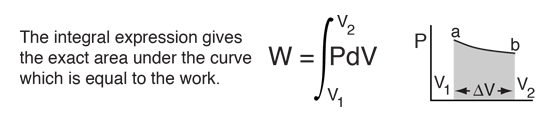
For non-constant pressure, the work can be visualized as the area under the pressure-volume curve which represents the process taking place. The more general expression for work done is:

对于非恒定压力,功可以可视化为压力-体积曲线下的面积,该曲线代表发生的进程。更一般的功的表达式为:

Work done by a system decreases the internal energy of the system, as indicated in the First Law of Thermodynamics. System work is a major focus in the discussion of heat engines.

系统对外做的功会降低系统的内能,如第一热力学定律所示。系统功在热机讨论中是一个重点。
当热力学系统做功时,通常是气体在做功。在恒定压力下,气体所做的功为:
Index

Heat engine concepts
热机概念索引
 
HyperPhysics***** Thermodynamics
HyperPhysics ***** 热力学
R Nave
Go Back
返回