Bilingual edition: English is preserved and Chinese follows each unit. Terminology uses the confirmed v20260916 glossary; automated semantic review remains traceable.
中英双语版:英文原文完整保留,中文紧随对应单元;术语采用 v20260916 确认表,自动语义审校结果可追溯。

Edge Tone

边缘音
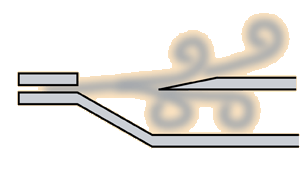
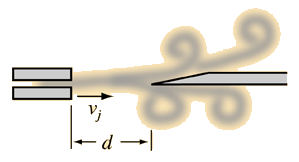
When air is directed at an edge, it does not divide smoothly, but tends to move to one side and form a swirl or vortex. Predisposed toward vortex formation by the flow through the slit, the resulting undulating flow may take the stream below the edge. As noted below, the behavior of an edge which is associated with a pipe is quite different from that of a free edge.
当空气 directed 到边缘时,它不会平滑地分开,而是倾向于向一侧移动并形成旋涡或涡流。由于流经狭缝的流动倾向于形成涡流,因此 resulting 的波动流动可能使流体流到边缘下方。如下所述,与管道相关的边缘行为与自由边缘的行为 quite 不同。

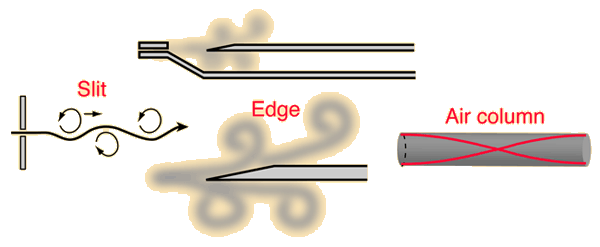
The pressure created by this interaction with the edge feeds back to the area of the slit, tending to push the stream upward. The reverse happens when the stream moves to the top side of the edge and then the process repeats itself. As a result, a periodic flipping of the airstream from side to side can produce a sound called an edge tone. More efficient edge tone instruments can be created by coupling a slit, an edge, and an air column. When such an instrument has been produced, the frequency is determined primarily by the air column resonant frequencies which will control the rate of oscillation of the air across the edge. The edgetone effect in such an instrument serves to help initiate and sustain the tone, and can help make the transition to a higher harmonic of the air column.

这种与边缘的相互作用所产生的压力会反馈到狭缝区域,倾向于将气流向上推。当气流移动到边缘的顶部时,情况则相反,这一过程会重复发生。因此,气流在两侧来回翻转的周期性运动可以产生一种称为边缘音的声音。通过将狭缝、边缘和空气柱结合,可以制造出更高效的边缘音乐器。一旦这种乐器被制造出来,频率主要由空气柱的共振频率决定,这将控制空气在边缘处的振荡速率。这种边缘音效应有助于启动和维持音色,并可以帮助过渡到空气柱的更高泛音。

The difference between the "edgetone" as envisioned in the sounding of a flute, recorder, organ pipe, etc. and the tones produced by directing air over an edge which is not coupled to an air column has been a subject of considerable discussion and investigation. Benade comments "Until recently there has been a tendency ... to confuse the sounds produced by blowing a narrow air jet against a sharp edge when the edge forms part of a flute or an organ pipe (air reed behavior) with those produced when the system is run in isolation (edge-tone behavior). In the latter case a type of repetitive eddying called vortex shedding takes place on alternate sides of the air jet, and a sound is produced if a sharp edge is used to separate the two sets of vortices. Vortex phenomena have only a secondary influence on flute-type sound production; moreover, at ordinary musical blowing pressures the edge-tone frequencies are so high as to be nearly inaudible.

关于吹奏笛子、竖笛、管风琴等乐器时所发出的'边音'与通过将空气吹过一个不与空气柱耦合的边缘所产生声音之间的差异,一直是讨论和研究的焦点。Benade指出:‘直到最近,人们倾向于混淆将狭窄的气流吹向锐利边缘时所产生的声音(即笛子或管风琴的空气簧行为),与系统孤立运行时所产生的声音(即边音行为)。在后者情况下,气流在气流的两侧交替产生一种重复的涡旋现象,称为涡旋脱落,如果使用锐利边缘将两组涡旋分开,就会产生声音。涡旋现象对笛子类声音的产生只有次要影响;而且在普通音乐吹奏压力下,边音频率非常高,几乎听不见。

Some of the literature which addresses the differences between the free edgetones and the behavior of the edges in flutes and organ pipes:

  1. Coltman, John W., "Sounding Mechanism of the Flute and Organ Pipe", J. Acoust. Soc. Am. 44 (1968)
    Coltman, John W., '管风琴与管乐器的发声机制', 《声学学会杂志》44 (1968)
  2. Fletcher, N. H., "Nonlinear Interactions in Organ Flue Pipes," J. Acoust. Soc. Am. 56 (1974)
    弗莱彻,N. H.,《风琴管中的非线性相互作用》,《声学学会杂志》56(1974)
  3. Bouasse, H., Instruments a' Vent, 2 vols., Paris: Librairie Delagrave, 1929,1930.
    布瓦塞,H.,《风中的仪器》,2卷,巴黎:德拉格雷出版社,1929,1930年。
  4. Cremer, L. and Ising, H., "Die selbsterregten Schwingungen von Orgelpfeifen," Acustica 19, 143-153,(1968)
    Cremer, L. 和 Ising, H., 'Orgelpfeifen的自激振动,' Acustica 19, 143-153,(1968)
  5. Elder, S. A., "Edgetones versus Pipetones," J. Acoust. Soc. Am. 64, 1721-1723, (1978)
    Elder, S. A., 'Edgetones versus Pipetones,' J. Acoust. Soc. Am. 64, 1721-1723, (1978)

一些讨论自由边缘与风琴管和管风琴边缘行为差异的文献:
Effect of increasing air velocity
空气速度增加的影响
Changing slit-to-edge distance
改变狭缝到边缘的距离
Flute as edge tone instrument
flute 作为边缘音乐器
"Flow-controlled valve model" for pipe excitation
管路激励的流量控制阀模型
Index

Woodwind instruments

Musical instruments

References
Benade
Sec 22.6, p492
索引 木管乐器 音乐乐器 参考文献 Benade 第22章第6节,第492页
 
HyperPhysics***** Sound
HyperPhysics ***** 声音
R Nave
Go Back
返回


Slit, Edge and Air Column

缝隙、边缘和空气柱

The slit aids tone production because air forced through a slit or small opening tends toward an undulating path with side eddies spun off from it. This aids the vortex formation when it strikes the edge.

狭缝有助于发声,因为通过狭缝或小开口强制吹气时,气流倾向于形成波动路径,并从其边缘产生侧涡流。这有助于涡流的形成。
The unconstrained edge tone has a frequency proportional to the airstream velocity and inversely proportional to the diameter of the edge. It is a source of oscillation in the air and helps initiate and sustain the tone produced by airflow over an isolated edge. For musical instruments such as the flute and organ pipe, the role of the edge is viewed differently; the unconstrained edge frequency is actually much higher than the playing frequency. The oscillation in the pipe is sometimes modeled as a "flow-controlled valve".
无约束边缘的音调频率与气流速度成正比,与边缘直径成反比。它在空气中产生振动,并有助于引发和维持气流经过孤立边缘所产生的音调。对于如 flute( flute 为音管乐器,此处应译为‘竖笛’)和管风琴这样的乐器,边缘的作用有所不同;实际上,无约束边缘频率远高于演奏频率。管中的振动有时被建模为一种‘流控阀’。
The air column has natural resonant frequencies determined by its length and tends to take control and determine the frequency of the tone initiated by the air oscillation at the edge. The air column becomes the dominant effect on the air vibrations in the instrument, and will force the air oscillation at the edge to match the natural frequency of the air column.
空气柱的自然共振频率由其长度决定,并倾向于控制和确定由空气振荡在边缘引发的音调的频率。空气柱在乐器中成为主导因素,会迫使边缘的空气振荡与空气柱的自然频率相匹配。
Edge tone
边缘音
Index

Woodwind instruments

Musical instruments
索引 长笛类乐器 音乐乐器
 
HyperPhysics***** Sound
HyperPhysics ***** 声音
R Nave
Go Back
返回


Air Oscillations from Slits

从缝隙产生的空气振荡

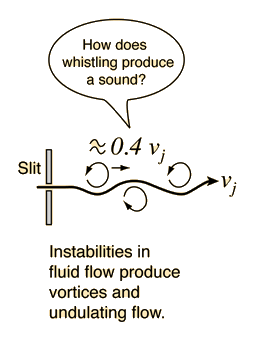
When air is forced through a small opening or slit, the fast-moving airstream moves through slower air. It's edges meet resistance from that slower air and tend to peel back and form vortices. These vortices interact with the stream, exerting a sideways influence on it and causing it to move in an undulating path. This undulation can actually produce a substantial amount of sound, as when you whistle. An even greater amount of sound can be produced by coupling the slit to an edge.

当空气被强制通过一个小孔或狭缝时,高速流动的气流会穿过较慢的空气。气流的边缘会遇到较慢空气的阻力,从而向后卷曲并形成涡旋。这些涡旋与气流相互作用,对气流产生侧向影响,使其沿波动路径移动。这种波动实际上可以产生相当大的声音,就像吹口哨时一样。如果将狭缝与边缘耦合,可以产生更多的声音。

The undulations in the stream move along the stream at something less than one half the speed of the air in the stream ( about 0.4 V according to Backus). Then the faster the airstream speed, the faster the oscillations of the stream when it hits an edge.

溪流中的波动以小于溪流中空气速度一半的速度沿溪流传播(据Backus称约为0.4V)。当溪流遇到边缘时,空气流速越快,溪流的振荡越快。
For other discussions see Rigden p114 and Backus p 220.
Flute discussion
长笛讨论
其他讨论请参见Rigden第114页和Backus第220页。
Index

Woodwind instruments

Musical instruments

Reference
Hall
p. 235
索引 长笛类乐器 音乐乐器 参考 Hall 页 235
 
HyperPhysics***** Sound
HyperPhysics ***** 声音
R Nave
Go Back
返回


Slit and Edge

缝和边缘

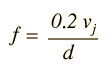
For a slit and an edge, not coupled to an air column, the frequency of the edgetone tends to be about

对于不连接到空气柱的狭缝和边缘,边缘音的频率通常约为

for the first main edgetone regime.

对于第一主边缘态区域

This regime, referred to as Region I of the edgetone behavior, is the main operating mode for organ pipes and presumably also for the flute. Note that the pitch can be made to go up by either increasing the airstream velocity, or by decreasing the distance from the slit to the edge (both applicable to playing the flute). Because of the feedback mechanism to the slit, the effective diameter of the edge does not figure directly in this pitch relationship as it does in the case of aeolian tones.

这种模式被称为边缘音行为的Region I,是管风琴的主要工作模式,可能也是 flute 的主要工作模式。需要注意的是,可以通过增加气流速度或减小缝隙到边缘的距离(这两种方法都适用于演奏 flute)来使音调升高。由于反馈机制作用于缝隙,因此在这一音调关系中,边缘的有效直径并不像在 aeolian 音调情况下那样直接参与其中。
Flute discussion
长笛讨论
Index

Woodwind instruments

Musical instruments

Reference
Hall
p. 235
索引 长笛类乐器 音乐乐器 参考 Hall 页 235
 
HyperPhysics***** Sound
HyperPhysics ***** 声音
R Nave
Go Back
返回