Bilingual edition: English is preserved and Chinese follows each unit. Terminology uses the confirmed v20260916 glossary; automated semantic review remains traceable.
中英双语版:英文原文完整保留,中文紧随对应单元;术语采用 v20260916 确认表,自动语义审校结果可追溯。

"Flow-controlled Valve" Model for Pipe Excitation

用于管道激励的'流量控制阀'模型

The process of sounding a flute or a flue-type organ pipe employs an airstream directed at an edge. However, the process differs so much from the process of directing an airstream on an isolated edge that it is modeled in different ways and different language is used to describe it. Rossing's Science of Sound uses the term "air reed" to describe the situation in which the oscillating air stream is the means for excitation of the pipe sound. In using the "air reed" terminology, it is pointed out that the oscillation is controlled not by pressure, but by the air flow. The edge structure represents an "open end" for the pipe, and thus is a pressure node. The open end is an antinode for air motion (air displacement antinode) and this maximized air flow associated with the standing waves of the pipe can drive the oscillation of the airstream. By contrast, the mouthpiece end of a clarinet with its reed constitutes an acoustical "closed end", a pressure antinode which provides pressure feedback to help stabilize and control the reed oscillation.

吹奏长笛或风管管风琴的过程是将气流 directed at 一个边缘。然而,这一过程与将气流 directed on 一个孤立边缘的过程差别很大,因此用不同的方式来建模,也使用不同的语言来描述。Rossing 的《声音科学》使用“空气簧片”这一术语来描述气流振荡作为管声激发的手段的情况。在使用“空气簧片”这一术语时,指出振荡不是由压力控制,而是由气流控制。边缘结构代表管的“开放端”,因此是一个压力节点。开放端是空气运动的抗节点(空气位移抗节点),这种与管的驻波相关的最大气流可以驱动气流的振荡。相比之下,萨克斯管的吹口与簧片构成一个“声学封闭端”,这是一个压力抗节点,可以提供压力反馈以帮助稳定和控制簧片的振荡。

The description of the excitation process as a "flow-controlled valve" or "flow-controlled oscillator" dates back to Helmholtz in his investigation of cavity resonance. The tone you produce by blowing over a coke bottle involves air oscillation in and out of the mouth of the bottle which can be described as "flow controlled". When the air is flowing out of the bottle, it directs the airstream outward, and when the airflow associated with the resonant vibration is inward, it directs the airstream inward to provide energy to sustain the oscillation. Helmholtz described the flute excitation in the same sort of way, with the air motion from a standing wave forcing the players airstream out of and into the flute periodically.

将激发过程描述为“流量控制阀”或“流量控制振荡器”的说法可以追溯到亥姆霍兹在研究腔体共振时的探讨。当你用嘴吹过一个可乐瓶时,产生的声音涉及空气在瓶口的进出 oscillation,这可以被描述为“流量控制”。当空气从瓶中流出时,它会将气流导向外部,而当与共振振动相关的气流向内流动时,它会将气流导向内部以维持振荡。亥姆霍兹以相同的方式描述了 flute 的激发,即通过驻波中的空气运动周期性地将演奏者的气流推出和吸入 flute。

Benade comments on the shortcomings of Helmholtz's model, explaining that the player's airstream lags considerably behind these air motion changes from the pipes standing waves. He cites the work of Coltman and Fletcher as clarifying some of the details of the "flow-controlled valve" action at the flute's embouchure hole. Their work highlighted the importance of the transit time from the players lips to the side of the embouchure hole and its relationship to the periods of oscillation of the sound components (harmonics) present in the tone.

Benade指出Helmholtz模型的不足,解释说玩家的气流明显滞后于管状驻波所引起的空气运动变化。他引用Coltman和Fletcher的工作,以澄清 flute 嘴部孔处的‘流控阀’作用的一些细节。他们的工作强调了从玩家嘴唇到嘴孔侧面的传输时间的重要性,以及它与声音成分(谐波)振荡周期的关系。

Hall discusses the nature of edges and the excitation of organ pipes. The role of the eddies or swirls in the air at the edge is explored and some illustration is given of feedback mechanisms which presumably contribute to the oscillation of the airstream and help with the sounding of the pipe at its resonant frequencies.

Hall探讨了边缘的性质以及管风琴的激发现象。探讨了边缘处空气涡流或旋涡的作用,并给出了一些关于反馈机制的示例,这些机制可能有助于气流的振荡,并有助于管风琴在共振频率下的发声。

The difference between the "edgetone" as envisioned in the sounding of a flute, recorder, organ pipe, etc. and the tones produced by directing air over an edge which is not coupled to an air column has been a subject of considerable discussion and investigation. Benade comments "Until recently there has been a tendency ... to confuse the sounds produced by blowing a narrow air jet against a sharp edge when the edge forms part of a flute or an organ pipe (air reed behavior) with those produced when the system is run in isolation (edge-tone behavior). In the latter case a type of repetitive eddying called vortex shedding takes place on alternate sides of the air jet, and a sound is produced if a sharp edge is used to separate the two sets of vortices. Vortex phenomena have only a secondary influence on flute-type sound production; moreover, at ordinary musical blowing pressures the edge-tone frequencies are so high as to be nearly inaudible".

关于‘边缘涡流’作为吹奏笛子、竖笛、管风琴等乐器发声时所设想的‘边缘涡流’与通过将空气吹过一个不与空气柱耦合的边缘所产生声音之间的差异,一直是讨论和研究的焦点。Benade指出:‘直到最近,人们倾向于将吹奏狭窄气流冲击锐利边缘时产生的声音(即笛子或管风琴的空气簧行为)与系统孤立运行时产生的声音(边缘涡流行为)混淆。在后者情况下,气流在气流的两侧交替产生一种重复的涡旋现象,称为涡旋脱落,如果使用锐利边缘将两组涡旋分离,就会产生声音。涡旋现象对笛子类发声方式仅有次要影响;此外,在普通音乐吹奏压力下,边缘涡流频率如此之高,几乎听不见。

Some of the literature which addresses the differences between the free edgetones and the behavior of the edges in flutes and organ pipes:

  1. Coltman, John W., "Sounding Mechanism of the Flute and Organ Pipe", J. Acoust. Soc. Am. 44 (1968)
    Coltman, John W., '管风琴与管乐器的发声机制', 《声学学会杂志》44 (1968)
  2. Fletcher, N. H., "Nonlinear Interactions in Organ Flue Pipes," J. Acoust. Soc. Am. 56 (1974)
    弗莱彻,N. H.,《风琴管中的非线性相互作用》,《声学学会杂志》56(1974)
  3. Bouasse, H., Instruments a' Vent, 2 vols., Paris: Librairie Delagrave, 1929,1930.
    布瓦塞,H.,《风中的仪器》,2卷,巴黎:德拉格雷出版社,1929,1930年。
  4. Cremer, L. and Ising, H., "Die selbsterregten Schwingungen von Orgelpfeifen," Acustica 19, 143-153,(1968)
    Cremer, L. 和 Ising, H., 'Orgelpfeifen的自激振动,' Acustica 19, 143-153,(1968)
  5. Elder, S. A., "Edgetones versus Pipetones," J. Acoust. Soc. Am. 64, 1721-1723, (1978)
    Elder, S. A., 'Edgetones versus Pipetones,' J. Acoust. Soc. Am. 64, 1721-1723, (1978)

一些讨论自由边缘与风琴管和管风琴边缘行为差异的文献:
Effect of increasing air velocity
空气速度增加的影响
Changing slit-to-edge distance
改变狭缝到边缘的距离
Flute as edge tone instrument
flute 作为边缘音乐器
Index

Woodwind instruments

Musical instruments

References
Rossing
Science of Sound, 2nd Ed. Sec 12.8

Helmholtz

Coltman
JASA 1968

Fletcher
JASA 1974

Hall
Ch 12
索引 风管乐器 音乐乐器 参考文献 Rossing 《声音的科学》第二版 第12章 Helmholtz Coltman 1968 Fletcher 1974 Hall 第12章
  HyperPhysics***** Sound
HyperPhysics ***** 声音
Go Back
返回


Oscillations at a Free Edge

自由边缘的振动

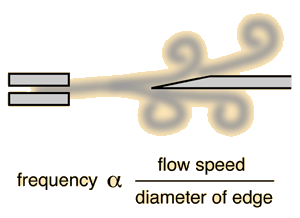
If you directed air or a liquid toward a sharp edge, you might expect it to divide evenly and smoothly at the edge. But nature doesn't behave that way. You tend to get oscillations of the flow back and forth across the edge. This has long been associated with the the formation of swirls or vortices in the flow. It is observed that the frequency of the oscillation tends to go up linearly with the flow velocity, but that the frequency for a larger diameter "edge" is lower.

如果你将空气或液体 directed 向一个尖锐的边缘,你可能会期望它在边缘处均匀且平滑地分开。但自然界的行为并非如此。你往往会观察到流体在边缘处来回的振荡。这种现象长期以来一直与流体中旋涡或涡流的形成有关。观察发现,振荡的频率随着流速线性增加,但对于较大直径的‘边缘’,其频率却较低。

This fluid driven oscillation is observed in a wide variety of settings. One of the most familiar is the singing of tightly stretched electric wires in the wind. My wife and I lived in North Wales for a year and heard this sound daily. Outside the bedroom of our third floor "flat" was a thin, tightly stretched electric wire which was constantly exposed to the wind off the Menai Strait. We awoke every morning to the sound of the wire singing in the wind, so we had an instant weather report since a higher pitch meant higher wind speed. Our common line was "The wire is up to an F this morning! Let's stay in bed!"

这种由流体驱动的振荡现象在许多不同环境中都能观察到。最熟悉的例子之一是强风中紧绷的电力线发出的鸣响。我和我的妻子在威尔士北部住了一年,每天都能听到这种声音。我们三楼的卧室外侧有一根细而紧绷的电力线,它始终暴露在从曼奈海峡吹来的风中。我们每天早上都会被这根线在风中鸣响的声音唤醒,因此这相当于一个即时的天气报告,因为音调越高,风速越快。我们的口头约定是:‘今天早上这根线音调到了F,我们待在床上吧!’

Other common examples of fluid-driven oscillations:

其他常见的流体驱动振荡示例:
  1. The strap you use to tie a load on a pickup truck will vibrate in the wind. Often you can see examples of the fundamental string mode of vibration in a tightly stretched strap in the wind.
    用于固定卡车载重的皮带在风中会振动。你常常可以看到在风中紧绷的皮带振动时的基本振动模式。
  2. If you tried to use plastic to cover the load described above, you find out that any exposed edge of the plastic will oscillate wildly in the wind, so that it is hard to keep a load covered if any edges are exposed. Corners of a cover or loose ends of a strap will flap so wildly that they tend to fray.
    如果你尝试用塑料覆盖上述负载,会发现任何暴露的塑料边缘在风中都会剧烈摆动,因此如果任何边缘暴露在外,很难保持负载被覆盖。覆盖物的角落或松散的带子末端会剧烈摆动,容易撕裂。
  3. A flag on a flagpole will flutter in the wind. A steady wind will generate a rapid fluttering of the cloth of the flag.
    旗杆上的旗帜会在风中飘动。稳定的风会使得旗帜布料快速飘动。
  4. A kite in the wind demonstrates the diameter dependence of the fluid-induced oscillation. The kite material will flutter rapidly from the component of wind directed toward its edge, but will also bob slowly back and forth in the wind, presumably from the component of wind directed toward the full area of the kite. Acting as a larger barrier, the body of the kite experiences a slower oscillation.
    风中的风筝展示了流体诱导振荡的直径依赖性。风筝材料会因风向其边缘的分量而迅速颤动,但也会因风向整个风筝面积的分量而缓慢地在风中前后摆动。作为更大的屏障,风筝的本体会经历更慢的振荡。
  5. If you dip your fingers in water and move your hand quickly through the water, your fingers will beat together, presumably because of fluid-induced oscillation.
    如果你将手指浸入水中并快速通过水移动手,你的手指会相互拍打,可能是由于流体诱导的振荡。
  6. Direct the stream of a hose on a twig or stalk. If you hold the stream steady, you will observe the twig to start an oscillation back and forth in the stream.
    将水 hose 的水流对着一根树枝或茎部 directed,如果保持水流稳定,你会观察到树枝开始在水流中来回振动。
  7. A fluid oscillation you can feel is in the experience of mounting a slalom water ski. As the ski breaks the surface of the water and begins to plow through the water, it will begin to oscillate back and forth. That's when you usually fall! If you make it through the oscillation period and get the ski up on a plane, it ceases to oscillate.
    你可以在体验滑水转弯时感受到流体的振荡。当滑板破水而出并开始切开水面时,它会开始来回振荡。这时你通常会摔倒!如果你能度过振荡期并将滑板抬升到平面上,它就不再振荡了。

If you blow with increasing air stream velocity on a whistle composed of a slit and an edge, you will note that you get jumps in pitch and experience several ranges of edgetones. Associated with the vortices in the flow, there are several regimes of edge tones . The illustration below is adapted from Hall, who references the work of Coltman. It associated the different edgetone regimes with patterns of vortex formation and feedback to the slit from the edge.
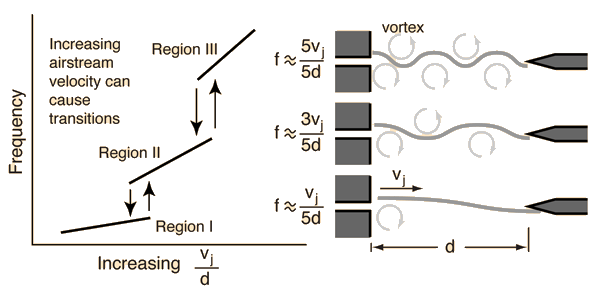
如果你在 whistle 上以逐渐增加的气流速度吹气,你会注意到音调会出现跳跃,并体验到几个音调范围的 edgetones。与流动中的涡旋相关,存在几个 edgetone 的 regime。下图改编自 Hall 的工作,他引用了 Coltman 的研究。它将不同的 edgetone regime 与涡旋形成模式和从边缘反馈到 slit 的情况相关联。
Edge tone
边缘音
Index

References

Hall
Ch 12

Coltman
JASA 1976
索引参考 Hall 第12章 Coltman JASA 1976
  HyperPhysics***** Sound
HyperPhysics ***** 声音
Go Back
返回