Feynman Diagrams and the Strong Force
At the most fundamental level, the strong force is an exchange force between quarks mediated by gluons. The use of Feynman diagrams to visualize the strong interaction involves primitive vertices with quarks and gluons. Quarks interact with each other by the exchange of gluons; a primitive vertex in the Feynman diagram involves a change in "color" and can take the form
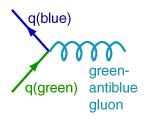
The gluons carry the "color charge" and therefore the emergent quark will not have the same color as the entering quark. This process is very different from the electromagnetic force since the photon as the exchange particle for the force between charges does not itself carry charge. An interaction between quarks could be represented by the diagram
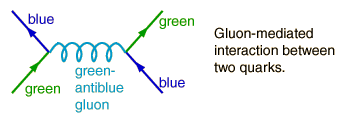
The interaction depicted here is responsible for binding quarks together into mesons and baryons, and responsible for holding protons and neutrons together to form nuclei.
|
Particles can decay via the strong interaction, and if such a decay pathway is available to a particle, it decays very quickly - on the order of 10-23 seconds. An example is the decay Δ0 → p+ + π-. Note that the delta baryon Δ0 has the same quark makeup as the neutron, but its mass is much larger. Its mass is sufficient for this decay to be energetically favorable. 粒子可以通过强相互作用衰变,如果某种衰变路径对一个粒子是可行的,它会迅速衰变——大约在10⁻²³秒的量级。一个例子是Δ⁰ → p⁺ + π⁻。请注意,Δ⁰重子的夸克组成与中子相同,但其质量大得多。其质量足以使这种衰变在能量上是有利的。 |
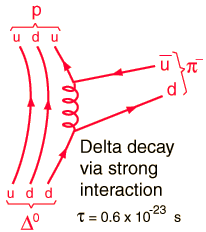 |
Because gluons carry color, the property associated with the strong interaction, then they can interact with each other. Possible Feynman diagrams for those interactions are
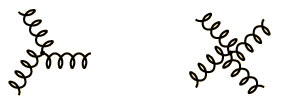
This possibility of "glueballs" greatly increases the complexity of the strong interaction. In addition to bound quarks, there can be collections of bound gluons hanging around.
Fundamental force concepts
Reference
Griffiths
Ch 2
| HyperPhysics***** Quantum Physics
HyperPhysics ***** 量子物理 | R Nave |