Bilingual edition: English is preserved and Chinese follows each unit. Terminology uses the confirmed v20260916 glossary; automated semantic review remains traceable.
中英双语版:英文原文完整保留,中文紧随对应单元;术语采用 v20260916 确认表,自动语义审校结果可追溯。

System Matrix

系统矩阵

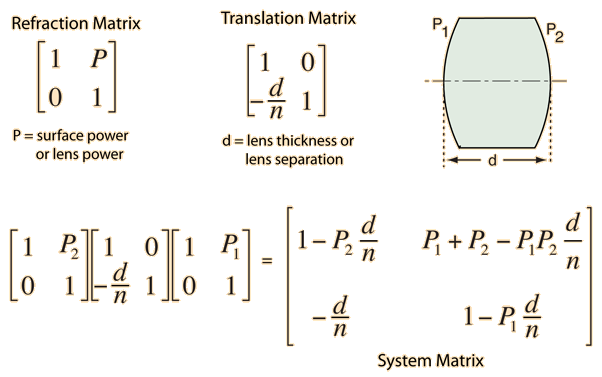
For systems of multiple thick lenses, it is sometimes useful to represent the system by a system matrix. The matrix is built up by multiplying the refraction matrices and translation matrices. The positions of the principal planes, the front and back surface powers, and the equivalent focal length of Gullstrand's equation can be calculated from the system matrix.

对于多个厚透镜系统,有时用系统矩阵来表示该系统是有用的。该矩阵由折射矩阵和位移矩阵相乘构成。主平面的位置、前表面和后表面的屈光力,以及Gullstrand方程的等效焦距可以从系统矩阵中计算出来。
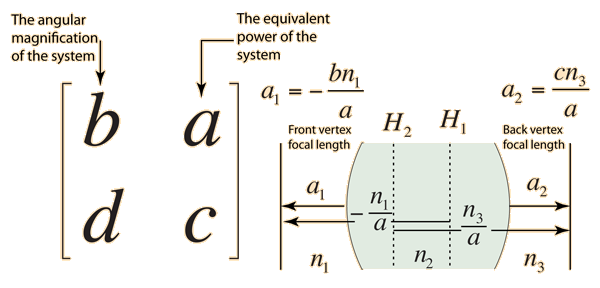
This is the form of the system matrix used by Meyer-Arendt. An alternate form is used by Hecht.

这是Meyer-Arendt使用的系统矩阵形式。另一种形式则被Hecht采用。
Example calculation of system matrix and principal planes
系统矩阵和主平面的计算示例
Calculations
计算
Alternate form of system matrix: Hecht form
系统矩阵的另一种形式:Hecht形式
Index

Lens concepts

Thick lens concepts

References
Meyer-Arendt

Hecht
索引 透镜概念 厚透镜概念 参考文献 Meyer-Arendt Hecht
 
HyperPhysics***** Light and Vision
HyperPhysics ***** 光与视觉
R Nave
Go Back
返回


Refraction and Translation Matrices

折射与平移矩阵

The system matrix for a thick lens is obtained by multiplying the translation matrix associated with the thickness of the lens times refraction matrix of the first surface and then multiplying by the refraction matrix of the back surface.

厚透镜的系统矩阵是通过将与透镜厚度相关的平移矩阵乘以第一表面的折射矩阵,然后再乘以后表面的折射矩阵得到的。
Refraction matrix development
折射矩阵开发
Translation matrix development
翻译矩阵开发
Alternate form : Hecht form
另一种形式:Hecht形式
Index

Lens concepts

Reference
Meyer-Arendt
索引透镜概念 参考 Meyer-Arendt
 
HyperPhysics***** Light and Vision
HyperPhysics ***** 光与视觉
R Nave
Go Back
返回


Refraction Matrix

折射矩阵

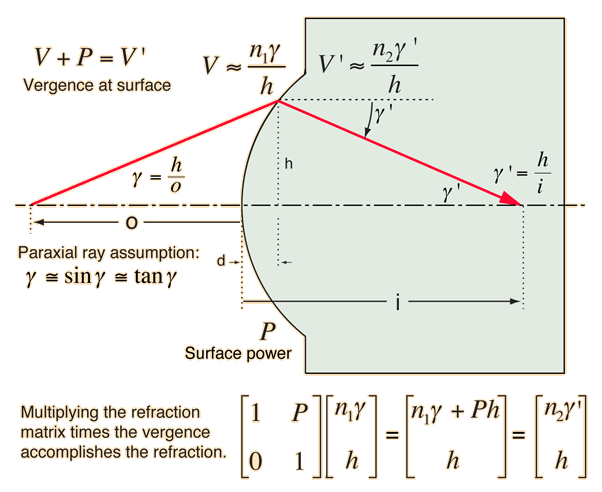
The use of vergence to describe the refraction at an interface can be used as a starting point for developing a matrix to perform the refraction. Note that the approximations made are valid only for paraxial rays.

用汇聚度来描述界面处的折射可以作为构建矩阵以进行折射分析的起点。需要注意的是,所作的近似仅适用于近轴光线。

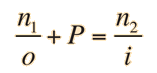
The vergence relationship for a surface is

表面的汇聚关系

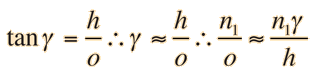
and the relevant paraxial approximations are

以及相关的近轴近似

These are applied to the refraction at a surface. For more geometrical detail, see surface power.

这些应用于表面的折射。如需更详细的几何说明,请参见表面功率。

Note that the process involves arbitrarily treating the numerator and denominator of the vergence fraction as the elements of a column vector and using matrix multiplication. This is a strategy to represent the refraction as a matrix in such a way that it accomplishes the refraction.

需要注意的是,这个过程是任意地将 vergence 分数的分子和分母视为列向量的元素,并利用矩阵乘法进行处理。这是一种将折射表示为矩阵的方式,以实现折射效果。
Index

Lens concepts

Reference
Meyer-Arendt
索引透镜概念 参考 Meyer-Arendt
 
HyperPhysics***** Light and Vision
HyperPhysics ***** 光与视觉
R Nave
Go Back
返回


Translation Matrix

翻译矩阵

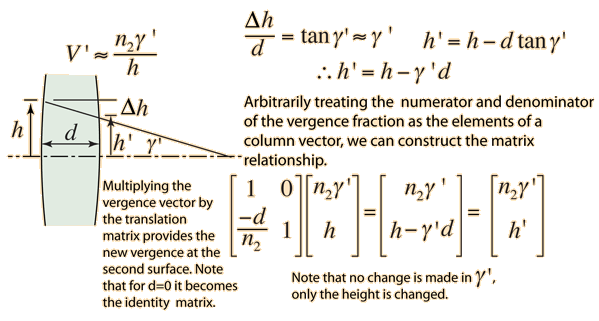
The geometry of translation across the thickness of a lens can be put in matrix form for rays satisfying the paraxial approximation.

透镜的厚度方向的传输几何可以以矩阵形式表示,适用于满足近轴近似条件的光线。
Index

Lens concepts

Reference
Meyer-Arendt
索引透镜概念 参考 Meyer-Arendt
 
HyperPhysics***** Light and Vision
HyperPhysics ***** 光与视觉
R Nave
Go Back
返回