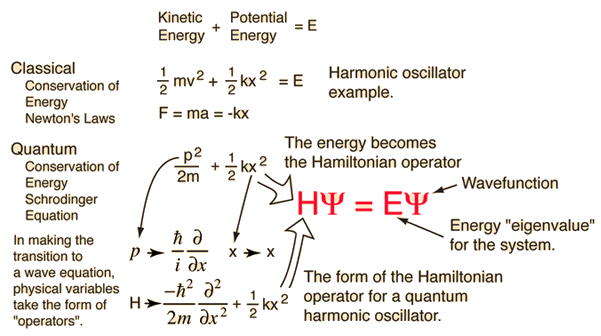
Schrodinger EquationThe Schrodinger equation plays the role of Newton's laws and conservation of energy in classical mechanics - i.e., it predicts the future behavior of a dynamic system. It is a wave equation in terms of the wavefunction which predicts analytically and precisely the probability of events or outcome. The detailed outcome is not strictly determined, but given a large number of events, the Schrodinger equation will predict the distribution of results. ![]() The kinetic and potential energies are transformed into the Hamiltonian which acts upon the wavefunction to generate the evolution of the wavefunction in time and space. The Schrodinger equation gives the quantized energies of the system and gives the form of the wavefunction so that other properties may be calculated. |
Index Schrodinger equation concepts | |||||
|
Go Back |
Particle in a Box
|
Index | |||||
|
Go Back |
Particle in a Box
|
Index | ||||
|
Go Back |
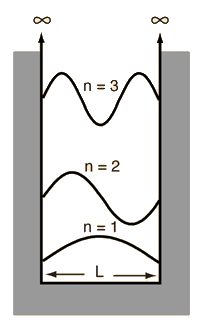
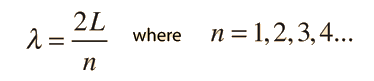
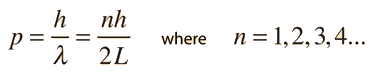
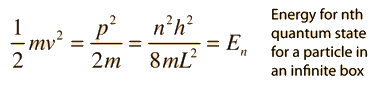
Particle in a Box CalculationFor a one-dimensional particle in a box , the particle energy for a box of dimension L can be calculated below. For a three-dimensional box there will be three values for the quantum number n. The energies for each dimension could be calculated and added. The implication of that addition is that it takes more energy to confine a particle in three dimensions than in one, and that the minimum confinement energy for a 3D box of dimension L is three times that of a 1D box. Note: If the energy value is changed, then the state is set to n=1 and the box dimension L is calculated. Any other changes initiate a recalculation of the energy. |
| Compare to uncertainty principle | Energies in eV | Finite wall box |
| Example of required energy to confine particles |
| HyperPhysics***** Quantum Physics | R Nave |