Cronin and Fitch Experiment with KaonsCronin 和 Fitch 的 kaon 实验
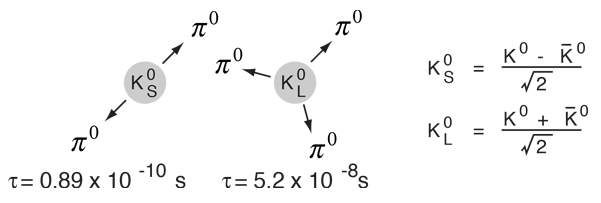
In the study of neutral kaons, two particle species were found, having apparently identical masses but very different lifetimes. These particles have different decay modes. 在中性K介子的研究中,发现了两种粒子种类,它们似乎具有相同的质量但寿命却非常不同。这些粒子有不同的衰变模式。
![]() In 1964, Cronin and Fitch performed a beam experiment in which they measured the decay of pions at the end of a 57 foot beamline. Given the disparity of the lifetimes of the two kaon species, you expect to see only the long-lived version at the end of the beam tube, but they found about 1 in 500 decays to be 2-pion decays, characteristic of the short-lived species. 1964年,Cronin和Fitch进行了一项实验,他们测量了在57英尺长的束管末端的π介子衰变。考虑到两种K介子种类的寿命差异,你预期在束管末端只看到寿命较长的种类,但他们发现大约有1/500的衰变是双π介子衰变,这特征性地表明是寿命较短的种类。
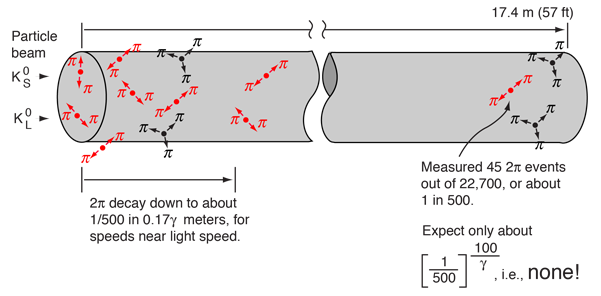
![]() The short-lived particle should not be observable more than a few centimeters down the beam line. To show that, suppose we calculate the time required to drop to 1/500 the original population. With the stated lifetime, the halflife calculation gives a time of 5.5 x 10⁻¹⁰ seconds. At nearly the speed of light, this would give a distance of about 17 centimeters, only 1/100 the length of Cronin and Fitch's beam tube. The problem with this number is that it ignores relativistic time dilation, and the lifetime as seen in the laboratory frame is dilated by the relativity factor γ (at 0.98c, γ =5). The revised distance is then 17γ cm, so even at 0.98c the population would be down by a factor of 500 by the time you got a meter down the beam tube. So for any expected particle velocity, you would expect all of them to have decayed long before you get to the end of the beam line. 寿命很短的粒子在束线中不应被观测到超过几厘米。为了说明这一点,假设我们计算使粒子数减少到原始数量的1/500所需的时间。根据给定的寿命,半衰期计算给出的时间为5.5×10⁻¹⁰秒。在接近光速的情况下,这将给出约17厘米的距离,仅是Cronin和Fitch束管长度的1/100。这个数字的问题在于它忽略了相对论性时间膨胀,实验室框架中观察到的寿命被相对论因子γ(在0.98c时,γ=5)所延长。因此修正后的距离是17γ厘米,即使在0.98c的情况下,到束管末端一米处时,粒子数也会减少到原始数量的1/500。因此,对于任何预期的粒子速度,你都会在到达束管末端之前,所有粒子都已衰变完毕。
This experiment showed that there was a small CP violation in the kaon decay, so the kaon has played a central role in the discussions of these symmetries since that time. 这个实验表明,在K介子衰变中存在微小的CP破坏现象,因此自那时起,K介子在这些对称性的讨论中发挥了核心作用。
|
Index Particle concepts Reference Griffiths Ch. 4 Das & Ferbel Ch. 12 索引粒子概念 参考 Griffiths 第4章 Das & Ferbel 第12章 | ||
|
Go Back
返回 |
CP Violation in Kaon DecayK介子衰变中的CP破坏
The neutral kaon decay is the only experimental example of CP violation. The Cronin and Fitch experiment was the first to demonstrate it, but the decay of the kaons to pions and electrons is more clear-cut. The two processes of decay are: 中性K介子的衰变是CP破坏的唯一实验实例。Cronin和Fitch实验是首次证明这一现象的实验,但K介子衰变成π介子和电子的过程更为明确。这两种衰变过程为:
K0L -> π+ + e- + ν e K0L -> π- + e+ + ν e These decays are called semileptonic decays, producing one meson and two leptons. They account for about 39% of K0L decays compared to 34% for the 3π mode. Using the CP operations 这些衰变称为半轻子衰变,产生一个介子和两个轻子。它们占K₀ₗ衰变的约39%,而占3π模式的34%。利用CP操作
we see that CP transforms one set of decay products into the other. CP invariance would then suggest an identical probability for the two. But the experimental evidence is that the positron decay pattern happens more often than the electron decay. The fractional excess is only 3.3 x 10⁻³, but this tiny excess suggests a difference between matter and antimatter. This small violation of CP invariance might hold part of the answer to why the universe consists almost entirely of matter rather than antimatter. 我们看到,CP变换将一组衰变产物转化为另一组。如果CP不变性成立,那么这两种衰变应具有相同的概率。但实验证据表明,正电子衰变模式比电子衰变更常见。这种微小的过剩量仅为3.3×10⁻³,但这种微小的CP不变性破坏可能解释了为何宇宙几乎完全由物质而非反物质构成。
|
Index Particle concepts Reference Griffiths Sec 4.8 索引 质点 概念 参考 Griffiths 第4.8节 | |||
|
Go Back
返回 |