Kaons
| Particle
质点 | Symbol
符号 | Anti- particle 反粒子 | Makeup
组成 | MeV/c2 静止质量 MeV/c² | S | C | B | Lifetime
寿命 | 衰变模式 |
K介子 | 0 | x10-8 | |||||||
K介子 | 0 | x10-10 | |||||||
K介子 | 0 | x10-8 |
1* The neutral Kaons K0s and K0L represent symmetric and antisymmetric mixtures of the quark combinations down-antistrange and antidown-strange.
The charged kaons are mesons which have a quark composition of up-antistrange for the positive kaon and antiup-strange for the negative kaon. They decay in about 10-8 seconds by the processes:


Decay times in this range indicate decay by the weak interaction. None of the decay products has a strange quark, so this decay violates conservation of strangeness and cannot proceed by the strong interaction.
Describing the neutral kaons is much more complex. There are two versions of this particle with the same mass but different decay lifetimes!
| One is called K-zero-short
一种称为K-zero-short |  |
| The other is called K-zero-long.
另一种称为K-zero-long。 |  |

The quark mixing which leads to these combinations involves the exchange of two W bosons.
The neutral kaons are important historically for their part in advancing our understanding of quark processes. When first discovered in the late 1940s they were labeled the τ and θ mesons, and their decay was a great mystery, labeled the τ-θ puzzle. The particles were identical in mass, and the only thing which apparently differentiated them was their decay processes and the fact that the two different sets of decay products had different parity. Particle decays by the strong or electromagnetic interactions had been observed to conserve parity in their decays. Theoretical physicists T. D. Lee and C. N. Yang proposed in 1956 that parity need not be conserved in weak interaction decays. In 1957 Chien-Shiung Wu showed this violation of parity conservation in the beta decay of cobalt. Even with the violation of parity, it was thought that the combination of charge conjugation and parity would leave the system invariant (CP invariance). An experiment by Cronin and Fitch in 1964 showed that there was a small CP violation in the kaon decay, so the kaon has played a central role in the discussions of these symmetries since that time.
When Rochester and Butler discovered the short-lived version of the neutral kaon in 1946, they did so by observing a characteristic "V" pattern in a cloud chamber. The decay they saw was
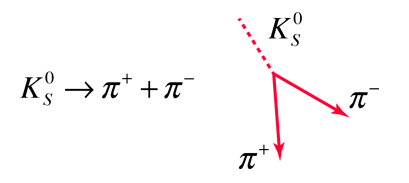
The neutral kaon did not leave a track in the cloud chamber, so the "V" track of pions revealed its presence upon decay.
| Table of mesons
介子表 | Meson diagram
介子图 |
Particle concepts
Reference
Rohlf
Ch. 18
Griffiths
Ch. 4
| HyperPhysics***** Quantum Physics
HyperPhysics ***** 量子物理 | R Nave |